Cartalax vs Epitalon
The distinction that mattersOne residue apart and from the same laboratory: Epitalon is AEDG, this is AED without the terminal glycine. They are sold side by side and their claims get swapped freely, but Epitalon's pitch is telomerase and lifespan while this one is assigned cartilage, and neither inherits the other's evidence — which in both cases is thin and from the same source.
These are not equivalent in evidence Epitalon is rated 2/5 and Cartalax is rated 1/5 — a gap of 1 level on our scale. Similar marketing does not mean similar proof.
| Cartalax Research Use Only | Epitalon Research Use Only | |
|---|---|---|
| Evidence rating |
1/5 Minimal
Evidence rating 1 out of 5: Minimal
|
2/5 Limited
Evidence rating 2 out of 5: Limited
|
| Regulatory status | Not an approved medicine anywhere. In Russia it is sold as a capsule food supplement rather than as a registered drug; elsewhere it moves under research-use-only labelling. No registered human trial exists as of September 2026. | Not approved in the US, EU or UK. Used in Russian gerontology practice. Widely sold as an anti-aging research peptide. |
| Category | Healing & Tissue Repair | Longevity & Mitochondrial |
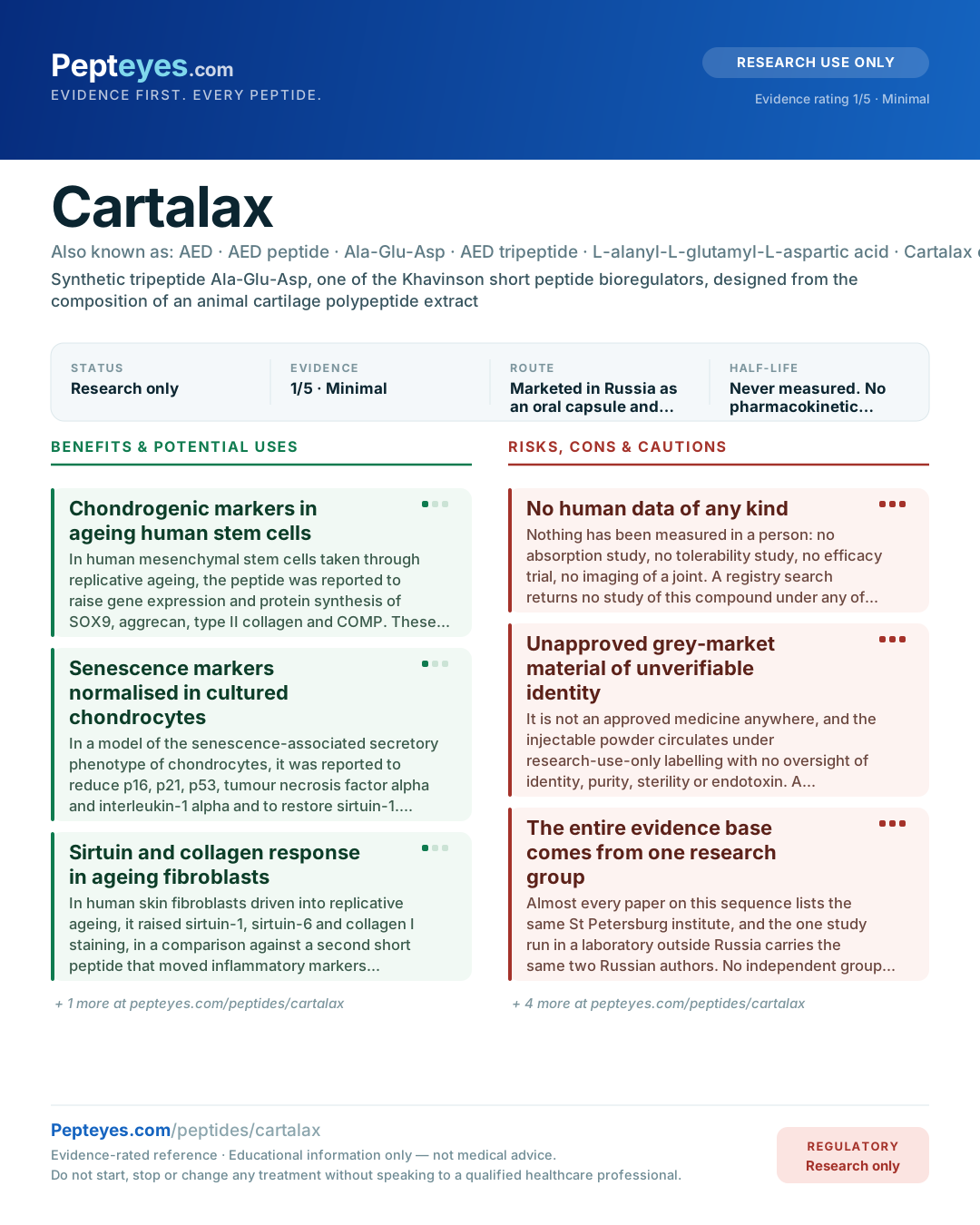
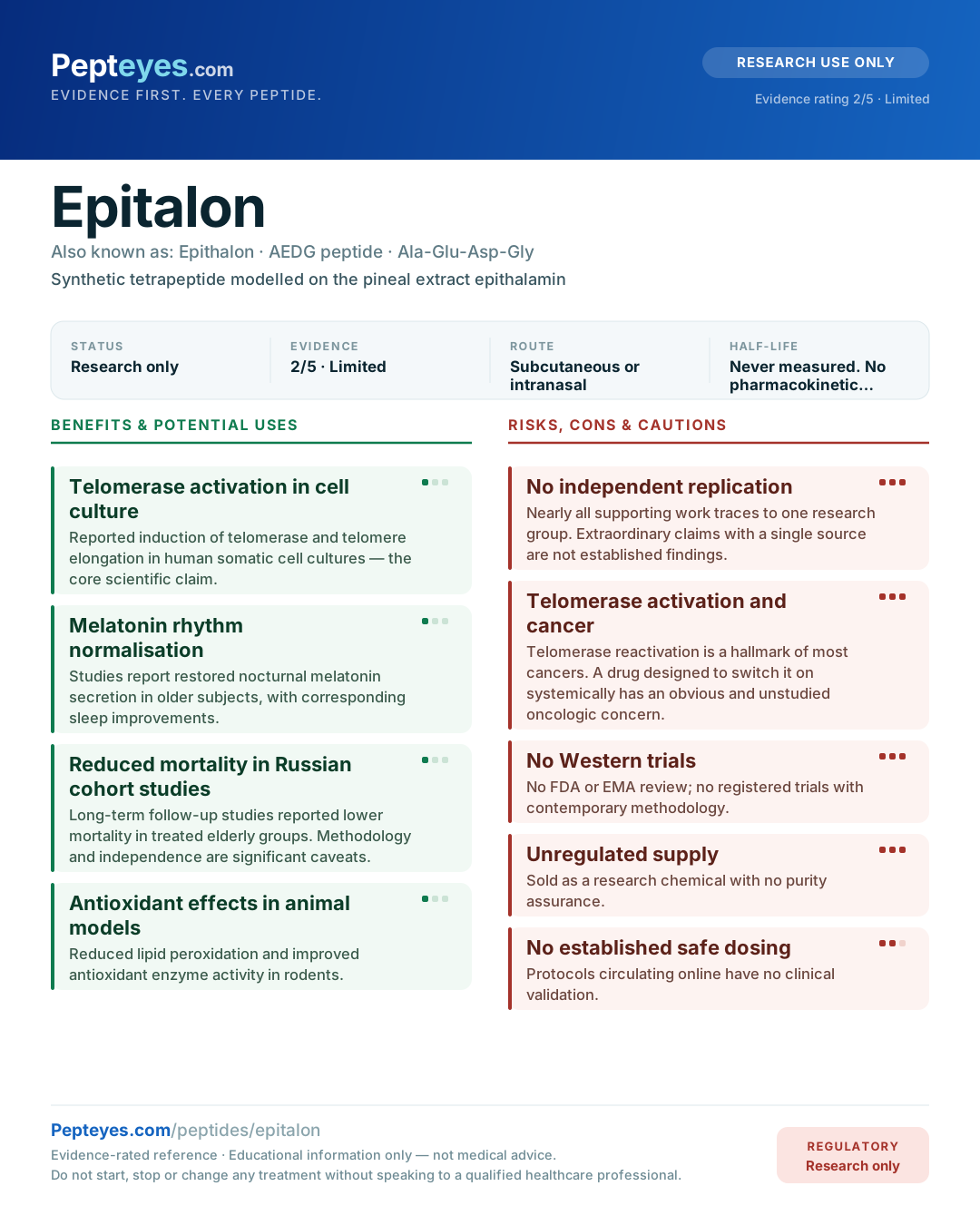
| Drug class | Synthetic tripeptide Ala-Glu-Asp, one of the Khavinson short peptide bioregulators, designed from the composition of an animal cartilage polypeptide extract | Synthetic tetrapeptide modelled on the pineal extract epithalamin |
| Route | Marketed in Russia as an oral capsule and on the grey market as a lyophilised powder for injection; neither route has been studied in a person. | Subcutaneous or intranasal (research) |
| Half-life | Never measured. No pharmacokinetic study of this sequence has been published in any species, so nothing is known about how long it persists or where it goes. | Never measured. No pharmacokinetic study of Epitalon has been published in any species; reviews only note that short peptides like it degrade fast in vivo. |
| Sequence length | 3 residues | 4 residues |
| Molecular weight | 333.3 Da | 390.4 Da |
| Studied in | Cell culture almost exclusively: human mesenchymal stem cells and chondrocytes in replicative-ageing models, human and rat skin fibroblasts, and human periodontal ligament stem cells. One rat study of cisplatin kidney injury included it among several peptides. No human study of any design has been published or registered. | Russian studies in elderly cohorts reporting reduced mortality over multi-year follow-up; cell culture telomerase work; rodent lifespan studies. |
| Who should avoid it |
|
|
| Legal status | Cartalax has no marketing authorisation in the United States, the European Union or the United Kingdom, and is not a licensed medicine in any of them. It is not a controlled substance. In Russia it is marketed as a capsule food supplement rather than as a registered medicine, and the originating group's own review of this peptide family flags only one member as a medicinal product, which is not this one. There is no FDA substance-registry record for it at all, while its close relative Epitalon has one. It is not named on the WADA Prohibited List, but its clause for agents with no approval from any health authority reaches it. | Not approved for human use in the US, EU or UK. |
Benefits — Cartalax
- Chondrogenic markers in ageing human stem cells
In human mesenchymal stem cells taken through replicative ageing, the peptide was reported to raise gene expression and protein synthesis of SOX9, aggrecan, type II collagen and COMP. These are the markers a cell moving toward a cartilage phenotype should show, measured in culture rather than in cartilage.
- Senescence markers normalised in cultured chondrocytes
In a model of the senescence-associated secretory phenotype of chondrocytes, it was reported to reduce p16, p21, p53, tumour necrosis factor alpha and interleukin-1 alpha and to restore sirtuin-1. The readouts are immunostains of cells in a dish, not joint tissue or joint function.
- Sirtuin and collagen response in ageing fibroblasts
In human skin fibroblasts driven into replicative ageing, it raised sirtuin-1, sirtuin-6 and collagen I staining, in a comparison against a second short peptide that moved inflammatory markers instead. It is the most direct evidence that the sequence does something to a human cell.
- One whole-animal signal, in kidneys rather than joints
In rats with cisplatin-induced acute renal failure it reduced urinary protein and electrolyte excretion, though a different short peptide in the same experiment carried the protective effect. It is the only in-vivo result of note, and it has nothing to do with cartilage.
Benefits — Epitalon
- Telomerase activation in cell culture
Reported induction of telomerase and telomere elongation in human somatic cell cultures — the core scientific claim.
- Melatonin rhythm normalisation
Studies report restored nocturnal melatonin secretion in older subjects, with corresponding sleep improvements.
- Reduced mortality in Russian cohort studies
Long-term follow-up studies reported lower mortality in treated elderly groups. Methodology and independence are significant caveats.
- Antioxidant effects in animal models
Reduced lipid peroxidation and improved antioxidant enzyme activity in rodents.
Risks & cons — Cartalax
- No human data of any kind
Nothing has been measured in a person: no absorption study, no tolerability study, no efficacy trial, no imaging of a joint. A registry search returns no study of this compound under any of its names. Everything claimed for it in people is extrapolation from cultured cells.
- Unapproved grey-market material of unverifiable identity
It is not an approved medicine anywhere, and the injectable powder circulates under research-use-only labelling with no oversight of identity, purity, sterility or endotoxin. A three-residue peptide is cheap to fake and impossible to tell apart from filler by eye.
- The entire evidence base comes from one research group
Almost every paper on this sequence lists the same St Petersburg institute, and the one study run in a laboratory outside Russia carries the same two Russian authors. No independent group has reproduced any of it, which is a different and weaker position than simply being untested.
- Delaying real osteoarthritis care
Osteoarthritis has treatments with actual trial evidence behind them, including exercise therapy, weight management, established analgesia and, at the end of the road, joint replacement. Substituting an untested peptide for assessment of a painful joint is the practical harm most likely to occur here.
- Gene-expression effects are not benign by default
The reported actions include raising IGF1, NF-kappa-B and a tankyrase gene tied to telomere maintenance, and altering sirtuins and p53. Those are growth, inflammation and senescence pathways. Nobody has looked at what sustained exposure does, and the oncologic question has not been asked at all.
Risks & cons — Epitalon
- No independent replication
Nearly all supporting work traces to one research group. Extraordinary claims with a single source are not established findings.
- Telomerase activation and cancer
Telomerase reactivation is a hallmark of most cancers. A drug designed to switch it on systemically has an obvious and unstudied oncologic concern.
- No Western trials
No FDA or EMA review; no registered trials with contemporary methodology.
- Unregulated supply
Sold as a research chemical with no purity assurance.
- No established safe dosing
Protocols circulating online have no clinical validation.
A comparison is not a recommendation. Neither column is being suggested for you. Which — if either — is appropriate depends on your diagnosis, history and medications, and that is a conversation for a qualified clinician.