Supplied as a lyophilised powder to reconstitute
Metabolic & Weight
At a glance
Ten answers, each one line. Open any row for the detail behind it.
What it does Marketed as "the fat-loss fragment of growth hormone without the growth hormone side…
Marketed as "the fat-loss fragment of growth hormone without the growth hormone side effects". The marketing outlived the science: the clinical trials that tested exactly that claim did not show meaningful weight loss.
Half-life Never reported. The published human trials of AOD9604 did not… — Documented
Never reported. The published human trials of AOD9604 did not measure a half-life, so no figure exists for any route.
Typical studied dose None established. No dose has ever been set for a human being, because… — Nothing established
None established. No dose has ever been set for a human being, because the studies that would set one have not been done. Any figure circulating for this compound was chosen by somebody selling it or by somebody guessing.
How often it is used No schedule exists. Cycles and intervals quoted for this compound come… — Nothing established
No schedule exists. Cycles and intervals quoted for this compound come from forums rather than from any study, and they vary because nothing anchors them.
How it is taken Subcutaneous or oral (research) — Documented
Subcutaneous or oral (research)
Main side effects No demonstrated efficacy · Unapproved and unregulated · Unknown long-term safety — Carries serious risk
No demonstrated efficacy — The pivotal obesity trials did not separate from placebo on weight loss. This is the central fact about AOD-9604.
Unapproved and unregulated — Sold as a "research chemical" or in illegal supplements; the FDA has issued warning letters over it.
Unknown long-term safety — No chronic human exposure data.
Storage before mixing As a sealed lyophilised powder, refrigerated is typical and a freezer…
As a sealed lyophilised powder, refrigerated is typical and a freezer suits long storage; both should be dark and dry. A dry powder tolerates a few days out of the cold far better than anything in solution — which is why it ships that way.
Shelf life after mixing Once mixed it is refrigerated and treated as short-lived. Bacteriostatic…
Once mixed it is refrigerated and treated as short-lived. Bacteriostatic water contains a preservative and buys the longer window; sterile water contains none and buys a much shorter one. Peptides in solution also degrade on their own, so the container is only half the question.
Evidence level 2/5 · Limited — Nothing established
Preclinical work plus scattered human reports, uncontrolled use, or negative trials.
Regulatory status Research Use Only — Nothing established
Failed clinical development for obesity. Not approved. FDA has rejected it as a dietary supplement ingredient. Not approved. FDA has determined it is not lawful as a dietary ingredient.
Overview
Marketed as "the fat-loss fragment of growth hormone without the growth hormone side effects". The marketing outlived the science: the clinical trials that tested exactly that claim did not show meaningful weight loss.
Not approved for human use anywhereNo approval anywhere for human use. Sold under research-use labelling. Not approved. FDA has determined it is not lawful as a dietary ingredient.
| Regulatory status | Failed clinical development for obesity. Not approved. FDA has rejected it as a dietary supplement ingredient. |
|---|---|
| Drug class | C-terminal fragment of human growth hormone (residues 176–191) |
| Route | Subcutaneous or oral (research) |
| Half-life | Never reported. The published human trials of AOD9604 did not measure a half-life, so no figure exists for any route. |
| Evidence rating |
2/5 Limited
Evidence rating 2 out of 5: Limited
Preclinical work plus scattered human reports, uncontrolled use, or negative trials. |
| Studied in | Phase 2 obesity trials conducted in the 2000s; later small studies in osteoarthritis with intra-articular delivery. |
AOD-9604 sequence & structure
AOD-9604 is a 16-residue disulfide-bridged peptide with a free C-terminal acid; molecular weight 1,815.1 Da.
| Three-letter | H-Tyr-Leu-Arg-Ile-Val-Gln-Cys-Arg-Ser-Val-Glu-Gly-Ser-Cys-Gly-Phe-OH |
|---|---|
| Length | 16 amino acid residues |
| Modifications |
|
| Molecular formula | C78H123N23O23S2 |
| Molecular weight | 1,815.1 Da (average, free base) |
| SMILES | CCC(C)C(C(=O)NC(C(C)C)C(=O)NC(CCC(=O)N)C(=O)NC1CSSCC(NC(=O)C(NC(=O)CNC(=O)C(NC(=O)C(NC(=O)C(NC(=O)C(NC1=O)CCCNC(=N)N)CO)C(C)C)CCC(=O)O)CO)C(=O)NCC(=O)NC(CC2=CC=CC=C2)C(=O)O)NC(=O)C(CCCNC(=N)N)NC(=O)C(CC(C)C)NC(=O)C(CC3=CC=C(C=C3)O)N |
| Identifiers | CAS 221231-10-3 · PubChem CID 71300630 · UniProt P01241 |
| Which molecule | The name AOD-9604 refers to one molecule: Tyr-hGH(177-191). Because mature hGH residue 176 is Phe, the same peptide is also described as 'hGH fragment 176-191 with Phe176 replaced by Tyr' (the pepteyes monograph's 'residues 176–191 with a tyrosine cap'); both labels denote this record. The unmodified fragment hGH(177-191) is AOD-9401, a different peptide. Later developed under the code LAT8881, which is the same substance (GSRS UNII 7UP768IP4M). |
| Sources | FDA GSRS / precisionFDA UNII 7UP768IP4M (LAT-8881 / AOD-9604) — sequence, CAS, cyclic (7→14)-disulfidePubChem CID 71300630 (AOD-9604)US Patent 7,098,029 (Metabolic Pharmaceuticals) — SEQ ID NO: 9 YLRIVQCRSVEGSCGFUniProt P01241 SOMA_HUMAN (parent hGH sequence; C-terminal ...FLRIVQCRSVEGSCGF)ChEMBL CHEMBL6068615 (LAT-8881 / AOD-9604) |
Formula and MW (1815.1) are for the oxidised, disulfide-bridged free peptide as in the PubChem record (formula independently recomputed from the sequence and from the SMILES heavy-atom count); research vials are typically the acetate or TFA salt, so the salt mass is higher. Some vendor pages misplace the disulfide as Cys7–Cys15; GSRS records it as cyclic (7→14), i.e. the two cysteines are at positions 7 and 14 of the 16-mer. Developed by Metabolic Pharmaceuticals (Melbourne); obesity programme terminated in 2007, later revived as LAT8881 by Lateral Pharma. Not in DrugBank; UNII 7UP768IP4M.
Record confidence: high — two independent authoritative sources agree on the sequence and modifications. Every sequence on the site is listed with its sources on the peptide sequences index.
How it works
Proposed to stimulate lipolysis and inhibit lipogenesis via beta-3 adrenergic signalling in adipose tissue, without binding the GH receptor and therefore without raising IGF-1. The mechanism is plausible in rodent adipocytes; translation to humans was not demonstrated.
Evidence base
Rated 2 of 5 — Limited. Preclinical work plus scattered human reports, uncontrolled use, or negative trials.
- Negative phase 2 results are the highest-quality evidence available.
Benefits and risks, weighed against the evidence
Every entry below carries the strength of the evidence behind it — three bars for strong human data, two for moderate, one for preliminary or preclinical work. The two columns are not equal by design: where a compound has more documented risk than demonstrated benefit, the lists say so.
Reported benefits
3 entries
-
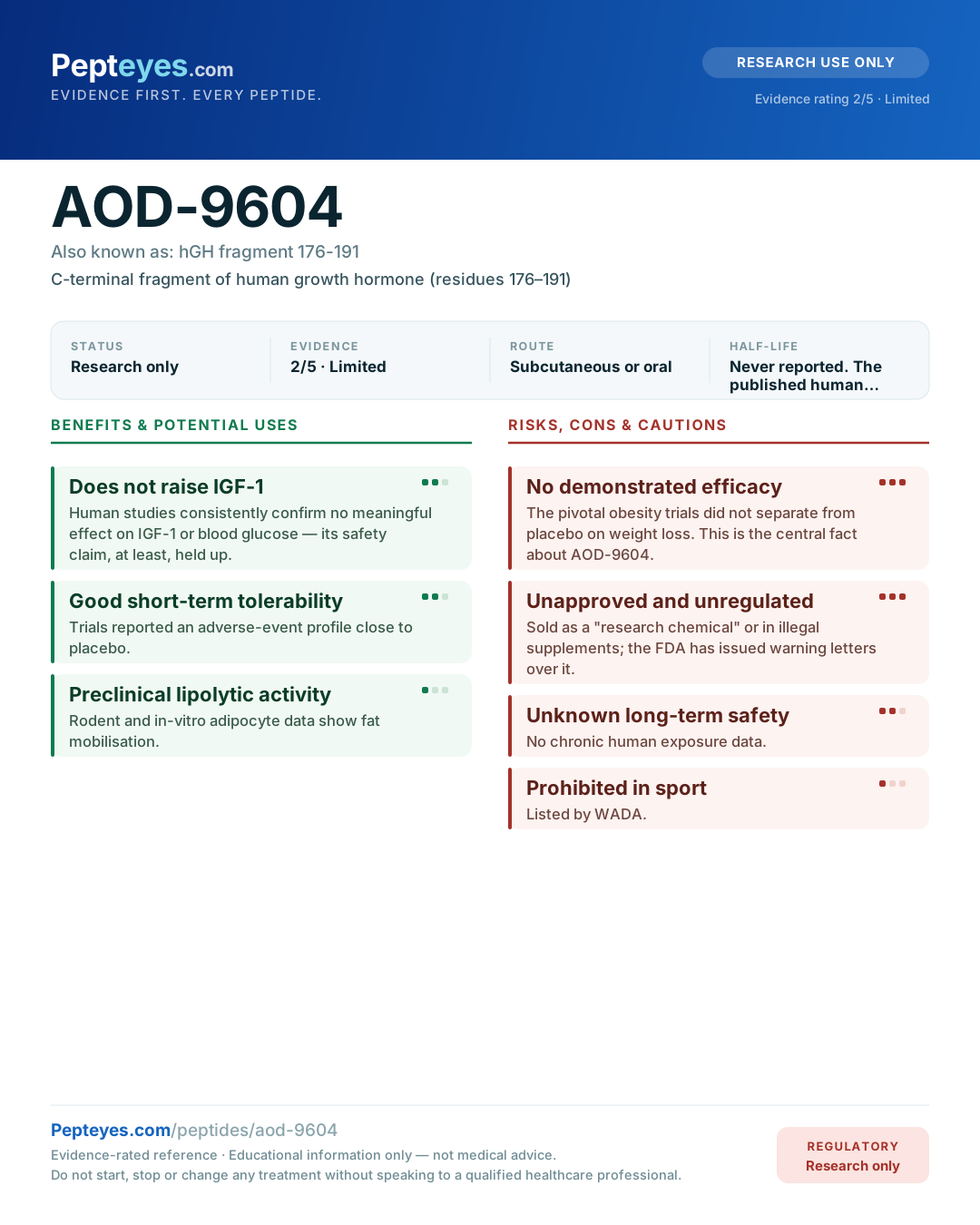
Does not raise IGF-1
Human studies consistently confirm no meaningful effect on IGF-1 or blood glucose — its safety claim, at least, held up.
Evidence: Moderate evidence -
Good short-term tolerability
Trials reported an adverse-event profile close to placebo.
Evidence: Moderate evidence -
Preclinical lipolytic activity
Rodent and in-vitro adipocyte data show fat mobilisation.
Evidence: Preliminary
Risks and cautions
4 entries · 2 serious or common
-
No demonstrated efficacy
The pivotal obesity trials did not separate from placebo on weight loss. This is the central fact about AOD-9604.
Evidence: Serious -
Unapproved and unregulated
Sold as a "research chemical" or in illegal supplements; the FDA has issued warning letters over it.
Evidence: Serious -
Unknown long-term safety
No chronic human exposure data.
Evidence: Moderate evidence -
Prohibited in sport
Listed by WADA.
Evidence: Minor
Counts are not a score. A single serious risk can outweigh several well-supported benefits, and a long benefit list built on preclinical work outweighs nothing at all.
Opinion — what people actually report
5 themes · 1 reported benefit · 1 reported problem
This is the weakest tier on this site. These are themes drawn from public discussion — forums, subreddits and patient threads — not from trials. There is no control group, no denominator, and no way to confirm that what someone injected matched its label. People post when a result is dramatic and when something goes wrong, and rarely when nothing happens, so treat everything below as a description of the conversation rather than of the compound. The bars count how often a thing is said, not how well it is supported.
-
Most reports are that it did nothing Reported problem. Dominant theme: Comes up in most discussions of this compound.
Unusually for this space, the dominant theme is absence of effect. Long threads are largely people concluding they wasted money.
-
Marketed far beyond what anyone reports experiencing Practical note. Dominant theme: Comes up in most discussions of this compound.
A frequent observation that clinic and vendor claims about fat loss bear little relation to what users describe.
-
Occasional appetite or energy reports Reported benefit. Occasional: Reported by a minority, or in specific contexts.
A small minority describe mild effects, usually alongside diet changes that could account for them.
-
Discussed more for joint use than fat loss Practical note. Recurring: Raised regularly, though not by everyone.
Interest has partly shifted toward cartilage and joint claims, which have even less behind them.
-
The obesity trial result is known and cited Practical note. Occasional: Reported by a minority, or in specific contexts.
Better-informed posters are aware it failed its human trial, and use that to counter marketing claims.
Where the reports and the evidence part ways
This is one of the rare entries where the community is more accurate than the marketing, and the evidence agrees with the community. AOD-9604 completed a phase 2b obesity trial and failed to beat placebo on weight loss. It is still sold on the strength of preclinical fat-metabolism work and of an Australian regulatory determination about safety as a food ingredient — a safety finding, not an efficacy one, and routinely misrepresented as approval. When forum reports and trial results both say a compound does not work, that is about as clear as this field gets.
Cheat sheet
The full sheet, all 77 compounds →The community reference numbers for this compound — reconstitution, working dose, cycle and bloodwork. Research and education only, not medical advice, and not part of the evidence-rated monograph above. Doses assume a 1mL / 100-unit insulin syringe — the calculator does the units for you.
Protocol overview
Dosing & reconstitution 5 mg vial
| WEEK | DAILY DOSE | UNITS PER INJECTION |
|---|---|---|
| Weeks 1 to 4 | 300 mcg | 3 units (0.03 mL) |
| Weeks 5 to 12 | 500 mcg | 5 units (0.05 mL) |
Frequency: Inject once daily subcutaneously, typically in the morning on an empty stomach. Rotate injection sites (abdomen, thighs, upper arms) to minimize local irritation.
On the master sheet
- Vial
- 5mg
- BAC
- 3mL
- Dose
- 250–500mcg daily fasted
- Route
- SubQ
- Cycle
- 4–12 wks
- Time Off
- 2–4 wks
- Bloodwork
- Basic metabolic
Readers on AOD-9604
Questions and answers from readers, under generated names. Nothing here has been checked or reviewed by the site and none of it is medical advice. It is the least verified thing on this page — and it is here because people ask each other these things anyway, and most of the other places they can ask are run by sellers.
0 questions · 0 answers
No questions yet. Ask the first one above — it takes one box and an email address.
How names work, and the house rules
Names. Every verified address is given one generated name — two ordinary words — and keeps it. Nobody chooses a name and nobody can take another's. Posts marked desk were written by the site's own editorial desk, usually to open a thread; they carry a generated name like everyone else's and are held to the site's rules, which means they never state an amount.
What is not allowed. Selling, sourcing, vendor names, coupon codes and "message me" — posts that read that way are held and usually removed. Personal medical details you would not want public. Abuse. Instructions framed as what someone else should do.
What this is not. A reader's report of what happened to them is a report, not a finding, and an answer here is one person's view. Nothing in this section changes the evidence rating above it. If something you read here would change what you take, take it to a pharmacist or physician first.
Your data. Delete any post of yours at any time, or remove everything you have written together with your name. Details in the privacy notice.
Who should avoid it
- Anyone seeking evidence-based weight loss — approved options vastly outperform it
If used under medical supervision, monitor
- Not applicable
Commonly confused with
These mix-ups cause real harm — two products sold under one name, or two molecules whose effects run in opposite directions.
AOD-9604 is a fragment of growth hormone marketed as giving fat loss without GH side effects. It also failed to produce weight loss in its phase 2 trials, which somatropin does not.
Compare side by sideRegulatory & legal status
Not approved. FDA has determined it is not lawful as a dietary ingredient.
Still in Category 2 of the 503A review, so not eligible for lawful pharmacy compounding in the United States.
- Listed since
- September 2023
- Court challenge
- Placement under challenge; a final rule is expected no later than March 2027
- Approved as a drug?
- No. Compounding status and drug approval are separate questions; this compound has no approval for the uses it is sold for.
The full dated record, with sources, and every affected peptide →
Infographic
Where to read further
We link to live literature searches rather than a frozen citation list, so you always see current results — including anything published after our last review.
- PubMed — all published literature on AOD-9604
- PubMed — randomized controlled trials only
- ClinicalTrials.gov — registered human trials
Related peptides in Metabolic & Weight
Terms used on this page
- Growth Hormone (GH)
- Growth hormone is a 191-amino-acid pituitary protein secreted in pulses that acts directly on tissues and indirectly through hepatic IGF-1, and is approved for a defined list of indications.
- Adverse Drug Reaction (ADR)
- An adverse drug reaction is a noxious, unintended response to a medicine given at normal doses, and unlike an adverse event the term carries a causal judgement inside it.
- Adiposity
- Adiposity is the total quantity and anatomical distribution of body fat, treated as an active endocrine tissue rather than as inert storage.
- Growth Hormone Receptor (GHR)
- The growth hormone receptor is a preformed cytokine-receptor dimer that a single GH molecule activates by binding two subunits at separate sites, signalling through JAK2 and STAT5b to induce IGF-1.
- Insulin-Like Growth Factor 1 (IGF-1)
- IGF-1 is a 70-amino-acid, proinsulin-like peptide produced mainly by the liver under growth hormone control, and it mediates most of the anabolic effects attributed to growth hormone.
- Phase 2 Trial
- A Phase 2 trial is the first test of a compound in the target patient population, sized to find a workable dose and an early efficacy signal rather than to prove clinical benefit.
This page is educational information, not medical advice. It cannot account for your medical history, medications, or risk factors. Do not start, stop or change any treatment based on it. Speak to a qualified healthcare professional who knows your case.