Supplied as eye drops
Ophthalmic
At a glance
Ten answers, each one line. Open any row for the detail behind it.
What it does The first drug ever approved for neurotrophic keratitis, a degenerative disease in which…
The first drug ever approved for neurotrophic keratitis, a degenerative disease in which the cornea loses its nerve supply and stops healing. It is a growth factor delivered as an eye drop, and it heals corneal ulcers that previously required surgery.
Half-life Local ocular action; negligible systemic exposure — Documented
Local ocular action; negligible systemic exposure
Typical studied dose Set on the approved label, which states the starting dose, how it is… — On the label
Set on the approved label, which states the starting dose, how it is increased and the maximum. Read it there rather than anywhere else — including here.
How often it is used The label schedule is daily. Dosing intervals follow the half-life above… — On the label
The label schedule is daily. Dosing intervals follow the half-life above, and the prescribing information is what sets them.
How it is taken Ophthalmic drops, six times daily for 8 weeks — Documented
Ophthalmic drops, six times daily for 8 weeks
Main side effects Eye pain during treatment · Demanding regimen · Very high cost — Depends on the study
Eye pain during treatment — The most common adverse effect, and mechanistically expected — restored corneal sensation in a previously anaesthetic eye is uncomfortable.
Demanding regimen — Six drops daily for eight weeks, with strict cold-chain handling and a specific administration schedule. Adherence is a genuine problem.
Very high cost — Among the most expensive ophthalmic treatment courses available.
Storage before mixing Refrigerated until first opened, then as the label directs. An eye…
Refrigerated until first opened, then as the label directs. An eye preparation is the one case where sterility is not a background worry but the whole point: the tip must touch nothing, and a shared bottle is not a thing.
Shelf life after mixing Nothing to mix — it is not supplied as a powder. The relevant date is…
Nothing to mix — it is not supplied as a powder. The relevant date is the one printed on the product.
Evidence level 5/5 · Very strong — Documented
Multiple phase 3 randomized trials plus regulatory approval in a major market.
Regulatory status FDA Approved — Documented
FDA-approved (2018) and EMA-approved for neurotrophic keratitis — the first approved treatment for that condition. Prescription ophthalmic drug, supplied through specialty distribution with cold-chain requirements.
Overview
The first drug ever approved for neurotrophic keratitis, a degenerative disease in which the cornea loses its nerve supply and stops healing. It is a growth factor delivered as an eye drop, and it heals corneal ulcers that previously required surgery.
FDA ApprovedFDA-approved (2018) and EMA-approved for neurotrophic keratitis — the first approved treatment for that condition.
| Regulatory status | FDA-approved (2018) and EMA-approved for neurotrophic keratitis — the first approved treatment for that condition. |
|---|---|
| Drug class | Recombinant human nerve growth factor — a 118-amino-acid protein |
| Route | Ophthalmic drops, six times daily for 8 weeks |
| Half-life | Local ocular action; negligible systemic exposure |
| Evidence rating |
5/5 Very strong
Evidence rating 5 out of 5: Very strong
Multiple phase 3 randomized trials plus regulatory approval in a major market. |
| Studied in | REPARO and a second phase 3 randomized vehicle-controlled trial in moderate to severe neurotrophic keratitis, with long-term follow-up. |
Cenegermin sequence & structure
Cenegermin is a 118-residue protein of about 13,266 Da, catalogued under UniProt P01138. The full sequence is shown below.
| Three-letter | H-Ser-Ser-Ser-His-Pro-Ile-Phe-His-Arg-Gly-Glu-Phe-Ser-Val-Cys-Asp-Ser-Val-Ser-Val-Trp-Val-Gly-Asp-Lys-Thr-Thr-Ala-Thr-Asp-Ile-Lys-Gly-Lys-Glu-Val-Met-Val-Leu-Gly-Glu-Val-Asn-Ile-Asn-Asn-Ser-Val-Phe-Lys-Gln-Tyr-Phe-Phe-Glu-Thr-Lys-Cys-Arg-Asp-Pro-Asn-Pro-Val-Asp-Ser-Gly-Cys-Arg-Gly-Ile-Asp-Ser-Lys-His-Trp-Asn-Ser-Tyr-Cys-Thr-Thr-Thr-His-Thr-Phe-Val-Lys-Ala-Leu-Thr-Met-Asp-Gly-Lys-Gln-Ala-Ala-Trp-Arg-Phe-Ile-Arg-Ile-Asp-Thr-Ala-Cys-Val-Cys-Val-Leu-Ser-Arg-Lys-Ala-Val-Arg-OH |
|---|---|
| Length | 118 amino acid residues |
| Modifications |
|
| Molecular formula | C583H908N166O173S8 |
| Molecular weight | 13,266 Da (average, free base) |
| Identifiers | CAS 1772578-74-1 · DrugBank DB13926 · UniProt P01138 |
| Which molecule | Cenegermin (INN; US suffix cenegermin-bkbj, brand Oxervate) is the recombinant, non-glycosylated E. coli-expressed form of the mature 118-residue human beta-NGF chain (proNGF residues 122–239 of UniProt P01138, i.e. beta-NGF 1–118). Generic 'rhNGF' research reagents may be produced in other hosts or carry an extra N-terminal Met; this record describes the approved drug substance, which is what the pepteyes monograph covers. |
| Sources | FDA prescribing information — OXERVATE (cenegermin-bkbj), BLA 761094, section 11 DescriptionWHO Drug Information Vol. 30 No. 2 (2016), Proposed INN List 115 — cenegermin (formula, CAS)UniProt P01138 (NGF_HUMAN) — precursor sequence, chain 122–241, disulfides 136–201/179–229/189–231KEGG DRUG D11028 — Cenegermin (INN) sequence and disulfide mapFDA GSRS — CENEGERMIN, UNII B6E7K36KT8 (beta-NGF-(1-118)-peptide, non-covalent dimer, E. coli) |
Sequence = mature human beta-NGF residues 1–118 (precursor 122–239 of P01138; the two C-terminal Arg-Ala of the UniProt chain annotation 122–241 are absent), as defined by the INN 'beta-NGF-(1-118)-peptide' and verified by substring match against the UniProt FASTA. The published formula C583H908N166O173S8 / 13,266 Da (FDA label, INN list) corresponds to the fully reduced single chain computed from that sequence (13,267.2 Da average); the folded chain with three intrachain disulfides is 6 H lighter (~13,261 Da). Produced in E. coli HMS174 as a proNGF that is cleaved enzymatically, so the product is non-glycosylated with no extra N-terminal Met. Oxervate 0.002% supplies 20 µg/mL; MW figures refer to the monomer, not the dimer. UNII B6E7K36KT8; CAS check digit validated.
Record confidence: high — two independent authoritative sources agree on the sequence and modifications. Every sequence on the site is listed with its sources on the peptide sequences index.
How it works
Recombinant human NGF binds TrkA and p75 receptors on corneal epithelial cells, sensory nerve endings and limbal stem cells, restoring the trophic signalling that maintains corneal integrity. Because the cornea and its nerves are damaged in the same disease process, supplying NGF supports both.
Evidence base
Rated 5 of 5 — Very strong. Multiple phase 3 randomized trials plus regulatory approval in a major market.
- Two randomized vehicle-controlled phase 3 trials with an objective imaging-confirmed endpoint.
Benefits and risks, weighed against the evidence
Every entry below carries the strength of the evidence behind it — three bars for strong human data, two for moderate, one for preliminary or preclinical work. The two columns are not equal by design: where a compound has more documented risk than demonstrated benefit, the lists say so.
Reported benefits
4 entries · 2 on strong human evidence
-
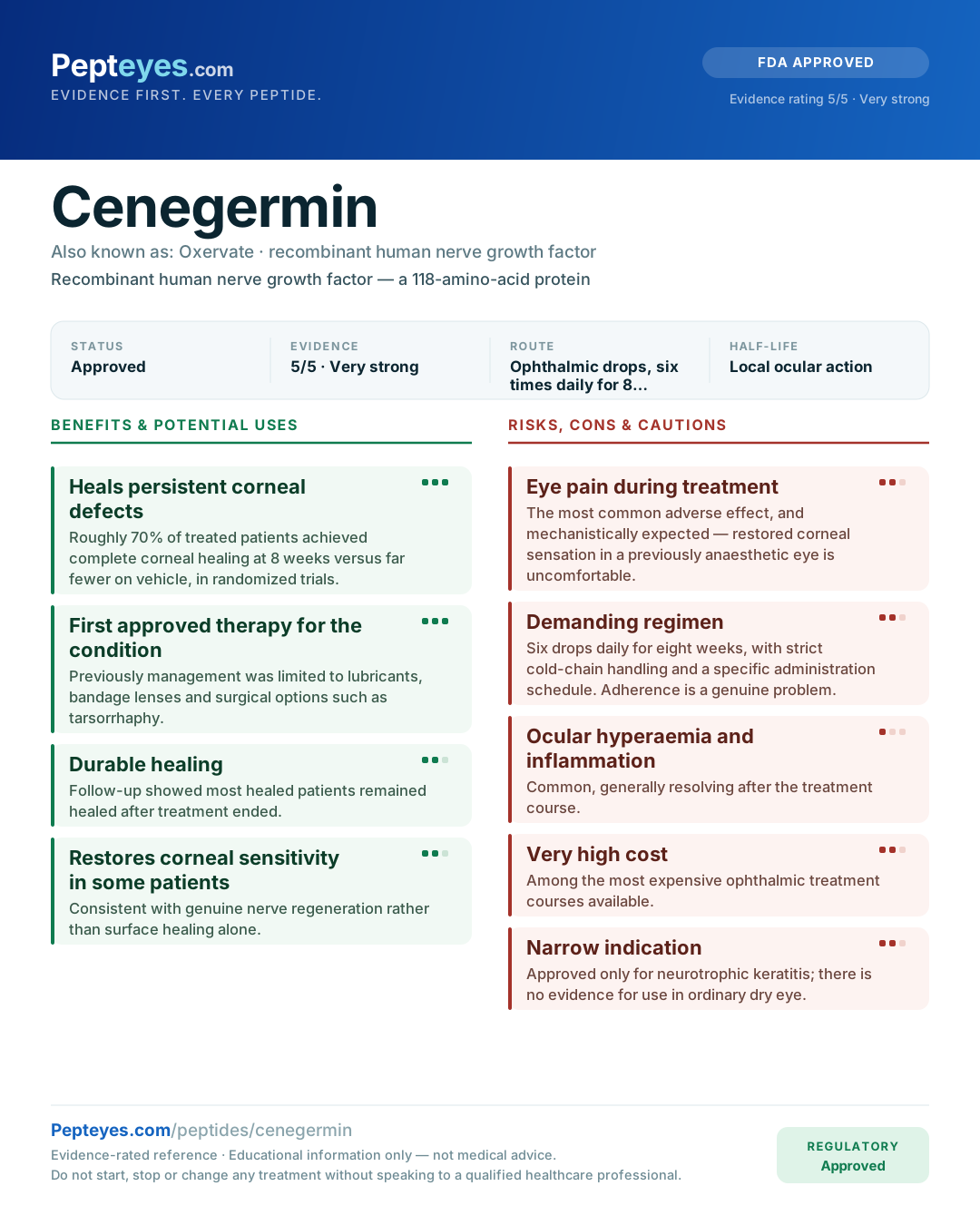
Heals persistent corneal defects
Roughly 70% of treated patients achieved complete corneal healing at 8 weeks versus far fewer on vehicle, in randomized trials.
Evidence: Strong evidence -
First approved therapy for the condition
Previously management was limited to lubricants, bandage lenses and surgical options such as tarsorrhaphy.
Evidence: Strong evidence -
Durable healing
Follow-up showed most healed patients remained healed after treatment ended.
Evidence: Moderate evidence -
Restores corneal sensitivity in some patients
Consistent with genuine nerve regeneration rather than surface healing alone.
Evidence: Moderate evidence
Risks and cautions
5 entries
-
Eye pain during treatment
The most common adverse effect, and mechanistically expected — restored corneal sensation in a previously anaesthetic eye is uncomfortable.
Evidence: Moderate evidence -
Demanding regimen
Six drops daily for eight weeks, with strict cold-chain handling and a specific administration schedule. Adherence is a genuine problem.
Evidence: Moderate evidence -
Ocular hyperaemia and inflammation
Common, generally resolving after the treatment course.
Evidence: Minor -
Very high cost
Among the most expensive ophthalmic treatment courses available.
Evidence: Moderate evidence -
Narrow indication
Approved only for neurotrophic keratitis; there is no evidence for use in ordinary dry eye.
Evidence: Moderate evidence
Counts are not a score. A single serious risk can outweigh several well-supported benefits, and a long benefit list built on preclinical work outweighs nothing at all.
Opinion — what people actually report
4 themes · 1 reported benefit · 3 reported problems
This is the weakest tier on this site. These are themes drawn from public discussion — forums, subreddits and patient threads — not from trials. There is no control group, no denominator, and no way to confirm that what someone injected matched its label. People post when a result is dramatic and when something goes wrong, and rarely when nothing happens, so treat everything below as a description of the conversation rather than of the compound. The bars count how often a thing is said, not how well it is supported.
-
Described as sight-saving by the patients who need it Reported benefit. Dominant theme: Comes up in most discussions of this compound.
Neurotrophic keratitis is rare and serious, and reports from patients who healed a persistent corneal defect are among the most positive here.
-
The dosing schedule is punishing Reported problem. Dominant theme: Comes up in most discussions of this compound.
Six times daily for eight weeks, with refrigeration and a specific handling routine, is the dominant practical complaint.
-
Eye pain during treatment Reported problem. Dominant theme: Comes up in most discussions of this compound.
Common and expected, and reported as substantial by many.
-
Cost is extraordinary Reported problem. Dominant theme: Comes up in most discussions of this compound.
Among the most expensive courses discussed anywhere, and access dominates patient conversation.
Where the reports and the evidence part ways
Patient reports align closely with the REPARO and NGF trials — corneal healing rates were markedly better than vehicle, and eye pain was the most common adverse event. This is a rare-disease drug with a small, motivated patient community and no wellness-market presence, which makes its discussion unusually reliable. The one thing that distinguishes it from most of this library: it is a recombinant human nerve growth factor, and the growth-factor mechanism people speculate about elsewhere is here demonstrated in controlled trials.
Readers on Cenegermin
Questions and answers from readers, under generated names. Nothing here has been checked or reviewed by the site and none of it is medical advice. It is the least verified thing on this page — and it is here because people ask each other these things anyway, and most of the other places they can ask are run by sellers.
0 questions · 0 answers
No questions yet. Ask the first one above — it takes one box and an email address.
How names work, and the house rules
Names. Every verified address is given one generated name — two ordinary words — and keeps it. Nobody chooses a name and nobody can take another's. Posts marked desk were written by the site's own editorial desk, usually to open a thread; they carry a generated name like everyone else's and are held to the site's rules, which means they never state an amount.
What is not allowed. Selling, sourcing, vendor names, coupon codes and "message me" — posts that read that way are held and usually removed. Personal medical details you would not want public. Abuse. Instructions framed as what someone else should do.
What this is not. A reader's report of what happened to them is a report, not a finding, and an answer here is one person's view. Nothing in this section changes the evidence rating above it. If something you read here would change what you take, take it to a pharmacist or physician first.
Your data. Delete any post of yours at any time, or remove everything you have written together with your name. Details in the privacy notice.
Who should avoid it
- Use for conditions other than neurotrophic keratitis
- Contact lens wear during treatment
- Known hypersensitivity to the formulation
If used under medical supervision, monitor
- Corneal healing by slit-lamp examination
- Corneal sensitivity testing
- Symptom assessment during the 8-week course
Interactions
Not exhaustive. Always have a pharmacist or physician review your full medication list — including supplements.
- No significant systemic interactions
- Other eye drops — separate instillation by at least 15 minutes
Regulatory & legal status
Prescription ophthalmic drug, supplied through specialty distribution with cold-chain requirements.
Infographic
Where to read further
We link to live literature searches rather than a frozen citation list, so you always see current results — including anything published after our last review.
- PubMed — all published literature on Cenegermin
- PubMed — randomized controlled trials only
- ClinicalTrials.gov — registered human trials
- DailyMed — official FDA prescribing information
Related peptides in Ophthalmic
Terms used on this page
- Phase 3 Trial
- A Phase 3 trial is the large confirmatory study, powered for a prespecified clinical endpoint, on which a marketing application and the resulting product label are built.
- Cold Chain and Refrigerated Storage
- Cold chain storage is the maintenance of a product within a validated refrigerated range from manufacture to administration, with excursions judged against documented stability data rather than appearance.
- Nerve Growth Factor (NGF)
- Nerve growth factor is the founding neurotrophin, supporting sympathetic and sensory neurons and basal forebrain cholinergic neurons while also acting as a potent peripheral pain mediator.
- Adverse Event (AE)
- An adverse event is any untoward medical occurrence in someone receiving a medicine, recorded whether or not the drug caused it, which is why an event table is not a harm table.
This page is educational information, not medical advice. It cannot account for your medical history, medications, or risk factors. Do not start, stop or change any treatment based on it. Speak to a qualified healthcare professional who knows your case.