Supplied as a nasal solution
Cognitive & Neurological
At a glance
Ten answers, each one line. Open any row for the detail behind it.
What it does One of the most instructive failures in neurology.
One of the most instructive failures in neurology. Davunetide had a clean mechanism, encouraging phase 2 data, and a well-designed phase 3 trial in a tau disease — and it did nothing. Any peptide marketed for cognition should be measured against this outcome.
Half-life Rapid biphasic elimination in the human phase 1 (intranasal… — Documented
Rapid biphasic elimination in the human phase 1 (intranasal and IV); no half-life figure was published, and lumbar CSF exposure was under 4% of plasma.
Typical studied dose No established dose. Each trial protocol fixes its own and publishes it… — Depends on the study
No established dose. Each trial protocol fixes its own and publishes it in the registry entry, under medical supervision that is part of the dose. There is no approved amount for use outside a study.
How often it is used Whatever the protocol specifies. The registry entry for a given study… — Depends on the study
Whatever the protocol specifies. The registry entry for a given study states its interval; nothing establishes one outside a study.
How it is taken Intranasal or intravenous (investigational) — Documented
Intranasal or intravenous (investigational)
Main side effects Failed a well-designed phase 3 · Phase 2 signals did not replicate · Not available — Carries serious risk
Failed a well-designed phase 3 — No benefit on any endpoint in progressive supranuclear palsy. This is the defining fact and it should temper enthusiasm for the whole neuroprotective peptide category.
Phase 2 signals did not replicate — A textbook example of early cognitive signals disappearing under proper power and blinding.
Not available — No approved product and no lawful supply.
Storage before mixing Refrigerated, upright and sealed. A nasal solution is usually preserved…
Refrigerated, upright and sealed. A nasal solution is usually preserved, but it is still a solution and the same rules on heat and light apply.
Shelf life after mixing Nothing to mix — it is not supplied as a powder. The relevant date is…
Nothing to mix — it is not supplied as a powder. The relevant date is the one printed on the product.
Evidence level 3/5 · Moderate — Depends on the study
Small or early-phase human trials, or good controlled topical human data.
Regulatory status In Clinical Trials — Depends on the study
Failed a phase 3 trial in progressive supranuclear palsy in 2012. Later explored for ADNP syndrome. Not approved. Investigational; development for the primary indication discontinued.
Overview
One of the most instructive failures in neurology. Davunetide had a clean mechanism, encouraging phase 2 data, and a well-designed phase 3 trial in a tau disease — and it did nothing. Any peptide marketed for cognition should be measured against this outcome.
Investigational — not approvedInvestigational; development for the primary indication discontinued.
| Regulatory status | Failed a phase 3 trial in progressive supranuclear palsy in 2012. Later explored for ADNP syndrome. Not approved. |
|---|---|
| Drug class | Eight-amino-acid fragment of activity-dependent neuroprotective protein (ADNP) |
| Route | Intranasal or intravenous (investigational) |
| Half-life | Rapid biphasic elimination in the human phase 1 (intranasal and IV); no half-life figure was published, and lumbar CSF exposure was under 4% of plasma. |
| Evidence rating |
3/5 Moderate
Evidence rating 3 out of 5: Moderate
Small or early-phase human trials, or good controlled topical human data. |
| Studied in | Phase 2 in amnestic mild cognitive impairment and schizophrenia; a large randomized phase 3 trial in progressive supranuclear palsy; later work in ADNP syndrome. |
Davunetide sequence & structure
Davunetide is a 8-residue linear peptide with a free C-terminal acid; molecular weight 824.93 Da.
| Three-letter | H-Asn-Ala-Pro-Val-Ser-Ile-Pro-Gln-OH |
|---|---|
| Length | 8 amino acid residues |
| Modifications | None — an unmodified chain of standard L-amino acids |
| Molecular formula | C36H60N10O12 |
| Molecular weight | 824.93 Da (average, free base) |
| SMILES | CC[C@H](C)[C@H](NC(=O)[C@H](CO)NC(=O)[C@@H](NC(=O)[C@@H]1CCCN1C(=O)[C@H](C)NC(=O)[C@@H](N)CC(N)=O)C(C)C)C(=O)N1CCC[C@H]1C(=O)N[C@@H](CCC(N)=O)C(=O)O |
| Identifiers | CAS 211439-12-2 · PubChem CID 9832404 · DrugBank DB12613 · UniProt Q9H2P0 |
| Which molecule | Davunetide (INN/USAN), NAP and AL-108 all denote the same unmodified octapeptide NAPVSIPQ; AL-108 was Allon Therapeutics' intranasal formulation code and AL-208 the intravenous one. An all-D-amino-acid analogue (D-NAP) exists in the literature but is not what this monograph describes. Research vendors commonly sell the acetate or trifluoroacetate salt. |
| Sources | PubChem CID 9832404 (properties + synonyms + CAS)ChEMBL CHEMBL2103826 (HELM PEPTIDE1{N.A.P.V.S.I.P.Q})KEGG DRUG D09401 — Davunetide (USAN/INN): formula, MW, CASUniProt Q9H2P0 (ADNP_HUMAN, precursor; residues 354–361)ALZFORUM therapeutics — Davunetide (sequence, AL-108/AL-208, development history) |
Unmodified all-L linear octapeptide with free N-terminal amine and free C-terminal acid; PubChem, ChEMBL and KEGG DRUG D09401 agree on formula C36H60N10O12 and MW 824.92–824.93, and the SMILES is stereochemically identical to PubChem's (all-S centres, i.e. all-L including 2S,3S-Ile). Corresponds to residues 354–361 of human ADNP (UniProt Q9H2P0, 1102 aa; verified against the FASTA). CAS 211439-12-2 is the free-peptide number given by KEGG, PubChem and vendors (check digit valid); PubChem also lists 132031-50-6 as a synonym, and acetate/TFA salts carry their own numbers. DrugBank DB12613 returned HTTP 403 and was not opened directly; the ID is as listed by PubChem.
Record confidence: high — two independent authoritative sources agree on the sequence and modifications. Every sequence on the site is listed with its sources on the peptide sequences index.
How it works
Derived from ADNP, davunetide interacts with tubulin and microtubule end-binding proteins, stabilising the microtubule network. Because tau normally stabilises microtubules, the rationale was to substitute for tau function in diseases where tau is dysfunctional.
Evidence base
Rated 3 of 5 — Moderate. Small or early-phase human trials, or good controlled topical human data.
- A properly powered negative phase 3 trial — high-quality evidence of absence of effect.
Benefits and risks, weighed against the evidence
Every entry below carries the strength of the evidence behind it — three bars for strong human data, two for moderate, one for preliminary or preclinical work. The two columns are not equal by design: where a compound has more documented risk than demonstrated benefit, the lists say so.
Reported benefits
4 entries · 1 on strong human evidence
-
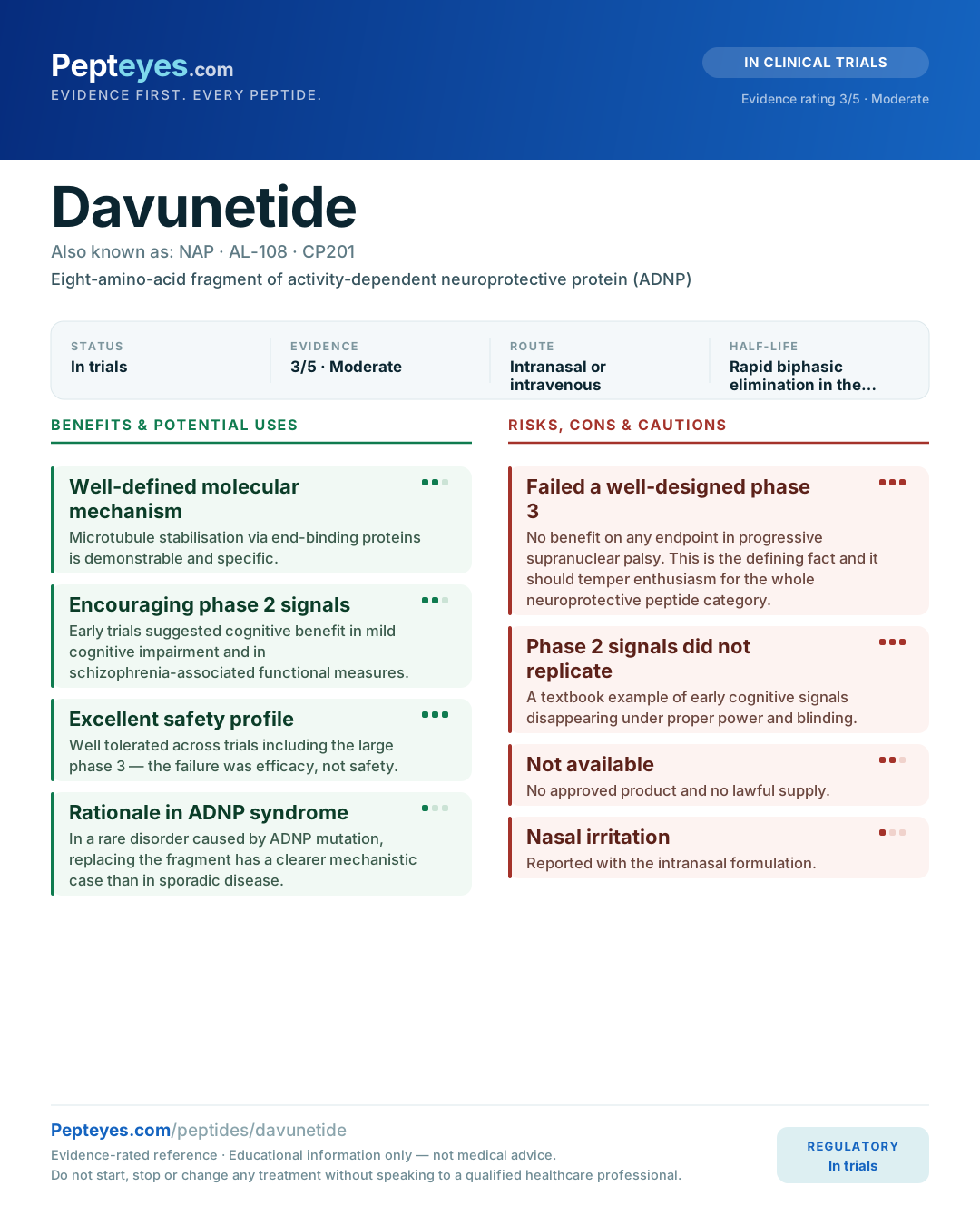
Well-defined molecular mechanism
Microtubule stabilisation via end-binding proteins is demonstrable and specific.
Evidence: Moderate evidence -
Encouraging phase 2 signals
Early trials suggested cognitive benefit in mild cognitive impairment and in schizophrenia-associated functional measures.
Evidence: Moderate evidence -
Excellent safety profile
Well tolerated across trials including the large phase 3 — the failure was efficacy, not safety.
Evidence: Strong evidence -
Rationale in ADNP syndrome
In a rare disorder caused by ADNP mutation, replacing the fragment has a clearer mechanistic case than in sporadic disease.
Evidence: Preliminary
Risks and cautions
4 entries · 2 serious or common
-
Failed a well-designed phase 3
No benefit on any endpoint in progressive supranuclear palsy. This is the defining fact and it should temper enthusiasm for the whole neuroprotective peptide category.
Evidence: Serious -
Phase 2 signals did not replicate
A textbook example of early cognitive signals disappearing under proper power and blinding.
Evidence: Serious -
Not available
No approved product and no lawful supply.
Evidence: Moderate evidence -
Nasal irritation
Reported with the intranasal formulation.
Evidence: Minor
Counts are not a score. A single serious risk can outweigh several well-supported benefits, and a long benefit list built on preclinical work outweighs nothing at all.
Opinion — what people actually report
No community discussion to summarise
There is effectively no community discussion of davunetide to summarise. It was developed as a neuroprotective candidate, failed its phase 3 trial in progressive supranuclear palsy in 2012, and development stopped. It never reached a wellness or grey market, so there is no body of self-report to draw on. That absence is itself worth knowing: a compound with a plausible mechanism and encouraging early data can fail decisively at the point where it is properly tested, and when that happens the interest disappears with it.
Readers on Davunetide
Questions and answers from readers, under generated names. Nothing here has been checked or reviewed by the site and none of it is medical advice. It is the least verified thing on this page — and it is here because people ask each other these things anyway, and most of the other places they can ask are run by sellers.
0 questions · 0 answers
No questions yet. Ask the first one above — it takes one box and an email address.
How names work, and the house rules
Names. Every verified address is given one generated name — two ordinary words — and keeps it. Nobody chooses a name and nobody can take another's. Posts marked desk were written by the site's own editorial desk, usually to open a thread; they carry a generated name like everyone else's and are held to the site's rules, which means they never state an amount.
What is not allowed. Selling, sourcing, vendor names, coupon codes and "message me" — posts that read that way are held and usually removed. Personal medical details you would not want public. Abuse. Instructions framed as what someone else should do.
What this is not. A reader's report of what happened to them is a report, not a finding, and an answer here is one person's view. Nothing in this section changes the evidence rating above it. If something you read here would change what you take, take it to a pharmacist or physician first.
Your data. Delete any post of yours at any time, or remove everything you have written together with your name. Details in the privacy notice.
Who should avoid it
- Not applicable — no lawful supply exists
If used under medical supervision, monitor
- Not applicable
Regulatory & legal status
Investigational; development for the primary indication discontinued.
Infographic
Where to read further
We link to live literature searches rather than a frozen citation list, so you always see current results — including anything published after our last review.
- PubMed — all published literature on Davunetide
- PubMed — randomized controlled trials only
- ClinicalTrials.gov — registered human trials
Related peptides in Cognitive & Neurological
Terms used on this page
- Phase 3 Trial
- A Phase 3 trial is the large confirmatory study, powered for a prespecified clinical endpoint, on which a marketing application and the resulting product label are built.
- Phase 2 Trial
- A Phase 2 trial is the first test of a compound in the target patient population, sized to find a workable dose and an early efficacy signal rather than to prove clinical benefit.
- Neuroprotection
- Neuroprotection is any intervention intended to preserve neurons from an ongoing insult, rather than to relieve symptoms, and it is the field with the widest gap between animal and human results.
- Blinding
- Blinding is the withholding of treatment-assignment knowledge from participants, clinicians, outcome assessors or analysts, so that expectation and behaviour cannot bias what a trial measures.
- Intranasal Delivery
- Intranasal delivery uses the nasal mucosa as an absorption surface, offering needle-free administration and rapid onset but low and variable bioavailability for peptides.
- Grey Market
- A grey market is trade in goods that are genuine or plausibly genuine but sold outside the manufacturer's authorised channel, or under a label exempting them from the rules governing medicines.
This page is educational information, not medical advice. It cannot account for your medical history, medications, or risk factors. Do not start, stop or change any treatment based on it. Speak to a qualified healthcare professional who knows your case.