Supplied as a lyophilised powder to reconstitute
Bone, Muscle & Other
At a glance
Ten answers, each one line. Open any row for the detail behind it.
What it does Named for an effect it has struggled to reproduce.
Named for an effect it has struggled to reproduce. Fifty years after its discovery, the sleep evidence remains inconsistent and the compound has never progressed toward approval anywhere.
Half-life About 4 minutes in dogs after intravenous dosing; no human… — Nothing established
About 4 minutes in dogs after intravenous dosing; no human half-life has been published. Cleared very fast by plasma peptidases.
Typical studied dose None established. No dose has ever been set for a human being, because… — Nothing established
None established. No dose has ever been set for a human being, because the studies that would set one have not been done. Any figure circulating for this compound was chosen by somebody selling it or by somebody guessing.
How often it is used No schedule exists. Cycles and intervals quoted for this compound come… — Nothing established
No schedule exists. Cycles and intervals quoted for this compound come from forums rather than from any study, and they vary because nothing anchors them.
How it is taken Subcutaneous or intravenous (research) — Documented
Subcutaneous or intravenous (research)
Main side effects Inconsistent and largely negative evidence · Unregulated supply · Extremely short half-life — Carries serious risk
Inconsistent and largely negative evidence — Fifty years of intermittent research has not established a reproducible sleep effect.
Unregulated supply — Research-chemical market.
Extremely short half-life — Rapid degradation makes sustained effect from peripheral administration implausible.
Storage before mixing As a sealed lyophilised powder, refrigerated is typical and a freezer…
As a sealed lyophilised powder, refrigerated is typical and a freezer suits long storage; both should be dark and dry. A dry powder tolerates a few days out of the cold far better than anything in solution — which is why it ships that way.
Shelf life after mixing Once mixed it is refrigerated and treated as short-lived. Bacteriostatic…
Once mixed it is refrigerated and treated as short-lived. Bacteriostatic water contains a preservative and buys the longer window; sterile water contains none and buys a much shorter one. Peptides in solution also degrade on their own, so the container is only half the question.
Evidence level 1/5 · Minimal — Nothing established
Animal or laboratory data only. No human efficacy evidence.
Regulatory status Research Use Only — Nothing established
Not approved. Studied sporadically since the 1970s without producing a consistent result. Not approved for human use.
Overview
Named for an effect it has struggled to reproduce. Fifty years after its discovery, the sleep evidence remains inconsistent and the compound has never progressed toward approval anywhere.
Not approved for human use anywhereNo approval anywhere for human use. Sold under research-use labelling. Not approved for human use.
| Regulatory status | Not approved. Studied sporadically since the 1970s without producing a consistent result. |
|---|---|
| Drug class | Nonapeptide isolated from rabbit cerebral venous blood during induced sleep |
| Route | Subcutaneous or intravenous (research) |
| Half-life | About 4 minutes in dogs after intravenous dosing; no human half-life has been published. Cleared very fast by plasma peptidases. |
| Evidence rating |
1/5 Minimal
Evidence rating 1 out of 5: Minimal
Animal or laboratory data only. No human efficacy evidence. |
| Studied in | Small human studies in insomnia, chronic pain and opioid withdrawal from the 1970s–1990s, with inconsistent results; sporadic subsequent work. |
DSIP sequence & structure
DSIP is a 9-residue linear peptide with a free C-terminal acid; molecular weight 848.82 Da.
| Three-letter | H-Trp-Ala-Gly-Gly-Asp-Ala-Ser-Gly-Glu-OH |
|---|---|
| Length | 9 amino acid residues |
| Modifications | None — an unmodified chain of standard L-amino acids |
| Molecular formula | C35H48N10O15 |
| Molecular weight | 848.82 Da (average, free base) |
| SMILES | C[C@H](NC(=O)[C@H](CC(=O)O)NC(=O)CNC(=O)CNC(=O)[C@H](C)NC(=O)[C@@H](N)Cc1c[nH]c2ccccc12)C(=O)N[C@@H](CO)C(=O)NCC(=O)N[C@@H](CCC(=O)O)C(=O)O |
| Identifiers | CAS 62568-57-4 · PubChem CID 68816 · UniProt P01158 |
| Which molecule | Record describes native rabbit DSIP (INN emideltide, UNII YN28Z5YZ73), the unmodified linear nonapeptide WAGGDASGE, which is what the pepteyes monograph ("nonapeptide isolated from rabbit cerebral venous blood") covers. Vendors also sell phospho-DSIP (Ser7-phosphorylated) and N-acetyl emideltide (UNII CL985USD2K); those are not covered here. |
| Sources | NCATS Inxight Drugs / GSRS – Emideltide (UNII YN28Z5YZ73)UniProt P01158 DSIP_RABIT (FASTA)PubChem CID 68816 (Emideltide)ChEMBL CHEMBL2104403 (Emideltide)Schoenenberger & Monnier, PNAS 1977 (PMID 265572) |
Unmodified, all-L linear nonapeptide with free N-terminal amine and free C-terminal acid; no precursor gene is known, so UniProt P01158 holds only the 9-residue peptide. Formula/MW are for the free base (GSRS 848.81, ChEMBL 848.82; computed from sequence 848.82); commercial material is usually the acetate or TFA salt, so vendor MW may differ. GSRS and PubChem both list a second CAS, 69431-45-4 (check digit valid); 62568-57-4 is the primary registry number for the free peptide.
Record confidence: high — two independent authoritative sources agree on the sequence and modifications. Every sequence on the site is listed with its sources on the peptide sequences index.
How it works
Not well established. Proposed effects on delta-wave sleep, modulation of hypothalamic-pituitary-adrenal axis activity, and interactions with opioid and GABAergic systems. No settled receptor target has been identified.
Evidence base
Rated 1 of 5 — Minimal. Animal or laboratory data only. No human efficacy evidence.
- A long research history that never converged on a reproducible effect.
Benefits and risks, weighed against the evidence
Every entry below carries the strength of the evidence behind it — three bars for strong human data, two for moderate, one for preliminary or preclinical work. The two columns are not equal by design: where a compound has more documented risk than demonstrated benefit, the lists say so.
Reported benefits
4 entries
-
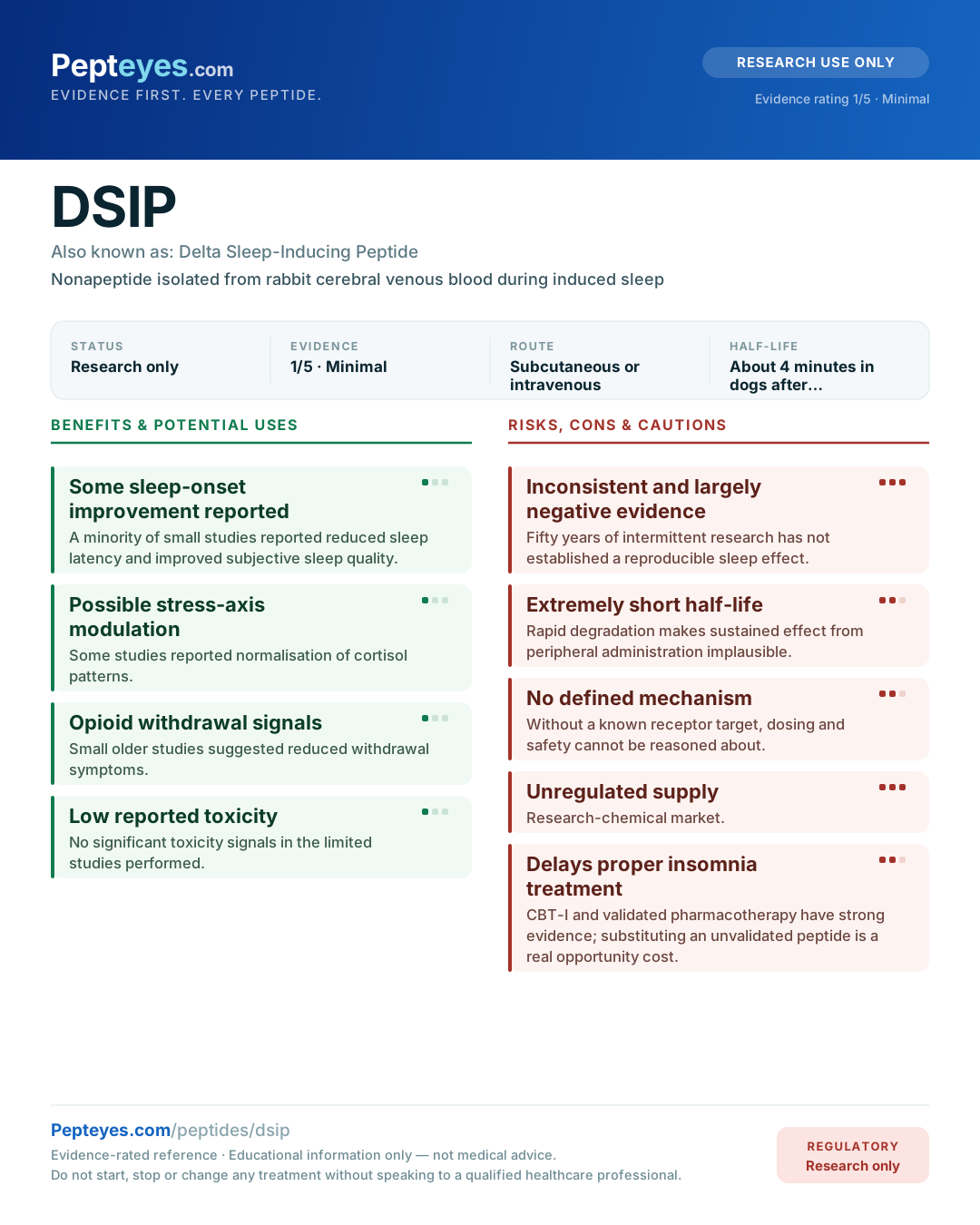
Some sleep-onset improvement reported
A minority of small studies reported reduced sleep latency and improved subjective sleep quality.
Evidence: Preliminary -
Possible stress-axis modulation
Some studies reported normalisation of cortisol patterns.
Evidence: Preliminary -
Opioid withdrawal signals
Small older studies suggested reduced withdrawal symptoms.
Evidence: Preliminary -
Low reported toxicity
No significant toxicity signals in the limited studies performed.
Evidence: Preliminary
Risks and cautions
5 entries · 2 serious or common
-
Inconsistent and largely negative evidence
Fifty years of intermittent research has not established a reproducible sleep effect.
Evidence: Serious -
Extremely short half-life
Rapid degradation makes sustained effect from peripheral administration implausible.
Evidence: Moderate evidence -
No defined mechanism
Without a known receptor target, dosing and safety cannot be reasoned about.
Evidence: Moderate evidence -
Unregulated supply
Research-chemical market.
Evidence: Serious -
Delays proper insomnia treatment
CBT-I and validated pharmacotherapy have strong evidence; substituting an unvalidated peptide is a real opportunity cost.
Evidence: Moderate evidence
Counts are not a score. A single serious risk can outweigh several well-supported benefits, and a long benefit list built on preclinical work outweighs nothing at all.
Opinion — what people actually report
4 themes · 1 reported benefit · 2 reported problems
This is the weakest tier on this site. These are themes drawn from public discussion — forums, subreddits and patient threads — not from trials. There is no control group, no denominator, and no way to confirm that what someone injected matched its label. People post when a result is dramatic and when something goes wrong, and rarely when nothing happens, so treat everything below as a description of the conversation rather than of the compound. The bars count how often a thing is said, not how well it is supported.
-
Sleep onset, when it works at all Reported benefit. Recurring: Raised regularly, though not by everyone.
The reason people try it, but the reports are markedly less consistent than for other sleep-adjacent compounds here.
-
Highly variable, often nothing Reported problem. Dominant theme: Comes up in most discussions of this compound.
The dominant theme. Response is described as unpredictable between people and between nights in the same person.
-
Timing is treated as critical Practical note. Recurring: Raised regularly, though not by everyone.
Elaborate advice about dosing relative to bedtime, based on trial and error rather than pharmacokinetics.
-
Grogginess the next morning Reported problem. Occasional: Reported by a minority, or in specific contexts.
A minority report, usually attributed to dose or timing.
Where the reports and the evidence part ways
Delta sleep-inducing peptide was isolated in the 1970s and named for an effect seen in rabbits. Human work since has been small, old and inconsistent, and the compound has never been developed into an approved product for sleep anywhere. The community's own experience — unpredictable, frequently absent — actually matches the human literature better than the marketing does. There is also an unresolved pharmacological problem the forums rarely raise: whether an intact peptide of this kind reaches the central nervous system in meaningful quantity after peripheral injection is not established.
Cheat sheet
The full sheet, all 77 compounds →The community reference numbers for this compound — reconstitution, working dose, cycle and bloodwork. Research and education only, not medical advice, and not part of the evidence-rated monograph above. Doses assume a 1mL / 100-unit insulin syringe — the calculator does the units for you.
Protocol overview
Dosing & reconstitution 5 mg vial
| WEEK | DAILY DOSE | UNITS PER INJECTION |
|---|---|---|
| Week 1 | 100 mcg | 1 units (0.01 mL) |
| Week 2 | 150 mcg | 1.5 units (0.02 mL) |
| Week 3 | 200 mcg | 2 units (0.02 mL) |
| Weeks 4 to 8 | 250 to 300 mcg | 2.5 to 3 units (0.03 to 0.03 mL) |
Frequency: Inject once daily subcutaneously, typically in the evening before bedtime. For 10 unit (0.10 mL) or smaller administrations (Weeks 1 to 2), consider 30- or 50-unit insulin syringes for improved readability.
On the master sheet
- Vial
- 5mg
- BAC
- 3mL
- Dose
- 100–300mcg pre-bed
- Route
- SubQ
- Cycle
- 8–12 wks, 5 on/2 off
- Notes
- Circadian-dependent sleep aid
- Pre-mixed nasal spray: DSIP 5mg — Deep sleep, recovery
Readers on DSIP
Questions and answers from readers, under generated names. Nothing here has been checked or reviewed by the site and none of it is medical advice. It is the least verified thing on this page — and it is here because people ask each other these things anyway, and most of the other places they can ask are run by sellers.
0 questions · 0 answers
No questions yet. Ask the first one above — it takes one box and an email address.
How names work, and the house rules
Names. Every verified address is given one generated name — two ordinary words — and keeps it. Nobody chooses a name and nobody can take another's. Posts marked desk were written by the site's own editorial desk, usually to open a thread; they carry a generated name like everyone else's and are held to the site's rules, which means they never state an amount.
What is not allowed. Selling, sourcing, vendor names, coupon codes and "message me" — posts that read that way are held and usually removed. Personal medical details you would not want public. Abuse. Instructions framed as what someone else should do.
What this is not. A reader's report of what happened to them is a report, not a finding, and an answer here is one person's view. Nothing in this section changes the evidence rating above it. If something you read here would change what you take, take it to a pharmacist or physician first.
Your data. Delete any post of yours at any time, or remove everything you have written together with your name. Details in the privacy notice.
Who should avoid it
- Use in place of evidence-based insomnia treatment
- Pregnancy
If used under medical supervision, monitor
- Sleep diary or actigraphy if used
- Screening for treatable sleep disorders such as apnea
Regulatory & legal status
Not approved for human use.
Off Category 2 since April 2026, but the advisory committee declined to recommend it in July 2026.
- Removed from Category 2
- 22 April 2026
- Advisory committee vote
- 6–7, one abstention on 23–24 July 2026, considered for opioid withdrawal, chronic insomnia and narcolepsy
- Approved as a drug?
- No. Compounding status and drug approval are separate questions; this compound has no approval for the uses it is sold for.
The only compound the committee declined to recommend.
The full dated record, with sources, and every affected peptide →
Infographic
Where to read further
We link to live literature searches rather than a frozen citation list, so you always see current results — including anything published after our last review.
- PubMed — all published literature on DSIP
- PubMed — randomized controlled trials only
- ClinicalTrials.gov — registered human trials
Related peptides in Bone, Muscle & Other
Terms used on this page
- Hypothalamic-Pituitary-Adrenal (HPA) Axis
- The hypothalamic-pituitary-adrenal axis is the CRH to ACTH to cortisol cascade that sets the daily glucocorticoid rhythm and mounts the endocrine response to physiological stress.
- Reproducibility and Replication
- Reproducibility is obtaining the same result from the same data and analysis, while replication is obtaining a consistent result from new data, and only the second shows the finding is real.
- Cortisol
- Cortisol is the principal human glucocorticoid, secreted by the adrenal cortex under ACTH control on a pronounced daily rhythm and carried in plasma largely bound to corticosteroid-binding globulin.
This page is educational information, not medical advice. It cannot account for your medical history, medications, or risk factors. Do not start, stop or change any treatment based on it. Speak to a qualified healthcare professional who knows your case.