Supplied ready in solution
Longevity & Mitochondrial
At a glance
Ten answers, each one line. Open any row for the detail behind it.
What it does The most rigorously developed mitochondrial peptide, and a case study in how a real drug…
The most rigorously developed mitochondrial peptide, and a case study in how a real drug development program plays out: an approval in one ultra-rare disease, and several failed trials in the larger indications people actually want it for.
Half-life ~2–4 hours — Documented
~2–4 hours
Typical studied dose Set on the approved label, which states the starting dose, how it is… — On the label
Set on the approved label, which states the starting dose, how it is increased and the maximum. Read it there rather than anywhere else — including here.
How often it is used Set on the approved label. The interval follows the half-life above… — On the label
Set on the approved label. The interval follows the half-life above, which is why some of these are weekly and others daily.
How it is taken Subcutaneous — Documented
Subcutaneous
Main side effects Failed its largest trials · Grey-market SS-31 · Injection-site reactions — Carries serious risk
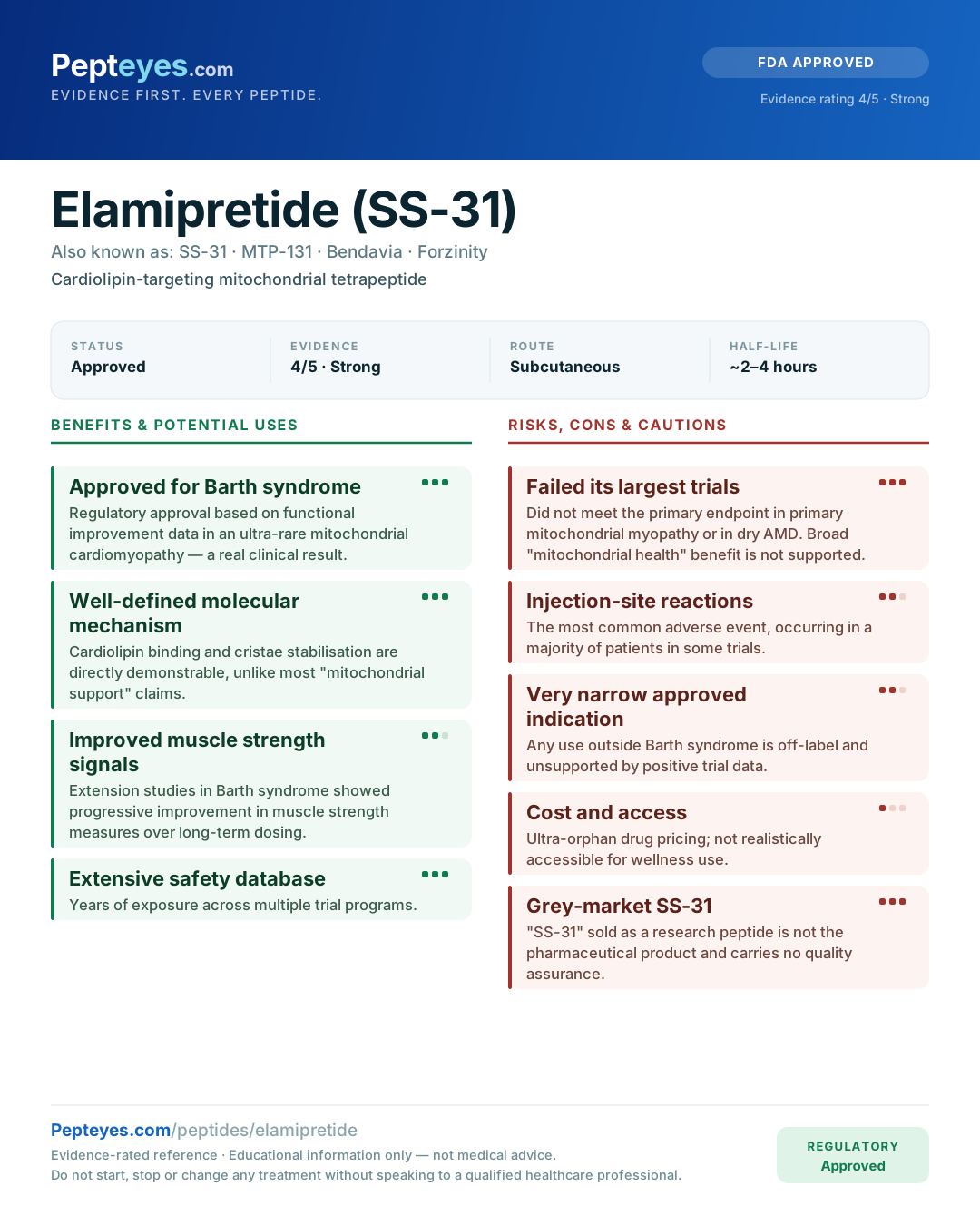
Failed its largest trials — Did not meet the primary endpoint in primary mitochondrial myopathy or in dry AMD. Broad "mitochondrial health" benefit is not supported.
Grey-market SS-31 — "SS-31" sold as a research peptide is not the pharmaceutical product and carries no quality assurance.
Injection-site reactions — The most common adverse event, occurring in a majority of patients in some trials.
Storage before mixing Supplied already in solution and kept refrigerated, not frozen. Freezing…
Supplied already in solution and kept refrigerated, not frozen. Freezing a protein solution can aggregate it, which is not always visible.
Shelf life after mixing Nothing to mix — it is not supplied as a powder. The relevant date is…
Nothing to mix — it is not supplied as a powder. The relevant date is the one printed on the product.
Evidence level 4/5 · Strong — Documented
Consistent human randomized trials, or approval outside the United States.
Regulatory status FDA Approved — Documented
Approved in the US for Barth syndrome, an ultra-rare mitochondrial disorder. Trials in primary mitochondrial myopathy and dry AMD did not meet primary endpoints. Approved for a single ultra-rare indication. Research-grade "SS-31" is a separate, unapproved product.
Overview
The most rigorously developed mitochondrial peptide, and a case study in how a real drug development program plays out: an approval in one ultra-rare disease, and several failed trials in the larger indications people actually want it for.
FDA ApprovedApproved in the US for Barth syndrome, an ultra-rare mitochondrial disorder. Trials in primary mitochondrial myopathy and dry AMD did not meet primary endpoints.
| Regulatory status | Approved in the US for Barth syndrome, an ultra-rare mitochondrial disorder. Trials in primary mitochondrial myopathy and dry AMD did not meet primary endpoints. |
|---|---|
| Drug class | Cardiolipin-targeting mitochondrial tetrapeptide |
| Route | Subcutaneous |
| Half-life | ~2–4 hours |
| Evidence rating |
4/5 Strong
Evidence rating 4 out of 5: Strong
Consistent human randomized trials, or approval outside the United States. |
| Studied in | Phase 3 trials in primary mitochondrial myopathy (MMPOWER-3), Barth syndrome (TAZPOWER and extension), dry age-related macular degeneration, and heart failure. |
Elamipretide (SS-31) sequence & structure
Elamipretide (SS-31) is a 4-residue linear peptide with a C-terminal amide, carrying D-amino acid substitutions, non-standard residues; molecular weight 639.79 Da.
lowercase = D-amino acid[bracketed] = non-standard residue
| Three-letter | H-D-Arg-Dmt-Lys-Phe-NH2 |
|---|---|
| Length | 4 amino acid residues |
| Modifications |
|
| Molecular formula | C32H49N9O5 |
| Molecular weight | 639.79 Da (average, free base) |
| SMILES | Cc1cc(O)cc(C)c1C[C@H](NC(=O)[C@H](N)CCCNC(=N)N)C(=O)N[C@@H](CCCCN)C(=O)N[C@@H](Cc1ccccc1)C(N)=O |
| Identifiers | CAS 736992-21-5 · PubChem CID 11764719 · DrugBank DB11981 |
| Sources | PubChem CID 11764719 (PUG REST)IUPHAR/BPS Guide to PHARMACOLOGY ligand 14276 (structure web service)KEGG DRUG D10925 Elamipretide (USAN/INN)FDA GSRS substance record UNII 87GWG91S09DailyMed – FORZINITY (elamipretide hydrochloride) injection label |
Formula/MW/SMILES are for the free base (InChIKey SFVLTCAESLKEHH-WKAQUBQDSA-N; ChEMBL CHEMBL3833370); the FDA-approved product FORZINITY (accelerated approval 2025 for Barth syndrome, as the pepteyes monograph states) is elamipretide hydrochloride, C32H49N9O5·3HCl, MW 749.17 (KEGG D11542; salt CAS not verified). SS-31, MTP-131, RX-31, Bendavia and Ocuvia all denote this same molecule; DrugBank DB11981 is confirmed via the GtoPdb cross-reference (drugbank.com itself returns HTTP 403), and DB12112 is a revoked DrugBank record.
Record confidence: high — two independent authoritative sources agree on the sequence and modifications. Every sequence on the site is listed with its sources on the peptide sequences index.
How it works
Concentrates in the inner mitochondrial membrane where it binds cardiolipin, stabilising cristae architecture and the electron transport chain supercomplexes. This improves ATP production efficiency and reduces electron leak and reactive oxygen species generation.
Evidence base
Rated 4 of 5 — Strong. Consistent human randomized trials, or approval outside the United States.
- Multiple phase 3 trials — a genuinely rigorous program, including informative negative results.
Benefits and risks, weighed against the evidence
Every entry below carries the strength of the evidence behind it — three bars for strong human data, two for moderate, one for preliminary or preclinical work. The two columns are not equal by design: where a compound has more documented risk than demonstrated benefit, the lists say so.
Reported benefits
4 entries · 3 on strong human evidence
-
Approved for Barth syndrome
Regulatory approval based on functional improvement data in an ultra-rare mitochondrial cardiomyopathy — a real clinical result.
Evidence: Strong evidence -
Well-defined molecular mechanism
Cardiolipin binding and cristae stabilisation are directly demonstrable, unlike most "mitochondrial support" claims.
Evidence: Strong evidence -
Improved muscle strength signals
Extension studies in Barth syndrome showed progressive improvement in muscle strength measures over long-term dosing.
Evidence: Moderate evidence -
Extensive safety database
Years of exposure across multiple trial programs.
Evidence: Strong evidence
Risks and cautions
5 entries · 2 serious or common
-
Failed its largest trials
Did not meet the primary endpoint in primary mitochondrial myopathy or in dry AMD. Broad "mitochondrial health" benefit is not supported.
Evidence: Serious -
Injection-site reactions
The most common adverse event, occurring in a majority of patients in some trials.
Evidence: Moderate evidence -
Very narrow approved indication
Any use outside Barth syndrome is off-label and unsupported by positive trial data.
Evidence: Moderate evidence -
Cost and access
Ultra-orphan drug pricing; not realistically accessible for wellness use.
Evidence: Minor -
Grey-market SS-31
"SS-31" sold as a research peptide is not the pharmaceutical product and carries no quality assurance.
Evidence: Serious
Counts are not a score. A single serious risk can outweigh several well-supported benefits, and a long benefit list built on preclinical work outweighs nothing at all.
Opinion — what people actually report
5 themes · 1 reported benefit · 2 reported problems
This is the weakest tier on this site. These are themes drawn from public discussion — forums, subreddits and patient threads — not from trials. There is no control group, no denominator, and no way to confirm that what someone injected matched its label. People post when a result is dramatic and when something goes wrong, and rarely when nothing happens, so treat everything below as a description of the conversation rather than of the compound. The bars count how often a thing is said, not how well it is supported.
-
Mostly discussed by patients with mitochondrial disease Practical note. Dominant theme: Comes up in most discussions of this compound.
Unlike most longevity compounds, a large share of the conversation comes from people with Barth syndrome and primary mitochondrial myopathy rather than from healthy enhancement seekers.
-
Fatigue and exercise tolerance in that group Reported benefit. Recurring: Raised regularly, though not by everyone.
Reports from patients and families describe meaningful functional change, though numbers are small.
-
Regulatory setbacks have shaped the mood Reported problem. Dominant theme: Comes up in most discussions of this compound.
A long history of missed endpoints and FDA decisions dominates discussion, and patient advocacy has been unusually visible.
-
Injection site reactions Reported problem. Recurring: Raised regularly, though not by everyone.
Redness, itching and hardening at the injection site are the most frequently reported problem, and rarely the reason people stop.
-
Almost no healthy-user accounts Practical note. Recurring: Raised regularly, though not by everyone.
Cost and scarcity have kept it out of general biohacking use.
Where the reports and the evidence part ways
Elamipretide targets cardiolipin on the inner mitochondrial membrane, which is a specific and well-characterised mechanism rather than a vague mitochondrial claim. The trial record is mixed: some functional endpoints have been met and several primary endpoints have not, which is why its regulatory path has been difficult. The community reflects this ambiguity fairly accurately, partly because patient groups have followed the trials closely. Extension to general anti-ageing use has essentially no evidence, and, unusually, almost nobody is claiming otherwise.
Cheat sheet
The full sheet, all 77 compounds →The community reference numbers for this compound — reconstitution, working dose, cycle and bloodwork. Research and education only, not medical advice, and not part of the evidence-rated monograph above. Doses assume a 1mL / 100-unit insulin syringe — the calculator does the units for you.
Protocol overview
Dosing & reconstitution 10 mg vial
| WEEK | DAILY DOSE | UNITS PER INJECTION |
|---|---|---|
| Weeks 1 to 2 | 5 mg (5,000 mcg) | 50 units (0.50 mL) |
| Weeks 3 to 8 | 10 mg (10,000 mcg) | 100 units (1.00 mL) |
Frequency: Inject once daily subcutaneously at a consistent time. This concentrated dilution keeps standard doses within a single insulin syringe for convenience and accuracy.
On the master sheet
- Vial
- 10mg
- BAC
- 1mL isotonic
- Dose
- 5–10mg daily
- Route
- SubQ
- Cycle
- 4–8 wks
- Time Off
- 2–4 wks
- Bloodwork
- Basic metabolic
Readers on Elamipretide (SS-31)
Questions and answers from readers, under generated names. Nothing here has been checked or reviewed by the site and none of it is medical advice. It is the least verified thing on this page — and it is here because people ask each other these things anyway, and most of the other places they can ask are run by sellers.
0 questions · 0 answers
No questions yet. Ask the first one above — it takes one box and an email address.
How names work, and the house rules
Names. Every verified address is given one generated name — two ordinary words — and keeps it. Nobody chooses a name and nobody can take another's. Posts marked desk were written by the site's own editorial desk, usually to open a thread; they carry a generated name like everyone else's and are held to the site's rules, which means they never state an amount.
What is not allowed. Selling, sourcing, vendor names, coupon codes and "message me" — posts that read that way are held and usually removed. Personal medical details you would not want public. Abuse. Instructions framed as what someone else should do.
What this is not. A reader's report of what happened to them is a report, not a finding, and an answer here is one person's view. Nothing in this section changes the evidence rating above it. If something you read here would change what you take, take it to a pharmacist or physician first.
Your data. Delete any post of yours at any time, or remove everything you have written together with your name. Details in the privacy notice.
Who should avoid it
- Off-label use for general anti-aging — the trials that tested broader benefit were negative
- Pregnancy (insufficient data)
If used under medical supervision, monitor
- Injection-site assessment
- Disease-specific functional measures
Commonly confused with
These mix-ups cause real harm — two products sold under one name, or two molecules whose effects run in opposite directions.
Both marketed as mitochondrial peptides. Elamipretide completed multiple phase 3 trials and holds an approval for one ultra-rare disease; MOTS-c has never been given to humans in a controlled trial.
Compare side by sideRegulatory & legal status
Approved for a single ultra-rare indication. Research-grade "SS-31" is a separate, unapproved product.
Infographic
Where to read further
We link to live literature searches rather than a frozen citation list, so you always see current results — including anything published after our last review.
- PubMed — all published literature on Elamipretide (SS-31)
- PubMed — randomized controlled trials only
- ClinicalTrials.gov — registered human trials
- DailyMed — official FDA prescribing information
Related peptides in Longevity & Mitochondrial
Terms used on this page
- Phase 3 Trial
- A Phase 3 trial is the large confirmatory study, powered for a prespecified clinical endpoint, on which a marketing application and the resulting product label are built.
- Primary vs Secondary Endpoint
- The primary endpoint is the single prespecified outcome a trial is powered and statistically budgeted for, while secondary endpoints are additional measures that support interpretation but cannot replace it.
- Adverse Event (AE)
- An adverse event is any untoward medical occurrence in someone receiving a medicine, recorded whether or not the drug caused it, which is why an event table is not a harm table.
- Injection Site Rotation
- Injection site rotation is the practice of distributing subcutaneous injections across tissue rather than repeating them in one spot, to prevent local tissue change that makes absorption erratic.
- Biohacking
- Biohacking is self-directed experimentation on one's own biology, spanning sleep and nutrition tracking through to unapproved compounds, conducted outside clinical protocols and regulatory oversight.
This page is educational information, not medical advice. It cannot account for your medical history, medications, or risk factors. Do not start, stop or change any treatment based on it. Speak to a qualified healthcare professional who knows your case.