Supplied as a lyophilised powder to reconstitute
Antimicrobial & Antibiotic
At a glance
Ten answers, each one line. Open any row for the detail behind it.
What it does A reminder that peptides are not a fringe category — this is a frontline hospital…
A reminder that peptides are not a fringe category — this is a frontline hospital antibiotic for MRSA bacteraemia, and it is a lipopeptide. It also carries one of the most instructive failures in antibiotic history: it does not work in the lungs, for a specific and knowable reason.
Half-life ~8–9 hours — Documented
~8–9 hours
Typical studied dose Set on the approved label, which states the starting dose, how it is… — On the label
Set on the approved label, which states the starting dose, how it is increased and the maximum. Read it there rather than anywhere else — including here.
How often it is used The label schedule is once daily. Dosing intervals follow the half-life… — On the label
The label schedule is once daily. Dosing intervals follow the half-life above, and the prescribing information is what sets them.
How it is taken Intravenous, once daily — Documented
Intravenous, once daily
Main side effects Inactivated by pulmonary surfactant — useless in pneumonia · Rhabdomyolysis and myopathy · Eosinophilic pneumonia — Carries serious risk
Inactivated by pulmonary surfactant — useless in pneumonia — Its pneumonia trial failed because surfactant neutralises the drug in the alveolus. It must never be used for pneumonia, and this is a mechanism-level absolute.
Rhabdomyolysis and myopathy — Creatine kinase must be monitored at least weekly; the drug is stopped if CK rises with muscle symptoms.
Eosinophilic pneumonia — A distinct, serious hypersensitivity reaction that paradoxically affects the lungs, typically after 2 or more weeks of therapy.
Storage before mixing As a sealed lyophilised powder, refrigerated is typical and a freezer…
As a sealed lyophilised powder, refrigerated is typical and a freezer suits long storage; both should be dark and dry. A dry powder tolerates a few days out of the cold far better than anything in solution — which is why it ships that way.
Shelf life after mixing Once mixed it is refrigerated and treated as short-lived. Bacteriostatic…
Once mixed it is refrigerated and treated as short-lived. Bacteriostatic water contains a preservative and buys the longer window; sterile water contains none and buys a much shorter one. Peptides in solution also degrade on their own, so the container is only half the question.
Evidence level 5/5 · Very strong — Documented
Multiple phase 3 randomized trials plus regulatory approval in a major market.
Regulatory status FDA Approved — Documented
FDA-approved for complicated skin and skin structure infections and for Staphylococcus aureus bacteraemia, including right-sided endocarditis. Prescription antibiotic administered in hospital or outpatient parenteral settings.
Overview
A reminder that peptides are not a fringe category — this is a frontline hospital antibiotic for MRSA bacteraemia, and it is a lipopeptide. It also carries one of the most instructive failures in antibiotic history: it does not work in the lungs, for a specific and knowable reason.
FDA ApprovedFDA-approved for complicated skin and skin structure infections and for Staphylococcus aureus bacteraemia, including right-sided endocarditis.
| Regulatory status | FDA-approved for complicated skin and skin structure infections and for Staphylococcus aureus bacteraemia, including right-sided endocarditis. |
|---|---|
| Drug class | Cyclic lipopeptide antibiotic — 13 amino acids with a decanoyl fatty acid tail |
| Route | Intravenous, once daily |
| Half-life | ~8–9 hours |
| Evidence rating |
5/5 Very strong
Evidence rating 5 out of 5: Very strong
Multiple phase 3 randomized trials plus regulatory approval in a major market. |
| Studied in | Randomized non-inferiority trials in complicated skin infection and in S. aureus bacteraemia and endocarditis; a pneumonia trial that failed and defined a contraindication. |
Daptomycin sequence & structure
Daptomycin is a 13-residue cyclic peptide with a free C-terminal acid, carrying a fatty-acid side chain, D-amino acid substitutions, non-standard residues; molecular weight 1,620.67 Da.
lowercase = D-amino acid[bracketed] = non-standard residue
| Three-letter | Decanoyl-Trp-D-Asn-Asp-Thr-Gly-Orn-Asp-D-Ala-Asp-Gly-D-Ser-3MeGlu-Kyn (Thr4 side-chain O to Kyn13 lactone) |
|---|---|
| Length | 13 amino acid residues |
| Modifications |
|
| Molecular formula | C72H101N17O26 |
| Molecular weight | 1,620.67 Da (average, free base) |
| SMILES | CCCCCCCCCC(=O)N[C@@H](CC1=CNC2=CC=CC=C21)C(=O)N[C@H](CC(=O)N)C(=O)N[C@@H](CC(=O)O)C(=O)N[C@H]3[C@H](OC(=O)[C@@H](NC(=O)[C@@H](NC(=O)[C@H](NC(=O)CNC(=O)[C@@H](NC(=O)[C@H](NC(=O)[C@@H](NC(=O)[C@@H](NC(=O)CNC3=O)CCCN)CC(=O)O)C)CC(=O)O)CO)[C@H](C)CC(=O)O)CC(=O)C4=CC=CC=C4N)C |
| Identifiers | CAS 103060-53-3 · PubChem CID 21585658 · DrugBank DB00080 |
| Sources | DailyMed / FDA label: CUBICIN RF (daptomycin for injection), Section 11 DescriptionPubChem CID 21585658 (Daptomycin) — formula, MW, IUPAC name with full stereodescriptors, isomeric SMILESKEGG DRUG D01080 (Daptomycin, JAN/USAN/INN) — formula C72H101N17O26, MW 1620.67, CAS 103060-53-3EMA EPAR Scientific Discussion, Cubicin (2006) — 13-amino-acid macrocyclic peptide with N-terminal decanoyl chainChEMBL CHEMBL387675 (Daptomycin) — formula/MW cross-check only; see notes on its stereochemistry |
Fermentation-derived cyclic lipodepsipeptide from Streptomyces roseosporus (LY 146032; the n-decanoyl member of the A21978C complex), not a synthetic peptide; supplied as the free acid (Cubicin, Cubicin RF), no salt form. FDA label and KEGG give MW 1620.67, PubChem/ChEMBL 1620.7/1620.69 (rounding only). Caution: the ChEMBL CHEMBL387675 structure (PubChem CID 16134395, '(2S)-daptomycin') draws residue 2 as L-Asn; the correct D-Asn2 stereochemistry is that of PubChem CID 21585658, whose SMILES is used here. DrugBank DB00080 is confirmed as the accession via KEGG/Wikipedia cross-references but the DrugBank page itself returns 403 to automated fetches.
Record confidence: high — two independent authoritative sources agree on the sequence and modifications. Every sequence on the site is listed with its sources on the peptide sequences index.
How it works
The calcium-dependent lipid tail inserts into the Gram-positive bacterial membrane, oligomerises, and causes rapid membrane depolarisation and potassium efflux. The cell dies without lysis, which reduces the release of inflammatory cell-wall fragments compared with lytic antibiotics.
Evidence base
Rated 5 of 5 — Very strong. Multiple phase 3 randomized trials plus regulatory approval in a major market.
- Randomized non-inferiority trials plus two decades of hospital use.
- The negative pneumonia trial is as important as the positive ones.
Benefits and risks, weighed against the evidence
Every entry below carries the strength of the evidence behind it — three bars for strong human data, two for moderate, one for preliminary or preclinical work. The two columns are not equal by design: where a compound has more documented risk than demonstrated benefit, the lists say so.
Reported benefits
4 entries · 3 on strong human evidence
-
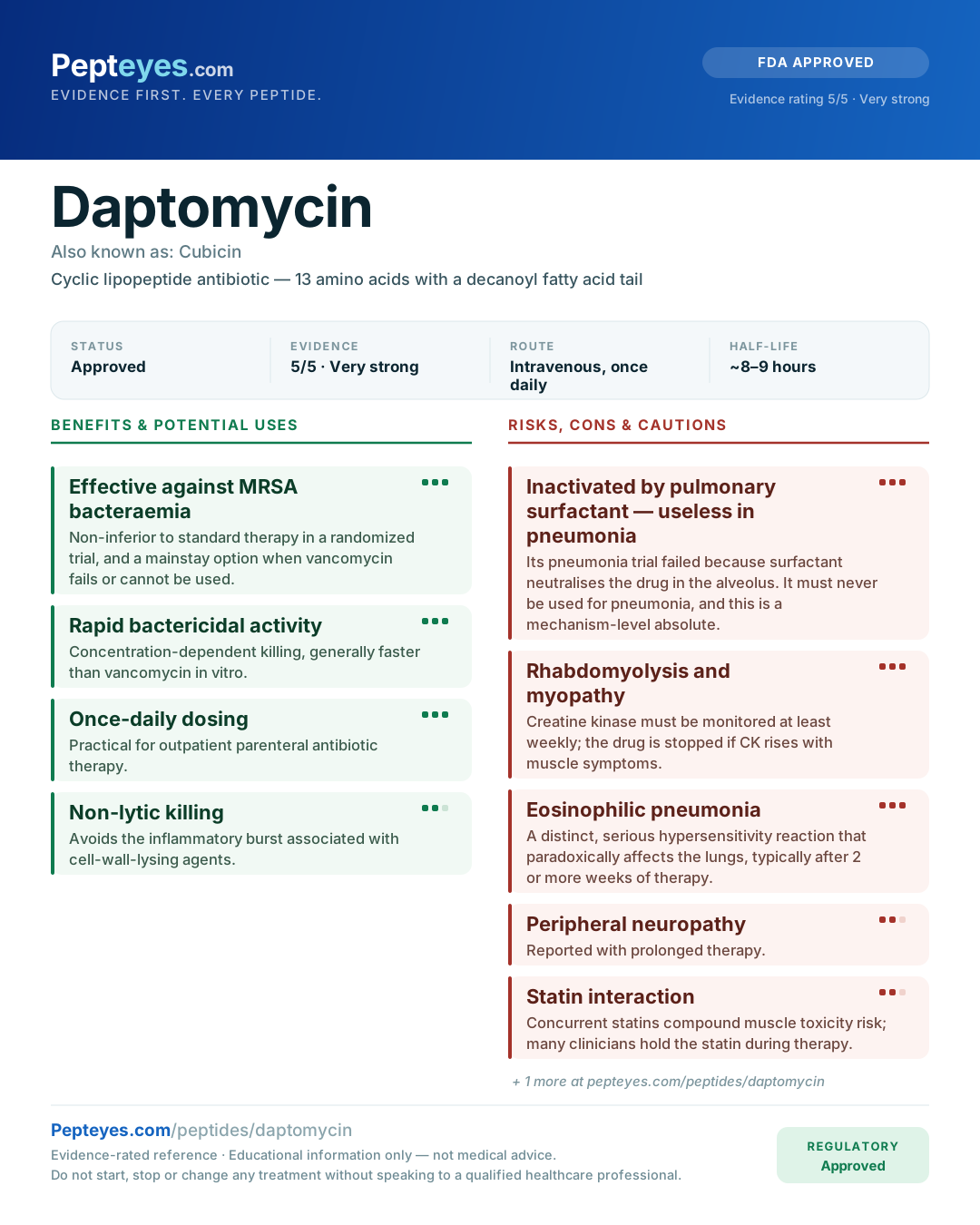
Effective against MRSA bacteraemia
Non-inferior to standard therapy in a randomized trial, and a mainstay option when vancomycin fails or cannot be used.
Evidence: Strong evidence -
Rapid bactericidal activity
Concentration-dependent killing, generally faster than vancomycin in vitro.
Evidence: Strong evidence -
Once-daily dosing
Practical for outpatient parenteral antibiotic therapy.
Evidence: Strong evidence -
Non-lytic killing
Avoids the inflammatory burst associated with cell-wall-lysing agents.
Evidence: Moderate evidence
Risks and cautions
6 entries · 3 serious or common
-
Inactivated by pulmonary surfactant — useless in pneumonia
Its pneumonia trial failed because surfactant neutralises the drug in the alveolus. It must never be used for pneumonia, and this is a mechanism-level absolute.
Evidence: Serious -
Rhabdomyolysis and myopathy
Creatine kinase must be monitored at least weekly; the drug is stopped if CK rises with muscle symptoms.
Evidence: Serious -
Eosinophilic pneumonia
A distinct, serious hypersensitivity reaction that paradoxically affects the lungs, typically after 2 or more weeks of therapy.
Evidence: Serious -
Peripheral neuropathy
Reported with prolonged therapy.
Evidence: Moderate evidence -
Statin interaction
Concurrent statins compound muscle toxicity risk; many clinicians hold the statin during therapy.
Evidence: Moderate evidence -
Resistance emergence on therapy
Non-susceptibility can develop during treatment of deep-seated infection, particularly with inadequate source control.
Evidence: Moderate evidence
Counts are not a score. A single serious risk can outweigh several well-supported benefits, and a long benefit list built on preclinical work outweighs nothing at all.
Opinion — what people actually report
No community discussion to summarise
No community self-report exists for daptomycin. It is a hospital-administered intravenous antibiotic for serious Gram-positive infection, used under specialist supervision with creatine kinase monitoring. Patient accounts, where they exist, describe the experience of outpatient parenteral antibiotic therapy rather than any choice about the drug itself.
Readers on Daptomycin
Questions and answers from readers, under generated names. Nothing here has been checked or reviewed by the site and none of it is medical advice. It is the least verified thing on this page — and it is here because people ask each other these things anyway, and most of the other places they can ask are run by sellers.
0 questions · 0 answers
No questions yet. Ask the first one above — it takes one box and an email address.
How names work, and the house rules
Names. Every verified address is given one generated name — two ordinary words — and keeps it. Nobody chooses a name and nobody can take another's. Posts marked desk were written by the site's own editorial desk, usually to open a thread; they carry a generated name like everyone else's and are held to the site's rules, which means they never state an amount.
What is not allowed. Selling, sourcing, vendor names, coupon codes and "message me" — posts that read that way are held and usually removed. Personal medical details you would not want public. Abuse. Instructions framed as what someone else should do.
What this is not. A reader's report of what happened to them is a report, not a finding, and an answer here is one person's view. Nothing in this section changes the evidence rating above it. If something you read here would change what you take, take it to a pharmacist or physician first.
Your data. Delete any post of yours at any time, or remove everything you have written together with your name. Details in the privacy notice.
Who should avoid it
- Pneumonia — inactivated by surfactant
- Known daptomycin hypersensitivity
- Caution with concurrent statin therapy
If used under medical supervision, monitor
- Creatine kinase at least weekly, more often with statins or renal impairment
- Renal function for dose adjustment
- New dyspnoea or fever after 2+ weeks — consider eosinophilic pneumonia
- Repeat blood cultures in bacteraemia
Interactions
Not exhaustive. Always have a pharmacist or physician review your full medication list — including supplements.
- HMG-CoA reductase inhibitors (statins) — additive myopathy risk
- Tobramycin — increases daptomycin exposure
- Warfarin — monitor INR in the first days
Regulatory & legal status
Prescription antibiotic administered in hospital or outpatient parenteral settings.
Infographic
Where to read further
We link to live literature searches rather than a frozen citation list, so you always see current results — including anything published after our last review.
- PubMed — all published literature on Daptomycin
- PubMed — randomized controlled trials only
- ClinicalTrials.gov — registered human trials
- DailyMed — official FDA prescribing information
Related peptides in Antimicrobial & Antibiotic
Terms used on this page
- Non-Inferiority and Equivalence Trials
- A non-inferiority trial tests whether a new treatment is worse than an active comparator by no more than a prespecified margin, rather than testing whether it is better.
- Randomised Controlled Trial (RCT)
- A randomised controlled trial assigns participants to intervention or control by chance and follows them prospectively, which is what allows an outcome difference to be attributed to the treatment itself.
- Surfactant Stabilizer (Polysorbate)
- A surfactant stabiliser is a non-ionic excipient, usually polysorbate 20 or 80, added to occupy interfaces so that the peptide is not the molecule that unfolds at them.
- Hypersensitivity Reaction
- A hypersensitivity reaction is an immune response to a drug that injures the host, classified by the Gell and Coombs types from immediate IgE-mediated events to delayed T-cell-mediated ones.
- Intravenous Administration (IV)
- Intravenous administration delivers drug directly into the bloodstream, giving complete bioavailability by definition and making it the reference route against which all others are measured.
This page is educational information, not medical advice. It cannot account for your medical history, medications, or risk factors. Do not start, stop or change any treatment based on it. Speak to a qualified healthcare professional who knows your case.