Supplied ready in solution
Growth Hormone Axis
At a glance
Ten answers, each one line. Open any row for the detail behind it.
What it does A potent GH secretagogue with a genuine regulatory approval — but as a single-dose…
A potent GH secretagogue with a genuine regulatory approval — but as a single-dose pituitary function test, not as a therapy. Its therapeutic use is entirely off-label extrapolation.
Half-life ~33 min (t1/2 0.55 h) after IV — measured in children, the… — Documented
~33 min (t1/2 0.55 h) after IV — measured in children, the only published human study; no adult figure exists.
Typical studied dose Set by the label of the regulator that approved it, which is not an FDA… — On the label
Set by the label of the regulator that approved it, which is not an FDA label and may not be in English. The approving country decides the dose, and it is not always the same as the dose studied elsewhere.
How often it is used Set on the approved label. The interval follows the half-life above… — On the label
Set on the approved label. The interval follows the half-life above, which is why some of these are weekly and others daily.
How it is taken Subcutaneous or intravenous — Documented
Subcutaneous or intravenous
Main side effects No therapeutic approval · Unregulated supply outside Japan · Cortisol and prolactin elevation — Carries serious risk
No therapeutic approval — Approved only as a one-off diagnostic; chronic dosing has never been evaluated for safety.
Unregulated supply outside Japan — Sold as a research chemical with no quality assurance.
Cortisol and prolactin elevation — Less selective than ipamorelin; repeated dosing can push these hormones outside normal ranges.
Storage before mixing Supplied already in solution and kept refrigerated, not frozen. Freezing…
Supplied already in solution and kept refrigerated, not frozen. Freezing a protein solution can aggregate it, which is not always visible.
Shelf life after mixing Nothing to mix — it is not supplied as a powder. The relevant date is…
Nothing to mix — it is not supplied as a powder. The relevant date is the one printed on the product.
Evidence level 3/5 · Moderate — Depends on the study
Small or early-phase human trials, or good controlled topical human data.
Regulatory status Limited Approval — Documented
Approved in Japan as a diagnostic agent for GH deficiency. Not approved in the US or EU for therapeutic use. Diagnostic approval in Japan only. Not lawful for therapeutic sale in the US.
Overview
A potent GH secretagogue with a genuine regulatory approval — but as a single-dose pituitary function test, not as a therapy. Its therapeutic use is entirely off-label extrapolation.
Limited or non-US approvalDiagnostic approval in Japan only. Not lawful for therapeutic sale in the US.
| Regulatory status | Approved in Japan as a diagnostic agent for GH deficiency. Not approved in the US or EU for therapeutic use. |
|---|---|
| Drug class | Growth hormone-releasing peptide — synthetic hexapeptide ghrelin mimetic |
| Route | Subcutaneous or intravenous |
| Half-life | ~33 min (t1/2 0.55 h) after IV — measured in children, the only published human study; no adult figure exists. |
| Evidence rating |
3/5 Moderate
Evidence rating 3 out of 5: Moderate
Small or early-phase human trials, or good controlled topical human data. |
| Studied in | Diagnostic validation studies in Japan; short-term GH secretion studies; small studies in cachexia. |
GHRP-2 sequence & structure
GHRP-2 is a 6-residue linear peptide with a C-terminal amide, carrying D-amino acid substitutions, non-standard residues; molecular weight 817.99 Da.
lowercase = D-amino acid[bracketed] = non-standard residue
| Three-letter | H-D-Ala-D-2Nal-Ala-Trp-D-Phe-Lys-NH2 |
|---|---|
| Length | 6 amino acid residues |
| Modifications |
|
| Molecular formula | C45H55N9O6 |
| Molecular weight | 817.99 Da (average, free base) |
| SMILES | C[C@H](NC(=O)[C@@H](Cc1ccc2ccccc2c1)NC(=O)[C@@H](C)N)C(=O)N[C@@H](Cc1c[nH]c2ccccc12)C(=O)N[C@H](Cc1ccccc1)C(=O)N[C@@H](CCCCN)C(N)=O |
| Identifiers | CAS 158861-67-7 · PubChem CID 6918245 · DrugBank DB18252 |
| Sources | PubChem CID 6918245 (Pralmorelin) — properties and synonyms via PUG RESTChEMBL CHEMBL106593 (Pralmorelin) — HELM PEPTIDE1{[dA].[dNal].A.W.[dF].K.[am]}ChEBI CHEBI:135890 (pralmorelin, INN)KEGG DRUG D02040 (Pralmorelin dihydrochloride, JAN/USAN)Wikidata Q21098924 (pralmorelin) — DrugBank ID P715 and CAS P231 claims |
INN pralmorelin; research codes KP-102, GPA-748; UNII E6S6E1F19M. Free-base formula and MW given (ChEBI 817.992, ChEMBL 817.99, PubChem 818.0); the Japanese diagnostic product (Kaken, GHRP) is the dihydrochloride C45H55N9O6·2HCl, MW 890.89, CAS 158827-34-0, while research vendors usually sell the acetate/TFA salt. PubChem CID 6852372, cited by Wikipedia, is the L-Phe5 stereoisomer, not pralmorelin. DrugBank DB18252 confirmed via Wikidata's DrugBank-ID claim; the DrugBank page itself returns 403 and was not read.
Record confidence: high — two independent authoritative sources agree on the sequence and modifications. Every sequence on the site is listed with its sources on the peptide sequences index.
How it works
Ghrelin receptor agonism at the pituitary and hypothalamus. More potent than ipamorelin at releasing GH, but less selective: it produces measurable rises in ACTH, cortisol and prolactin.
Evidence base
Rated 3 of 5 — Moderate. Small or early-phase human trials, or good controlled topical human data.
- Good acute pharmacology data; essentially no chronic-use safety data.
Benefits and risks, weighed against the evidence
Every entry below carries the strength of the evidence behind it — three bars for strong human data, two for moderate, one for preliminary or preclinical work. The two columns are not equal by design: where a compound has more documented risk than demonstrated benefit, the lists say so.
Reported benefits
3 entries · 1 on strong human evidence
-
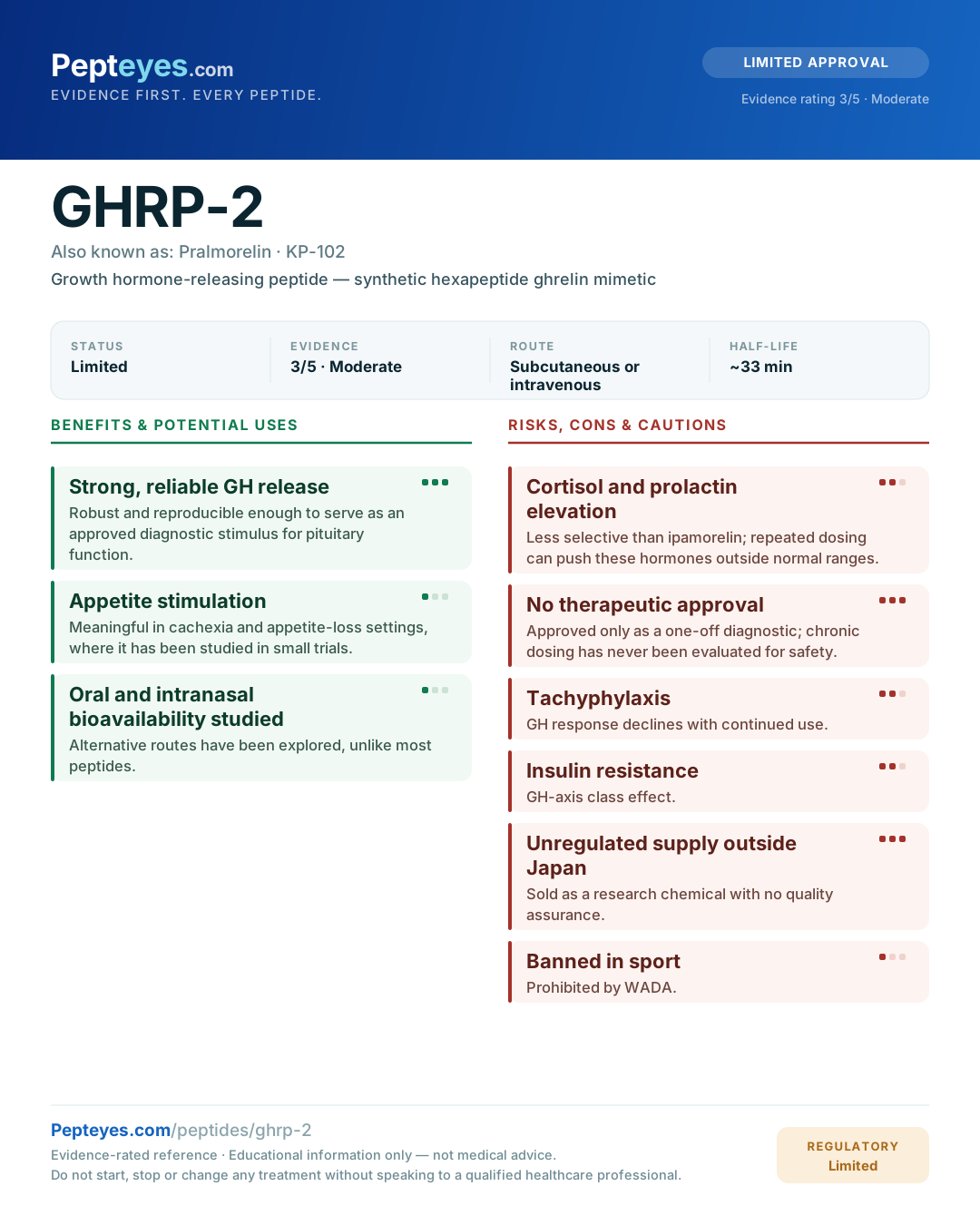
Strong, reliable GH release
Robust and reproducible enough to serve as an approved diagnostic stimulus for pituitary function.
Evidence: Strong evidence -
Appetite stimulation
Meaningful in cachexia and appetite-loss settings, where it has been studied in small trials.
Evidence: Preliminary -
Oral and intranasal bioavailability studied
Alternative routes have been explored, unlike most peptides.
Evidence: Preliminary
Risks and cautions
6 entries · 2 serious or common
-
Cortisol and prolactin elevation
Less selective than ipamorelin; repeated dosing can push these hormones outside normal ranges.
Evidence: Moderate evidence -
No therapeutic approval
Approved only as a one-off diagnostic; chronic dosing has never been evaluated for safety.
Evidence: Serious -
Tachyphylaxis
GH response declines with continued use.
Evidence: Moderate evidence -
Insulin resistance
GH-axis class effect.
Evidence: Moderate evidence -
Unregulated supply outside Japan
Sold as a research chemical with no quality assurance.
Evidence: Serious -
Banned in sport
Prohibited by WADA.
Evidence: Minor
Counts are not a score. A single serious risk can outweigh several well-supported benefits, and a long benefit list built on preclinical work outweighs nothing at all.
Opinion — what people actually report
5 themes · 1 reported benefit · 3 reported problems
This is the weakest tier on this site. These are themes drawn from public discussion — forums, subreddits and patient threads — not from trials. There is no control group, no denominator, and no way to confirm that what someone injected matched its label. People post when a result is dramatic and when something goes wrong, and rarely when nothing happens, so treat everything below as a description of the conversation rather than of the compound. The bars count how often a thing is said, not how well it is supported.
-
Stronger pulse than ipamorelin Reported benefit. Dominant theme: Comes up in most discussions of this compound.
The standard comparison. People describe a more pronounced effect, and choose it when ipamorelin has felt like nothing.
-
Hunger, though less than GHRP-6 Reported problem. Dominant theme: Comes up in most discussions of this compound.
Positioned in discussion as the middle option — noticeably appetite-stimulating but manageable.
-
Cortisol and prolactin are the standing worry Reported problem. Dominant theme: Comes up in most discussions of this compound.
The most-raised concern, often with people reporting water retention, mood changes or, occasionally, breast tenderness they attribute to prolactin.
-
Flushing and tingling after injection Reported problem. Recurring: Raised regularly, though not by everyone.
Facial warmth and tingling in the minutes after injection are described as routine rather than troubling, and pass quickly.
-
Desensitisation with continuous use Practical note. Recurring: Raised regularly, though not by everyone.
A widely held belief that the response fades, driving cycling schedules that are forum convention rather than evidence.
Where the reports and the evidence part ways
The receptor pharmacology is real: GHRP-2 is a ghrelin receptor agonist, it does release growth hormone, and it does raise cortisol and prolactin more than ipamorelin — the community ranking of these compounds by "cleanliness" is broadly accurate. What is absent is any efficacy evidence in humans for the outcomes people want. It was studied as a diagnostic agent and abandoned as a therapeutic, so there are no trials of body composition, recovery or ageing to check the reports against. The elaborate cycling protocols are inference from receptor theory, not findings.
Cheat sheet
The full sheet, all 77 compounds →The community reference numbers for this compound — reconstitution, working dose, cycle and bloodwork. Research and education only, not medical advice, and not part of the evidence-rated monograph above. Doses assume a 1mL / 100-unit insulin syringe — the calculator does the units for you.
Protocol overview
Dosing & reconstitution 5 mg vial
| WEEK | DAILY DOSE | UNITS PER INJECTION |
|---|---|---|
| Weeks 1 to 2 | 100 mcg | 1 units (0.01 mL) |
| Weeks 3 to 4 | 150 mcg | 1.5 units (0.02 mL) |
| Weeks 5 to 8 | 200 mcg | 2 units (0.02 mL) |
| Weeks 9 to 12 | 200 mcg | 2 units (0.02 mL) |
| Weeks 13 to 16 | 200 mcg | 2 units (0.02 mL) |
Frequency: Inject once daily subcutaneously. This once-daily schedule balances efficacy with receptor recovery time, avoiding the rapid attenuation seen with frequent dosing. Administering in the evening may capitalize on nocturnal GH rhythms. For 10 unit (0.10 mL) or smaller administrations, consider 30- or 50-unit insulin syringes for improved readability.
On the master sheet
- Vial
- 5mg
- BAC
- 2mL
- Dose
- 100–300mcg 1–3x daily
- Route
- SubQ
- Cycle
- 6–12 wks
- Time Off
- 3–4 wks
- Bloodwork
- IGF-1, prolactin, cortisol
Side-effect family — GH Secretagogues (CJC, Ipa, GHRP): Water retention and bloat · Carpal tunnel or tingling hands · Increased hunger (GHRP-6) · Drowsiness. What helps, and the red flags →
Readers on GHRP-2
Questions and answers from readers, under generated names. Nothing here has been checked or reviewed by the site and none of it is medical advice. It is the least verified thing on this page — and it is here because people ask each other these things anyway, and most of the other places they can ask are run by sellers.
0 questions · 0 answers
No questions yet. Ask the first one above — it takes one box and an email address.
How names work, and the house rules
Names. Every verified address is given one generated name — two ordinary words — and keeps it. Nobody chooses a name and nobody can take another's. Posts marked desk were written by the site's own editorial desk, usually to open a thread; they carry a generated name like everyone else's and are held to the site's rules, which means they never state an amount.
What is not allowed. Selling, sourcing, vendor names, coupon codes and "message me" — posts that read that way are held and usually removed. Personal medical details you would not want public. Abuse. Instructions framed as what someone else should do.
What this is not. A reader's report of what happened to them is a report, not a finding, and an answer here is one person's view. Nothing in this section changes the evidence rating above it. If something you read here would change what you take, take it to a pharmacist or physician first.
Your data. Delete any post of yours at any time, or remove everything you have written together with your name. Details in the privacy notice.
Who should avoid it
- Active malignancy
- Pregnancy
- Hyperprolactinemia
- Cushing syndrome or adrenal disorder
If used under medical supervision, monitor
- IGF-1, prolactin, morning cortisol
- Fasting glucose
Regulatory & legal status
Diagnostic approval in Japan only. Not lawful for therapeutic sale in the US.
Infographic
Where to read further
We link to live literature searches rather than a frozen citation list, so you always see current results — including anything published after our last review.
- PubMed — all published literature on GHRP-2
- PubMed — randomized controlled trials only
- ClinicalTrials.gov — registered human trials
Related peptides in Growth Hormone Axis
Terms used on this page
- Growth Hormone Secretagogue (GHS)
- A growth hormone secretagogue is any compound that stimulates endogenous GH release, a class spanning GHRH analogues and ghrelin-mimetic agents acting at the GHS receptor.
- Growth Hormone Secretagogue Receptor (GHS-R1a)
- GHS-R1a is the G protein-coupled ghrelin receptor mediating growth hormone release and appetite, notable for unusually high constitutive activity in the complete absence of any ligand.
- Potency vs Efficacy
- Potency is the concentration a drug needs to produce a given effect, while efficacy is the largest effect it can produce at any concentration; the two are independent properties.
- Prolactin
- Prolactin is a 199-amino-acid anterior pituitary hormone held under tonic dopamine inhibition, central to lactation and the marker of prolactinomas and drug-induced hyperprolactinaemia.
- Cortisol
- Cortisol is the principal human glucocorticoid, secreted by the adrenal cortex under ACTH control on a pronounced daily rhythm and carried in plasma largely bound to corticosteroid-binding globulin.
- Agonist
- An agonist is a ligand that binds a receptor and stabilises its active conformation, producing a biological response rather than merely occupying the binding site.
This page is educational information, not medical advice. It cannot account for your medical history, medications, or risk factors. Do not start, stop or change any treatment based on it. Speak to a qualified healthcare professional who knows your case.