Supplied as a lyophilised powder to reconstitute
Metabolic & Weight
At a glance
Ten answers, each one line. Open any row for the detail behind it.
What it does An emergency drug rather than a therapy.
An emergency drug rather than a therapy. Glucagon exists to reverse severe hypoglycaemia when someone cannot safely swallow, and its modern formulations were redesigned around a usability problem: the original kit required a panicking bystander to mix a vial correctly. It also appears on this site for a second reason — the glucagon receptor is one of the targets that dual and triple agonists like retatrutide are built to hit.
Half-life 8–18 minutes — Documented
8–18 minutes
Typical studied dose Set on the approved label, which states the starting dose, how it is… — On the label
Set on the approved label, which states the starting dose, how it is increased and the maximum. Read it there rather than anywhere else — including here.
How often it is used Set on the approved label. The interval follows the half-life above… — On the label
Set on the approved label. The interval follows the half-life above, which is why some of these are weekly and others daily.
How it is taken Subcutaneous or intramuscular injection, intranasal powder, or… — Documented
Subcutaneous or intramuscular injection, intranasal powder, or intravenous in hospital
Main side effects Fails when hepatic glycogen is depleted · Nausea and vomiting are common · Contraindicated in phaeochromocytoma and insulinoma — Carries serious risk
Fails when hepatic glycogen is depleted — It cannot release glucose that is not stored. In prolonged fasting, advanced liver disease, adrenal insufficiency or alcohol-related hypoglycaemia, glucagon may not work — and that failure is exactly when the situation is most dangerous.
Nausea and vomiting are common — Frequent after emergency doses, and a genuine aspiration risk in someone who is drowsy or unconscious. Recovery position matters.
Contraindicated in phaeochromocytoma and insulinoma — Can provoke a hypertensive crisis in the first and paradoxical hypoglycaemia in the second.
Storage before mixing As a sealed lyophilised powder, refrigerated is typical and a freezer…
As a sealed lyophilised powder, refrigerated is typical and a freezer suits long storage; both should be dark and dry. A dry powder tolerates a few days out of the cold far better than anything in solution — which is why it ships that way.
Shelf life after mixing Once mixed it is refrigerated and treated as short-lived. Bacteriostatic…
Once mixed it is refrigerated and treated as short-lived. Bacteriostatic water contains a preservative and buys the longer window; sterile water contains none and buys a much shorter one. Peptides in solution also degrade on their own, so the container is only half the question.
Evidence level 5/5 · Very strong — Documented
Multiple phase 3 randomized trials plus regulatory approval in a major market.
Regulatory status FDA Approved — Documented
Approved since 1960. Ready-to-use autoinjectors and a nasal powder replaced the older reconstitute-from-powder emergency kits from 2019 onward, specifically because bystanders could not assemble the old kits under pressure. Prescription-only. Increasingly co-prescribed by default with insulin, and many guidelines now treat a missing glucagon prescription as a care gap.
Overview
An emergency drug rather than a therapy. Glucagon exists to reverse severe hypoglycaemia when someone cannot safely swallow, and its modern formulations were redesigned around a usability problem: the original kit required a panicking bystander to mix a vial correctly. It also appears on this site for a second reason — the glucagon receptor is one of the targets that dual and triple agonists like retatrutide are built to hit.
FDA ApprovedApproved since 1960. Ready-to-use autoinjectors and a nasal powder replaced the older reconstitute-from-powder emergency kits from 2019 onward, specifically because bystanders could not assemble the old kits under pressure.
| Regulatory status | Approved since 1960. Ready-to-use autoinjectors and a nasal powder replaced the older reconstitute-from-powder emergency kits from 2019 onward, specifically because bystanders could not assemble the old kits under pressure. |
|---|---|
| Drug class | Endogenous 29-residue single-chain peptide hormone secreted by pancreatic alpha cells; the physiological counter-regulator to insulin |
| Route | Subcutaneous or intramuscular injection, intranasal powder, or intravenous in hospital |
| Half-life | 8–18 minutes |
| Evidence rating |
5/5 Very strong
Evidence rating 5 out of 5: Very strong
Multiple phase 3 randomized trials plus regulatory approval in a major market. |
| Studied in | Randomized comparisons of nasal versus injected glucagon show equivalent glycaemic recovery with markedly better success rates when untrained people administer it. Usability studies in simulated emergencies are, unusually, the evidence that changed practice. |
Glucagon sequence & structure
Glucagon is a 29-residue linear peptide with a free C-terminal acid; molecular weight 3,482.75 Da.
| Three-letter | H-His-Ser-Gln-Gly-Thr-Phe-Thr-Ser-Asp-Tyr-Ser-Lys-Tyr-Leu-Asp-Ser-Arg-Arg-Ala-Gln-Asp-Phe-Val-Gln-Trp-Leu-Met-Asn-Thr-OH |
|---|---|
| Length | 29 amino acid residues |
| Modifications | None — an unmodified chain of standard L-amino acids |
| Molecular formula | C153H225N43O49S |
| Molecular weight | 3,482.75 Da (average, free base) |
| Identifiers | CAS 16941-32-5 · PubChem CID 16132283 · DrugBank DB00040 · UniProt P01275 |
| Which molecule | This record describes native human glucagon (proglucagon residues 53-81, identical in rat and pig), which is the active ingredient of GlucaGen, Gvoke and Baqsimi. Dasiglucagon (Zegalogue) is a separate 7-substitution analogue and is not covered here. |
| Sources | UniProt P01275 (Pro-glucagon, human) — peptide feature Glucagon 53-81KEGG DRUG D00116 — Glucagon (USP/INN): sequence, formula C153H225N43O49S, MW 3482.75PubChem CID 16132283 (Glucagon)DailyMed — GlucaGen (glucagon rDNA origin) for injection labelNovoPro Labs — Glucagon (1-29) (human, rat, porcine) |
Unmodified 29-residue linear peptide with free N-terminus and free C-terminal acid; UniProt (proglucagon 53-81) and KEGG D00116 give the identical sequence, and the formula/MW match PubChem (3482.7), KEGG (3482.75) and the GlucaGen label (3483). Two CAS numbers are in use: 16941-32-5 is the peptide entry listed by PubChem, while KEGG/USP carry the older 9007-92-5 (both check digits valid). Approved products (GlucaGen, Gvoke, Baqsimi) are recombinant (E. coli or yeast) or synthetic human glucagon and may be supplied as the hydrochloride or lyophilised free peptide.
Record confidence: high — two independent authoritative sources agree on the sequence and modifications. Every sequence on the site is listed with its sources on the peptide sequences index.
How it works
Binds the hepatic glucagon receptor, a Gs-coupled GPCR. Rising cAMP activates protein kinase A, which drives glycogen phosphorylase and suppresses glycogen synthase, releasing stored hepatic glucose within minutes. It also relaxes gastrointestinal smooth muscle, which is why radiology uses it.
Evidence base
Rated 5 of 5 — Very strong. Multiple phase 3 randomized trials plus regulatory approval in a major market.
- The efficacy question was settled decades ago. The evidence that changed outcomes was human-factors research showing that the old kits failed at the moment of use.
- Dasiglucagon is a stable analogue in ready-to-use solution rather than a new mechanism.
- Glucagon receptor agonism is a deliberate component of several investigational multi-agonists on this site, where partial activation raises energy expenditure — a very different goal from emergency rescue.
Benefits and risks, weighed against the evidence
Every entry below carries the strength of the evidence behind it — three bars for strong human data, two for moderate, one for preliminary or preclinical work. The two columns are not equal by design: where a compound has more documented risk than demonstrated benefit, the lists say so.
Reported benefits
4 entries · 3 on strong human evidence
-
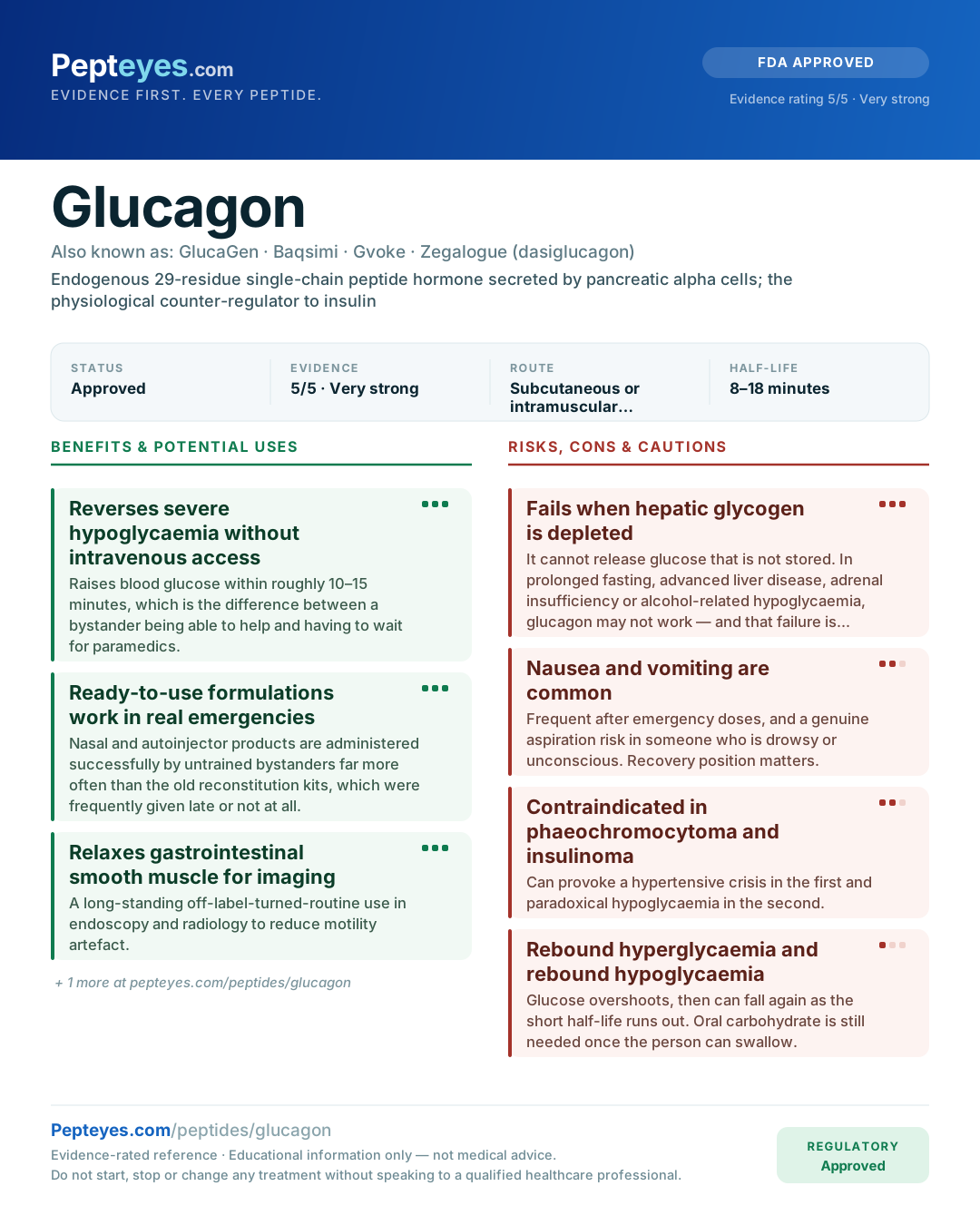
Reverses severe hypoglycaemia without intravenous access
Raises blood glucose within roughly 10–15 minutes, which is the difference between a bystander being able to help and having to wait for paramedics.
Evidence: Strong evidence -
Ready-to-use formulations work in real emergencies
Nasal and autoinjector products are administered successfully by untrained bystanders far more often than the old reconstitution kits, which were frequently given late or not at all.
Evidence: Strong evidence -
Relaxes gastrointestinal smooth muscle for imaging
A long-standing off-label-turned-routine use in endoscopy and radiology to reduce motility artefact.
Evidence: Strong evidence -
Used as an antidote in beta-blocker overdose
Bypasses beta-receptor blockade to restore cardiac contractility. Evidence is case-series rather than randomized, but the mechanism is sound and the alternative is poor.
Evidence: Moderate evidence
Risks and cautions
4 entries · 1 serious or common
-
Fails when hepatic glycogen is depleted
It cannot release glucose that is not stored. In prolonged fasting, advanced liver disease, adrenal insufficiency or alcohol-related hypoglycaemia, glucagon may not work — and that failure is exactly when the situation is most dangerous.
Evidence: Serious -
Nausea and vomiting are common
Frequent after emergency doses, and a genuine aspiration risk in someone who is drowsy or unconscious. Recovery position matters.
Evidence: Moderate evidence -
Contraindicated in phaeochromocytoma and insulinoma
Can provoke a hypertensive crisis in the first and paradoxical hypoglycaemia in the second.
Evidence: Moderate evidence -
Rebound hyperglycaemia and rebound hypoglycaemia
Glucose overshoots, then can fall again as the short half-life runs out. Oral carbohydrate is still needed once the person can swallow.
Evidence: Minor
Counts are not a score. A single serious risk can outweigh several well-supported benefits, and a long benefit list built on preclinical work outweighs nothing at all.
Opinion — what people actually report
5 themes · 1 reported benefit · 2 reported problems
This is the weakest tier on this site. These are themes drawn from public discussion — forums, subreddits and patient threads — not from trials. There is no control group, no denominator, and no way to confirm that what someone injected matched its label. People post when a result is dramatic and when something goes wrong, and rarely when nothing happens, so treat everything below as a description of the conversation rather than of the compound. The bars count how often a thing is said, not how well it is supported.
-
The old kits were the problem, and everyone says so Practical note. Dominant theme: Comes up in most discussions of this compound.
A striking consensus among people with diabetes and their families: the red-case reconstitution kits were too complicated to use in a real emergency, and many report expired ones sitting unused for years.
-
Nasal and autoinjector forms changed the calculus Reported benefit. Dominant theme: Comes up in most discussions of this compound.
Widely credited with making it realistic that a spouse, teacher or colleague could actually administer it.
-
Vomiting afterwards is expected Reported problem. Dominant theme: Comes up in most discussions of this compound.
Reported consistently by anyone who has needed it, and framed as the price of the rescue rather than a complaint.
-
Training the people around you matters more than the device Practical note. Dominant theme: Comes up in most discussions of this compound.
A dominant practical theme — the drug is used by someone else on your behalf, so who knows where it is and how to use it is the real variable.
-
Cost and expiry Reported problem. Recurring: Raised regularly, though not by everyone.
Frustration at replacing an expensive product that is usually never used.
Where the reports and the evidence part ways
This is the rare case where community experience drove a change in the products themselves. Human-factors studies confirmed what patients had been saying — untrained bystanders frequently failed to assemble and administer the old kits correctly under pressure — and that evidence, not a new mechanism, produced the nasal and ready-to-use formulations. The one thing worth adding to the community account is the limitation it rarely mentions: glucagon cannot release glucose that is not stored, so in prolonged fasting, alcohol-related hypoglycaemia or advanced liver disease it may simply not work, which is precisely when the situation is most dangerous.
Readers on Glucagon
Questions and answers from readers, under generated names. Nothing here has been checked or reviewed by the site and none of it is medical advice. It is the least verified thing on this page — and it is here because people ask each other these things anyway, and most of the other places they can ask are run by sellers.
0 questions · 0 answers
No questions yet. Ask the first one above — it takes one box and an email address.
How names work, and the house rules
Names. Every verified address is given one generated name — two ordinary words — and keeps it. Nobody chooses a name and nobody can take another's. Posts marked desk were written by the site's own editorial desk, usually to open a thread; they carry a generated name like everyone else's and are held to the site's rules, which means they never state an amount.
What is not allowed. Selling, sourcing, vendor names, coupon codes and "message me" — posts that read that way are held and usually removed. Personal medical details you would not want public. Abuse. Instructions framed as what someone else should do.
What this is not. A reader's report of what happened to them is a report, not a finding, and an answer here is one person's view. Nothing in this section changes the evidence rating above it. If something you read here would change what you take, take it to a pharmacist or physician first.
Your data. Delete any post of yours at any time, or remove everything you have written together with your name. Details in the privacy notice.
Who should avoid it
- Phaeochromocytoma
- Insulinoma
- Known hypersensitivity
- Reliance on it as the sole plan where glycogen stores are likely depleted
If used under medical supervision, monitor
- Recheck blood glucose 15 minutes after administration
- Give oral carbohydrate as soon as swallowing is safe
- Emergency services should be called regardless of apparent recovery
Regulatory & legal status
Prescription-only. Increasingly co-prescribed by default with insulin, and many guidelines now treat a missing glucagon prescription as a care gap.
Infographic
Where to read further
We link to live literature searches rather than a frozen citation list, so you always see current results — including anything published after our last review.
- PubMed — all published literature on Glucagon
- PubMed — randomized controlled trials only
- ClinicalTrials.gov — registered human trials
- DailyMed — official FDA prescribing information
Related peptides in Metabolic & Weight
Terms used on this page
- Hypoglycaemia
- Hypoglycaemia is a plasma glucose concentration low enough to risk harm, graded in three consensus levels ending in severe events that require another person's assistance.
- Glucagon
- Glucagon is a 29-amino-acid pancreatic alpha-cell hormone that raises blood glucose by driving hepatic glycogenolysis and gluconeogenesis, and also increases energy expenditure.
- Agonist
- An agonist is a ligand that binds a receptor and stabilises its active conformation, producing a biological response rather than merely occupying the binding site.
- G Protein-Coupled Receptor (GPCR)
- A G protein-coupled receptor is a seven-transmembrane cell-surface protein that converts ligand binding into intracellular signalling by activating heterotrimeric G proteins and arrestins.
- Peptide Analog
- A peptide analog is a molecule built from a native peptide sequence with deliberate substitutions or chemical modifications intended to change its stability, duration or receptor profile.
- Resting Energy Expenditure (REE)
- Resting energy expenditure is the energy a body uses at rest in a fasted, thermoneutral state, and it accounts for most of daily total energy expenditure.
This page is educational information, not medical advice. It cannot account for your medical history, medications, or risk factors. Do not start, stop or change any treatment based on it. Speak to a qualified healthcare professional who knows your case.