Supplied ready in solution
Hormonal & Reproductive
At a glance
Ten answers, each one line. Open any row for the detail behind it.
What it does Octreotide’s closest competitor, and the differences are pharmaceutical rather than…
Octreotide’s closest competitor, and the differences are pharmaceutical rather than pharmacological. Both hit the same receptors; lanreotide’s distinction is a gel depot that needs no reconstitution and injects into subcutaneous tissue rather than deep muscle, which is why it is the one most often self-administered or given by a partner at home. On efficacy the two are close enough that guidelines treat them as interchangeable.
Half-life Around 23–30 days from the gel depot — Documented
Around 23–30 days from the gel depot
Typical studied dose Set on the approved label, which states the starting dose, how it is… — On the label
Set on the approved label, which states the starting dose, how it is increased and the maximum. Read it there rather than anywhere else — including here.
How often it is used Set on the approved label. The interval follows the half-life above… — On the label
Set on the approved label. The interval follows the half-life above, which is why some of these are weekly and others daily.
How it is taken Deep subcutaneous injection every 4 weeks; intervals of 6–8 weeks are… — Documented
Deep subcutaneous injection every 4 weeks; intervals of 6–8 weeks are used in well-controlled patients
Main side effects Gallstones and biliary sludge · Glucose dysregulation · Injection site reactions and nodules — Carries serious risk
Gallstones and biliary sludge — The same class effect as octreotide, developing in a substantial proportion on long-term therapy. Usually asymptomatic, occasionally requiring surgery.
Glucose dysregulation — Suppression of both insulin and glucagon moves glucose unpredictably; hyperglycaemia is more commonly reported than hypoglycaemia.
Injection site reactions and nodules — More prominent than with intramuscular depots because the drug sits in subcutaneous tissue. Site rotation and correct deep technique matter.
Storage before mixing Supplied already in solution and kept refrigerated, not frozen. Freezing…
Supplied already in solution and kept refrigerated, not frozen. Freezing a protein solution can aggregate it, which is not always visible.
Shelf life after mixing Nothing to mix — it is not supplied as a powder. The relevant date is…
Nothing to mix — it is not supplied as a powder. The relevant date is the one printed on the product.
Evidence level 5/5 · Very strong — Documented
Multiple phase 3 randomized trials plus regulatory approval in a major market.
Regulatory status FDA Approved — Documented
FDA-approved 2007 for acromegaly, 2014 for gastroenteropancreatic neuroendocrine tumours, and 2017 for carcinoid syndrome. The first generic entered the US market in 2021. Prescription-only. A US generic has been available since 2021, though supply has been intermittent.
Overview
Octreotide’s closest competitor, and the differences are pharmaceutical rather than pharmacological. Both hit the same receptors; lanreotide’s distinction is a gel depot that needs no reconstitution and injects into subcutaneous tissue rather than deep muscle, which is why it is the one most often self-administered or given by a partner at home. On efficacy the two are close enough that guidelines treat them as interchangeable.
FDA ApprovedFDA-approved 2007 for acromegaly, 2014 for gastroenteropancreatic neuroendocrine tumours, and 2017 for carcinoid syndrome. The first generic entered the US market in 2021.
| Regulatory status | FDA-approved 2007 for acromegaly, 2014 for gastroenteropancreatic neuroendocrine tumours, and 2017 for carcinoid syndrome. The first generic entered the US market in 2021. |
|---|---|
| Drug class | Synthetic cyclic octapeptide somatostatin analogue, disulfide-bridged and D-amino acid substituted; formulated as a supersaturated aqueous gel that self-assembles into a depot without a polymer carrier |
| Route | Deep subcutaneous injection every 4 weeks; intervals of 6–8 weeks are used in well-controlled patients |
| Half-life | Around 23–30 days from the gel depot |
| Evidence rating |
5/5 Very strong
Evidence rating 5 out of 5: Very strong
Multiple phase 3 randomized trials plus regulatory approval in a major market. |
| Studied in | CLARINET randomized 204 patients with non-functioning enteropancreatic neuroendocrine tumours and showed progression-free survival not reached at 24 months against 18 months on placebo. Acromegaly trials show biochemical control comparable to octreotide LAR, with extended dosing intervals feasible in responders. |
Lanreotide sequence & structure
Lanreotide is a 8-residue cyclic peptide with a C-terminal amide, carrying D-amino acid substitutions, non-standard residues; molecular weight 1,096.34 Da.
lowercase = D-amino acid[bracketed] = non-standard residue
| Three-letter | H-D-2Nal-Cys-Tyr-D-Trp-Lys-Val-Cys-Thr-NH2 |
|---|---|
| Length | 8 amino acid residues |
| Modifications |
|
| Molecular formula | C54H69N11O10S2 |
| Molecular weight | 1,096.34 Da (average, free base) |
| SMILES | CC(C)[C@@H]1NC(=O)[C@H](CCCCN)NC(=O)[C@@H](Cc2c[nH]c3ccccc23)NC(=O)[C@H](Cc2ccc(O)cc2)NC(=O)[C@@H](NC(=O)[C@H](N)Cc2ccc3ccccc3c2)CSSC[C@@H](C(=O)N[C@H](C(N)=O)[C@@H](C)O)NC1=O |
| Identifiers | CAS 108736-35-2 · PubChem CID 6918011 · DrugBank DB06791 |
| Sources | FDA label – Somatuline Depot (lanreotide) injection, section 11 Description (NDA 022074, 2019; same text as the DailyMed SPL)PubChem CID 6918011 (lanreotide, fully stereo-defined record)ChEMBL CHEMBL1201185 (lanreotide; HELM PEPTIDE1{[dNal].C.Y.[dW].K.V.C.T.[am]} with 2:7 disulfide)ChEBI CHEBI:135901 (lanreotide)KEGG DRUG D04666 (lanreotide acetate, JAN/USAN) |
Marketed as the acetate salt (Somatuline Depot / Autogel; lanreotide acetate CAS 127984-74-1 per KEGG and PubChem, formula C54H69N11O10S2·x C2H4O2 with x = 1.0–2.0). Formula and MW here are for the free base: FDA label 1096.34, ChEBI 1096.347, ChEMBL 1096.35. PubChem also holds a stereo-undefined duplicate record CID 71349 (the one DrugBank deposits); DrugBank DB06791 is confirmed via the PubChem and Wikipedia cross-references because go.drugbank.com refused direct access (403).
Record confidence: high — two independent authoritative sources agree on the sequence and modifications. Every sequence on the site is listed with its sources on the peptide sequences index.
How it works
Agonist at somatostatin receptors 2 and 5, with the same downstream suppression of growth hormone, gastrointestinal and pancreatic hormone secretion as octreotide. The supersaturated gel forms its own depot on injection, giving sustained release across a month without a polymer matrix.
Evidence base
Rated 5 of 5 — Very strong. Multiple phase 3 randomized trials plus regulatory approval in a major market.
- CLARINET is the cleanest antiproliferative evidence for a somatostatin analogue because it enrolled non-functioning tumours.
- Choice between lanreotide and octreotide is generally driven by administration route, patient preference and cost rather than by a demonstrated efficacy difference.
- As with octreotide, response depends on somatostatin receptor expression, and receptor imaging predicts who will benefit.
Benefits and risks, weighed against the evidence
Every entry below carries the strength of the evidence behind it — three bars for strong human data, two for moderate, one for preliminary or preclinical work. The two columns are not equal by design: where a compound has more documented risk than demonstrated benefit, the lists say so.
Reported benefits
5 entries · 3 on strong human evidence
-
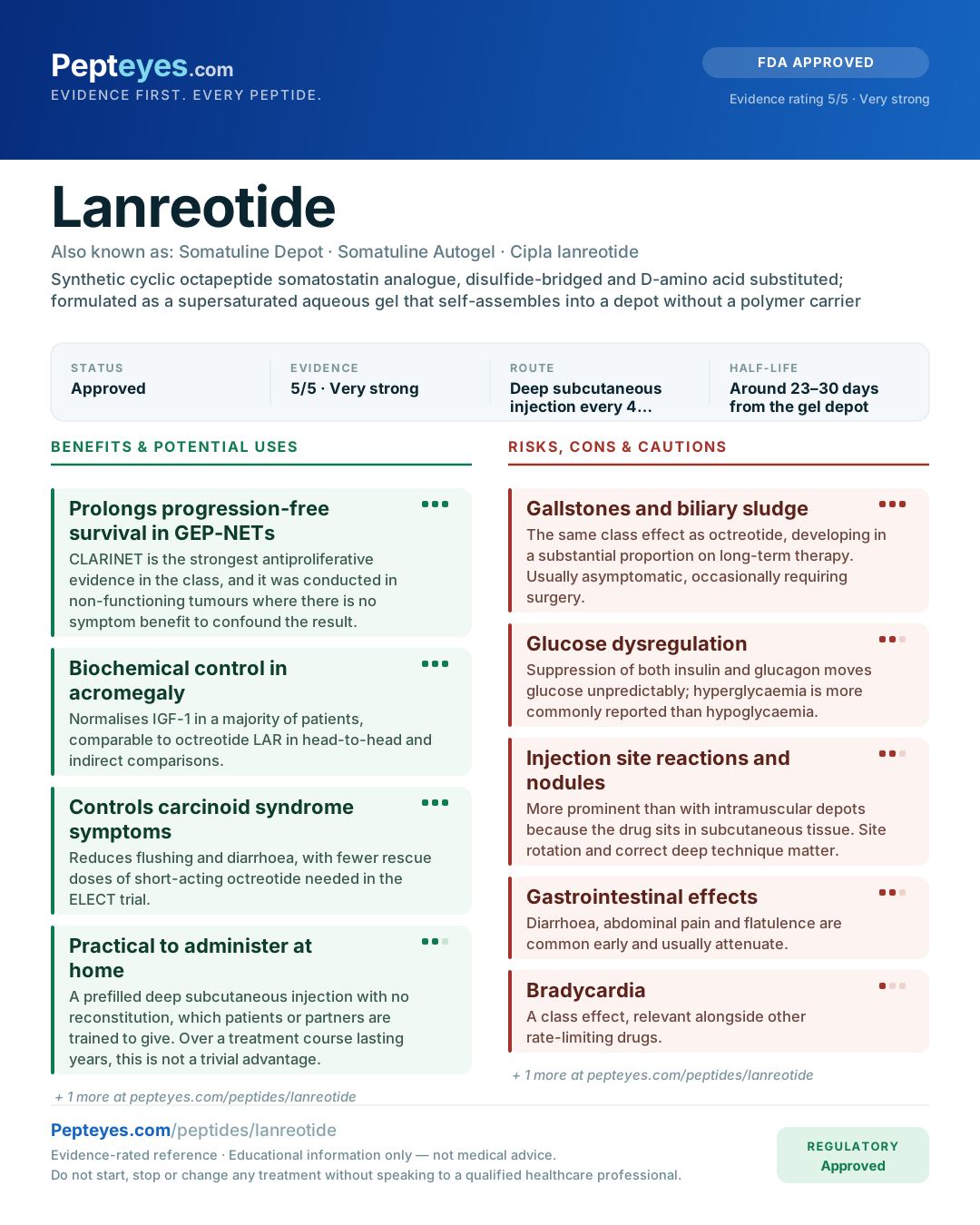
Prolongs progression-free survival in GEP-NETs
CLARINET is the strongest antiproliferative evidence in the class, and it was conducted in non-functioning tumours where there is no symptom benefit to confound the result.
Evidence: Strong evidence -
Biochemical control in acromegaly
Normalises IGF-1 in a majority of patients, comparable to octreotide LAR in head-to-head and indirect comparisons.
Evidence: Strong evidence -
Controls carcinoid syndrome symptoms
Reduces flushing and diarrhoea, with fewer rescue doses of short-acting octreotide needed in the ELECT trial.
Evidence: Strong evidence -
Practical to administer at home
A prefilled deep subcutaneous injection with no reconstitution, which patients or partners are trained to give. Over a treatment course lasting years, this is not a trivial advantage.
Evidence: Moderate evidence -
Dosing interval can be extended in responders
Well-controlled patients are often maintained at 6 or 8 weeks rather than 4, reducing burden and cost.
Evidence: Moderate evidence
Risks and cautions
6 entries · 1 serious or common
-
Gallstones and biliary sludge
The same class effect as octreotide, developing in a substantial proportion on long-term therapy. Usually asymptomatic, occasionally requiring surgery.
Evidence: Serious -
Glucose dysregulation
Suppression of both insulin and glucagon moves glucose unpredictably; hyperglycaemia is more commonly reported than hypoglycaemia.
Evidence: Moderate evidence -
Injection site reactions and nodules
More prominent than with intramuscular depots because the drug sits in subcutaneous tissue. Site rotation and correct deep technique matter.
Evidence: Moderate evidence -
Gastrointestinal effects
Diarrhoea, abdominal pain and flatulence are common early and usually attenuate.
Evidence: Moderate evidence -
Bradycardia
A class effect, relevant alongside other rate-limiting drugs.
Evidence: Minor -
Cholelithiasis risk accumulates with duration
The longer the course, the higher the prevalence, which matters in NET patients treated for many years.
Evidence: Moderate evidence
Counts are not a score. A single serious risk can outweigh several well-supported benefits, and a long benefit list built on preclinical work outweighs nothing at all.
Opinion — what people actually report
6 themes · 2 reported benefits · 3 reported problems
This is the weakest tier on this site. These are themes drawn from public discussion — forums, subreddits and patient threads — not from trials. There is no control group, no denominator, and no way to confirm that what someone injected matched its label. People post when a result is dramatic and when something goes wrong, and rarely when nothing happens, so treat everything below as a description of the conversation rather than of the compound. The bars count how often a thing is said, not how well it is supported.
-
Deep subcutaneous injection preferred to intramuscular Reported benefit. Dominant theme: Comes up in most discussions of this compound.
The most consistent comparison with octreotide, and the reason many patients ask to switch.
-
Home administration is a major quality-of-life factor Reported benefit. Dominant theme: Comes up in most discussions of this compound.
Patients or partners trained to give it describe avoiding monthly clinic visits as the biggest practical benefit over years of treatment.
-
Gallstones, as with the whole class Reported problem. Dominant theme: Comes up in most discussions of this compound.
Expected, monitored, and a common reason for eventual cholecystectomy.
-
Injection technique matters and lumps form Reported problem. Recurring: Raised regularly, though not by everyone.
Nodules and site reactions are reported more than with intramuscular depots, and correct deep technique is discussed carefully.
-
Extended intervals in stable patients Practical note. Recurring: Raised regularly, though not by everyone.
Moving from four-weekly to six- or eight-weekly is widely discussed as a goal.
-
Supply interruptions Reported problem. Recurring: Raised regularly, though not by everyone.
Both the branded and generic products have had availability problems, which patients report as genuinely alarming.
Where the reports and the evidence part ways
The administration advantages patients describe are real and are the main reason to choose this over octreotide; there is no evidence that either is more effective, and guidelines treat them as interchangeable. Where community discussion is thinner than the evidence is on CLARINET, which showed lanreotide slows tumour progression in non-functioning enteropancreatic tumours — patients without hormonal symptoms sometimes struggle to understand why they are on a drug they cannot feel working, and that trial is the answer.
Readers on Lanreotide
Questions and answers from readers, under generated names. Nothing here has been checked or reviewed by the site and none of it is medical advice. It is the least verified thing on this page — and it is here because people ask each other these things anyway, and most of the other places they can ask are run by sellers.
0 questions · 0 answers
No questions yet. Ask the first one above — it takes one box and an email address.
How names work, and the house rules
Names. Every verified address is given one generated name — two ordinary words — and keeps it. Nobody chooses a name and nobody can take another's. Posts marked desk were written by the site's own editorial desk, usually to open a thread; they carry a generated name like everyone else's and are held to the site's rules, which means they never state an amount.
What is not allowed. Selling, sourcing, vendor names, coupon codes and "message me" — posts that read that way are held and usually removed. Personal medical details you would not want public. Abuse. Instructions framed as what someone else should do.
What this is not. A reader's report of what happened to them is a report, not a finding, and an answer here is one person's view. Nothing in this section changes the evidence rating above it. If something you read here would change what you take, take it to a pharmacist or physician first.
Your data. Delete any post of yours at any time, or remove everything you have written together with your name. Details in the privacy notice.
Who should avoid it
- Known hypersensitivity
- Caution in pre-existing gallbladder disease
- Caution in diabetes without a glucose monitoring plan
- Caution in bradycardia or conduction disease
If used under medical supervision, monitor
- Gallbladder ultrasound at baseline and periodically
- IGF-1 in acromegaly; chromogranin A and imaging in NETs
- Glucose and HbA1c
- Thyroid function on long-term therapy
- Injection sites at each administration
Regulatory & legal status
Prescription-only. A US generic has been available since 2021, though supply has been intermittent.
Infographic
Where to read further
We link to live literature searches rather than a frozen citation list, so you always see current results — including anything published after our last review.
- PubMed — all published literature on Lanreotide
- PubMed — randomized controlled trials only
- ClinicalTrials.gov — registered human trials
- DailyMed — official FDA prescribing information
Related peptides in Hormonal & Reproductive
Terms used on this page
- Reconstitution
- Reconstitution is the dissolving of a lyophilised solid into a specified liquid to produce an injectable solution, a step that fixes the resulting concentration and restarts the product's clock.
- Subcutaneous Injection (SC)
- Subcutaneous injection places a formulation into the fatty layer beneath the dermis, from which peptides reach the circulation through capillaries and lymphatics over minutes to hours.
- Depot Formulation
- A depot formulation is an injected or implanted reservoir engineered to release its drug slowly over weeks to months, making absorption rather than elimination the rate-limiting step.
- Growth Hormone (GH)
- Growth hormone is a 191-amino-acid pituitary protein secreted in pulses that acts directly on tissues and indirectly through hepatic IGF-1, and is approved for a defined list of indications.
- Somatostatin
- Somatostatin is a cyclic inhibitory peptide, circulating as 14- and 28-residue forms, that suppresses growth hormone release and broadly inhibits endocrine and exocrine secretion.
- Agonist
- An agonist is a ligand that binds a receptor and stabilises its active conformation, producing a biological response rather than merely occupying the binding site.
This page is educational information, not medical advice. It cannot account for your medical history, medications, or risk factors. Do not start, stop or change any treatment based on it. Speak to a qualified healthcare professional who knows your case.