Supplied ready in solution
Metabolic & Weight
At a glance
Ten answers, each one line. Open any row for the detail behind it.
What it does Built on the backbone of oxyntomodulin, a naturally occurring gut hormone that hits both…
Built on the backbone of oxyntomodulin, a naturally occurring gut hormone that hits both the GLP-1 and glucagon receptors. It is the first of the glucagon co-agonists to reach approval anywhere, in China, ahead of the Western programs.
Half-life Reported terminal half-life ~6–17 days after weekly… — Documented
Reported terminal half-life ~6–17 days after weekly subcutaneous dosing (one higher-dose study ran wider); fatty-acid acylation drives albumin binding.
Typical studied dose Set by the label of the regulator that approved it, which is not an FDA… — On the label
Set by the label of the regulator that approved it, which is not an FDA label and may not be in English. The approving country decides the dose, and it is not always the same as the dose studied elsewhere.
How often it is used The label schedule is once weekly. Dosing intervals follow the half-life… — On the label
The label schedule is once weekly. Dosing intervals follow the half-life above, and the prescribing information is what sets them.
How it is taken Subcutaneous, once weekly — Documented
Subcutaneous, once weekly
Main side effects Grey-market import · No FDA or EMA approval · Trial populations may not generalise — Carries serious risk
Grey-market import — Widely sold to Western buyers outside any lawful channel.
No FDA or EMA approval — Approval is limited to China. Western regulators have not reviewed the dossier.
Trial populations may not generalise — The phase 3 program was conducted largely in Chinese participants, who differ in baseline BMI and metabolic phenotype from Western obesity populations.
Storage before mixing Supplied already in solution and kept refrigerated, not frozen. Freezing…
Supplied already in solution and kept refrigerated, not frozen. Freezing a protein solution can aggregate it, which is not always visible.
Shelf life after mixing Nothing to mix — it is not supplied as a powder. The relevant date is…
Nothing to mix — it is not supplied as a powder. The relevant date is the one printed on the product.
Evidence level 4/5 · Strong — Documented
Consistent human randomized trials, or approval outside the United States.
Regulatory status Limited Approval — Documented
Approved in China for weight management and type 2 diabetes. Not approved in the US, EU or UK. Prescription medicine in China. Unapproved elsewhere; import for personal use is legally constrained.
Overview
Built on the backbone of oxyntomodulin, a naturally occurring gut hormone that hits both the GLP-1 and glucagon receptors. It is the first of the glucagon co-agonists to reach approval anywhere, in China, ahead of the Western programs.
Limited or non-US approvalPrescription medicine in China. Unapproved elsewhere; import for personal use is legally constrained.
| Regulatory status | Approved in China for weight management and type 2 diabetes. Not approved in the US, EU or UK. |
|---|---|
| Drug class | Dual glucagon / GLP-1 receptor agonist based on oxyntomodulin |
| Route | Subcutaneous, once weekly |
| Half-life | Reported terminal half-life ~6–17 days after weekly subcutaneous dosing (one higher-dose study ran wider); fatty-acid acylation drives albumin binding. |
| Evidence rating |
4/5 Strong
Evidence rating 4 out of 5: Strong
Consistent human randomized trials, or approval outside the United States. |
| Studied in | GLORY and DREAMS phase 3 programs in Chinese populations for obesity and type 2 diabetes. |
Mazdutide sequence & structure
Mazdutide is a 34-residue linear peptide with a C-terminal amide, carrying a fatty-acid side chain, non-standard residues; molecular weight 4,563.14 Da.
* K: γGlu-2×OEG-C20 diacid
[bracketed] = non-standard residue* = side-chain modification
| Three-letter | H-His-Aib-Gln-Gly-Thr-Phe-Thr-Ser-Asp-Tyr-Ser-Lys-Tyr-Leu-Asp-Glu-Lys-Lys-Ala-Lys(γGlu-2×OEG-C20 diacid)-Glu-Phe-Val-Glu-Trp-Leu-Leu-Glu-Gly-Gly-Pro-Ser-Ser-Gly-NH2 |
|---|---|
| Length | 34 amino acid residues |
| Modifications |
|
| Molecular formula | C210H322N46O67 |
| Molecular weight | 4,563.14 Da (average, free base) |
| Identifiers | CAS 2259884-03-0 · PubChem CID 167312357 · DrugBank DB19099 · UniProt P01275 |
| Sources | WHO Proposed INN List 126 (WHO Drug Information Vol. 35 No. 4, 2021), mazdutidum, p. 1027 — full systematic name, C210H322N46O67, CAS 2259884-03-0IUPHAR/BPS Guide to PHARMACOLOGY, ligand 13924 (mazdutide) — sequence and cross-referencesChEMBL CHEMBL5095358 (mazdutide, biotherapeutic sequence HX1QGTFTSDYSKYLDEKKAX2EFVEWLLEGGPSSX3)PubChem CID 167312357 (mazdutide) — reports C207H317N45O65 / 4476 (see notes)Wikipedia: Mazdutide — corroborates formula C210H322N46O67, molar mass 4563.141, CAS, UNII MB76Z4IBZ5, DrugBank DB19099 |
Lipidated 34-residue glucagon/oxyntomodulin-family analog (dual GLP-1 and glucagon receptor agonist; codes IBI-362 and LY-3305677): Aib at position 2, a semaglutide-style albumin-binding side chain on Lys20 but with a C20 (eicosanedioic) rather than C18 diacid, and a C-terminal glycinamide. The WHO INN List 126 systematic name, ChEMBL CHEMBL5095358 and the Guide to PHARMACOLOGY sequence agree residue-for-residue on this 34-mer, and the INN formula C210H322N46O67 (MW 4563.14) is reproduced exactly by calculation from that sequence plus the side chain and amide. Caution: the PubChem depiction (CID 167312357, C207H317N45O65, 4476 Da) and the SMILES/InChI carried in the Guide to PHARMACOLOGY record are drawn with only one Ser before the C-terminal glycinamide (33 residues) and must not be used for formula or MW; vendor pages that copy PubChem inherit that error. UniProt P01275 is the proglucagon precursor of the parent hormone, not of mazdutide itself. The INN describes the free peptide with no salt form.
Record confidence: high — two independent authoritative sources agree on the sequence and modifications. Every sequence on the site is listed with its sources on the peptide sequences index.
How it works
Oxyntomodulin-derived dual agonism at the GLP-1 and glucagon receptors, reproducing an endogenous signalling pattern rather than engineering one from scratch. Appetite suppression plus increased energy expenditure and hepatic fat oxidation.
Evidence base
Rated 4 of 5 — Strong. Consistent human randomized trials, or approval outside the United States.
- Genuine phase 3 evidence and a real approval — but in one jurisdiction only.
Benefits and risks, weighed against the evidence
Every entry below carries the strength of the evidence behind it — three bars for strong human data, two for moderate, one for preliminary or preclinical work. The two columns are not equal by design: where a compound has more documented risk than demonstrated benefit, the lists say so.
Reported benefits
4 entries · 2 on strong human evidence
-
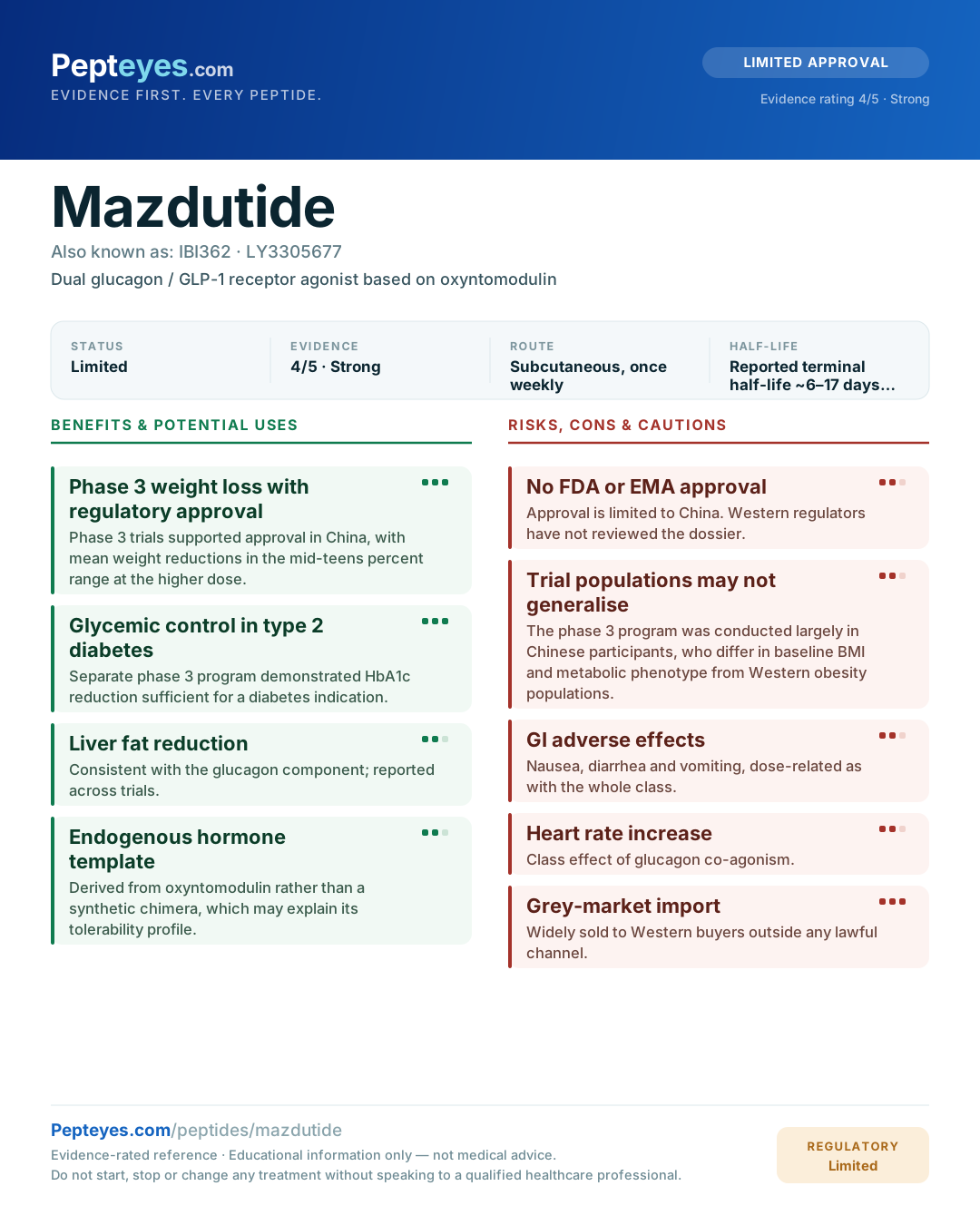
Phase 3 weight loss with regulatory approval
Phase 3 trials supported approval in China, with mean weight reductions in the mid-teens percent range at the higher dose.
Evidence: Strong evidence -
Glycemic control in type 2 diabetes
Separate phase 3 program demonstrated HbA1c reduction sufficient for a diabetes indication.
Evidence: Strong evidence -
Liver fat reduction
Consistent with the glucagon component; reported across trials.
Evidence: Moderate evidence -
Endogenous hormone template
Derived from oxyntomodulin rather than a synthetic chimera, which may explain its tolerability profile.
Evidence: Moderate evidence
Risks and cautions
5 entries · 1 serious or common
-
No FDA or EMA approval
Approval is limited to China. Western regulators have not reviewed the dossier.
Evidence: Moderate evidence -
Trial populations may not generalise
The phase 3 program was conducted largely in Chinese participants, who differ in baseline BMI and metabolic phenotype from Western obesity populations.
Evidence: Moderate evidence -
GI adverse effects
Nausea, diarrhea and vomiting, dose-related as with the whole class.
Evidence: Moderate evidence -
Heart rate increase
Class effect of glucagon co-agonism.
Evidence: Moderate evidence -
Grey-market import
Widely sold to Western buyers outside any lawful channel.
Evidence: Serious
Counts are not a score. A single serious risk can outweigh several well-supported benefits, and a long benefit list built on preclinical work outweighs nothing at all.
Opinion — what people actually report
4 themes · 1 reported benefit · 1 reported problem
This is the weakest tier on this site. These are themes drawn from public discussion — forums, subreddits and patient threads — not from trials. There is no control group, no denominator, and no way to confirm that what someone injected matched its label. People post when a result is dramatic and when something goes wrong, and rarely when nothing happens, so treat everything below as a description of the conversation rather than of the compound. The bars count how often a thing is said, not how well it is supported.
-
Discussion is mostly about the Chinese approval Practical note. Dominant theme: Comes up in most discussions of this compound.
Interest follows its regulatory progress in China rather than personal accounts, of which there are few outside that market.
-
Weight loss reported as comparable to tirzepatide Reported benefit. Recurring: Raised regularly, though not by everyone.
Claims circulate in comparison threads, generally sourced from trial data rather than user experience.
-
GI effects as expected for the class Reported problem. Recurring: Raised regularly, though not by everyone.
Nausea and diarrhoea reported in line with other incretin agents.
-
Grey-market supply is a growing topic Practical note. Recurring: Raised regularly, though not by everyone.
Increasing availability from research-chemical vendors is changing the shape of the discussion.
Where the reports and the evidence part ways
Mazdutide is a GLP-1 and glucagon dual agonist with real phase 3 data and an approval in China, which is more standing than most compounds in the grey market have. That is also the source of the confusion: an approval in one jurisdiction is being cited in forums as though it were a global one, and the material people are buying is not the approved product. Trial results and vial contents are separate questions, and the discussion routinely conflates them.
Readers on Mazdutide
Questions and answers from readers, under generated names. Nothing here has been checked or reviewed by the site and none of it is medical advice. It is the least verified thing on this page — and it is here because people ask each other these things anyway, and most of the other places they can ask are run by sellers.
0 questions · 0 answers
No questions yet. Ask the first one above — it takes one box and an email address.
How names work, and the house rules
Names. Every verified address is given one generated name — two ordinary words — and keeps it. Nobody chooses a name and nobody can take another's. Posts marked desk were written by the site's own editorial desk, usually to open a thread; they carry a generated name like everyone else's and are held to the site's rules, which means they never state an amount.
What is not allowed. Selling, sourcing, vendor names, coupon codes and "message me" — posts that read that way are held and usually removed. Personal medical details you would not want public. Abuse. Instructions framed as what someone else should do.
What this is not. A reader's report of what happened to them is a report, not a finding, and an answer here is one person's view. Nothing in this section changes the evidence rating above it. If something you read here would change what you take, take it to a pharmacist or physician first.
Your data. Delete any post of yours at any time, or remove everything you have written together with your name. Details in the privacy notice.
Who should avoid it
- Medullary thyroid carcinoma or MEN2 history
- Pregnancy
- Prior pancreatitis (relative)
If used under medical supervision, monitor
- HbA1c and weight
- Heart rate
- Hydration and renal function during GI illness
Interactions
Not exhaustive. Always have a pharmacist or physician review your full medication list — including supplements.
- Insulin and sulfonylureas — dose reduction usually required
- Oral drugs sensitive to gastric emptying rate
Regulatory & legal status
Prescription medicine in China. Unapproved elsewhere; import for personal use is legally constrained.
Infographic
Where to read further
We link to live literature searches rather than a frozen citation list, so you always see current results — including anything published after our last review.
- PubMed — all published literature on Mazdutide
- PubMed — randomized controlled trials only
- ClinicalTrials.gov — registered human trials
Related peptides in Metabolic & Weight
Terms used on this page
- Glucagon
- Glucagon is a 29-amino-acid pancreatic alpha-cell hormone that raises blood glucose by driving hepatic glycogenolysis and gluconeogenesis, and also increases energy expenditure.
- Glucagon-Like Peptide-1 (GLP-1)
- Glucagon-like peptide-1 is an incretin hormone released by intestinal L-cells after a meal that stimulates glucose-dependent insulin secretion and suppresses appetite.
- Satiety vs Satiation
- Satiation is the set of signals that ends a meal in progress, while satiety is the post-meal inhibition that determines how long it takes before eating begins again.
- Resting Energy Expenditure (REE)
- Resting energy expenditure is the energy a body uses at rest in a fasted, thermoneutral state, and it accounts for most of daily total energy expenditure.
- Agonist
- An agonist is a ligand that binds a receptor and stabilises its active conformation, producing a biological response rather than merely occupying the binding site.
- Phase 3 Trial
- A Phase 3 trial is the large confirmatory study, powered for a prespecified clinical endpoint, on which a marketing application and the resulting product label are built.
This page is educational information, not medical advice. It cannot account for your medical history, medications, or risk factors. Do not start, stop or change any treatment based on it. Speak to a qualified healthcare professional who knows your case.