Supplied as a lyophilised powder to reconstitute
Longevity & Mitochondrial
At a glance
Ten answers, each one line. Open any row for the detail behind it.
What it does Not a peptide, and not a failed drug candidate: NAD+ is a coenzyme every living cell makes…
Not a peptide, and not a failed drug candidate: NAD+ is a coenzyme every living cell makes and remakes for itself, sold in the same catalogues as peptides and marketed as energy, longevity and cellular repair in a bag. The underlying biochemistry is real and central to metabolism. The clinical record for putting it into a vein is one small open-label pharmacokinetic study, a retrospective clinic chart review, and no controlled trial of any marketed outcome. Almost everything cited in its favour was measured on oral precursors instead.
Half-life Not formally characterised in people. During a slow infusion… — Nothing established
Not formally characterised in people. During a slow infusion, plasma levels stayed flat for about two hours, implying rapid and near-complete clearance.
Typical studied dose None established. No dose has ever been set for a human being, because… — Nothing established
None established. No dose has ever been set for a human being, because the studies that would set one have not been done. Any figure circulating for this compound was chosen by somebody selling it or by somebody guessing.
How often it is used No schedule exists. Cycles and intervals quoted for this compound come… — Nothing established
No schedule exists. Cycles and intervals quoted for this compound come from forums rather than from any study, and they vary because nothing anchors them.
How it is taken Intravenous infusion in clinics; also sold for subcutaneous and… — Documented
Intravenous infusion in clinics; also sold for subcutaneous and intramuscular injection, and as oral, sublingual and nasal products.
Main side effects No controlled trial of anything it is sold for · Unapproved, grey-market and inconsistently made · A contaminated lot reached patients — Carries serious risk
No controlled trial of anything it is sold for — Energy, ageing, cognition, addiction recovery and chronic fatigue are all marketed uses, and none has been tested against placebo using infused NAD+. Reviews of the area conclude that randomised placebo-controlled trials of intravenous NAD+ are simply absent, and that the case rests on case series and uncontrolled report.
Unapproved, grey-market and inconsistently made — It is not an approved medicine anywhere, and the injectable material reaches people through compounding and wellness channels with no consistent standard of identity, purity or sterility. The federal recall record for compounded NAD+ injection runs back a decade and is dominated by failures of sterility assurance, with one batch also pulled as sub-potent.
A contaminated lot reached patients — In 2025 a compounded NAD+ injection was recalled at the most serious classification after three people developed low blood pressure, shaking and body aches from one lot; testing found bacterial endotoxin far above the permitted limit. The regulator's inspection described absent environmental monitoring and unvalidated aseptic practice.
Storage before mixing As a sealed lyophilised powder, refrigerated is typical and a freezer…
As a sealed lyophilised powder, refrigerated is typical and a freezer suits long storage; both should be dark and dry. A dry powder tolerates a few days out of the cold far better than anything in solution — which is why it ships that way.
Shelf life after mixing Once mixed it is refrigerated and treated as short-lived. Bacteriostatic…
Once mixed it is refrigerated and treated as short-lived. Bacteriostatic water contains a preservative and buys the longer window; sterile water contains none and buys a much shorter one. Peptides in solution also degrade on their own, so the container is only half the question.
Evidence level 2/5 · Limited — Nothing established
Preclinical work plus scattered human reports, uncontrolled use, or negative trials.
Regulatory status Not a Peptide — Nothing established
Not a peptide: a coenzyme present in every living cell. Not an approved drug anywhere. It sits in category 1 of the FDA's 503A compounding review — under evaluation, which is neither approval nor permission. No NAD+ product is an approved medicine in the United States or the European Union. In the FDA's 503A review of substances nominated for pharmacy compounding, nicotinamide adenine dinucleotide sits in category 1 — under evaluation, with no significant safety risk identified — which is a holding position rather than permission, and is not the same as appearing on the 503A bulks list itself. It is not on the 503B list that governs outsourcing facilities, and in January 2026 the FDA told one such facility that its NAD+ products were therefore unapproved new drugs. The oral precursors are regulated as foods, on separate and shifting rules.
Overview
Not a peptide, and not a failed drug candidate: NAD+ is a coenzyme every living cell makes and remakes for itself, sold in the same catalogues as peptides and marketed as energy, longevity and cellular repair in a bag. The underlying biochemistry is real and central to metabolism. The clinical record for putting it into a vein is one small open-label pharmacokinetic study, a retrospective clinic chart review, and no controlled trial of any marketed outcome. Almost everything cited in its favour was measured on oral precursors instead.
This is not a peptideIncluded because it is marketed alongside peptides, but is a different class of molecule. No NAD+ product is an approved medicine in the United States or the European Union. In the FDA's 503A review of substances nominated for pharmacy compounding, nicotinamide adenine dinucleotide sits in category 1 — under evaluation, with no significant safety risk identified — which is a holding position rather than permission, and is not the same as appearing on the 503A bulks list itself. It is not on the 503B list that governs outsourcing facilities, and in January 2026 the FDA told one such facility that its NAD+ products were therefore unapproved new drugs. The oral precursors are regulated as foods, on separate and shifting rules.
| Regulatory status | Not a peptide: a coenzyme present in every living cell. Not an approved drug anywhere. It sits in category 1 of the FDA's 503A compounding review — under evaluation, which is neither approval nor permission. |
|---|---|
| Drug class | Dinucleotide coenzyme, not a peptide — nicotinamide mononucleotide joined to adenosine monophosphate by a pyrophosphate bridge; a redox carrier and enzyme substrate in every living cell |
| Route | Intravenous infusion in clinics; also sold for subcutaneous and intramuscular injection, and as oral, sublingual and nasal products. |
| Half-life | Not formally characterised in people. During a slow infusion, plasma levels stayed flat for about two hours, implying rapid and near-complete clearance. |
| Evidence rating |
2/5 Limited
Evidence rating 2 out of 5: Limited
Preclinical work plus scattered human reports, uncontrolled use, or negative trials. |
| Studied in | An open-label study infused NAD+ into eleven men over six hours and tracked plasma and urine metabolites. A retrospective chart review compared intravenous NAD+ against intravenous nicotinamide riboside in a small clinic cohort, and a registered pilot compared both with saline. Everything else is precursor research. |
NAD+ (Nicotinamide Adenine Dinucleotide) sequence & structure
NAD+ (Nicotinamide Adenine Dinucleotide) is not a peptide. It has no amino-acid sequence; its formula and molecular weight (663.43 Da) are given for reference.
| Molecular formula | C21H27N7O14P2 |
|---|---|
| Molecular weight | 663.43 Da (average, free base) |
| SMILES | C1=CC(=C[N+](=C1)[C@H]2[C@@H]([C@@H]([C@H](O2)COP(=O)([O-])OP(=O)(O)OC[C@@H]3[C@H]([C@H]([C@@H](O3)N4C=NC5=C(N=CN=C54)N)O)O)O)O)C(=O)N |
| Identifiers | CAS 53-84-9 · PubChem CID 5892 |
| Which molecule | The formula, weight and CAS number here describe free NAD+ itself — the oxidised coenzyme as an inner salt, PubChem CID 5892, INN nadide, also catalogued as beta-NAD and coenzyme I. Three neighbours are frequently confused with it. The sodium salt (nadide sodium) is the form usually weighed out for solutions and is heavier than the figure given here, so a certificate of analysis may quote a larger mass for the same amount of coenzyme. NADH is the reduced form, a different molecule with two more hydrogens, sold as its disodium salt and the one actually used in the oral chronic-fatigue trials. NADP+ carries an extra phosphate and serves biosynthesis and antioxidant defence rather than energy metabolism. |
| Sources | PubChem CID 5892 (nadide, beta-NAD) — molecular formula, weight, CAS 53-84-9 and isomeric SMILESPubChem CID 439153 (NADH) — the reduced form, for contrastPubChem lookup of CAS 20111-18-6 — nadide sodium, the salt form supplied for solutions |
Figures describe the free oxidised coenzyme, not a salt, not the reduced form and not the phosphorylated one. The mass calculated from the formula agrees with the PubChem value to two decimal places.
Record confidence: high — two independent authoritative sources agree on the sequence and modifications. Every sequence on the site is listed with its sources on the peptide sequences index.
How it works
NAD+ is nicotinamide mononucleotide joined to adenosine monophosphate by a pyrophosphate bridge, and it works two ways. As a redox carrier it shuttles electrons through glycolysis, the citric acid cycle and oxidative phosphorylation, being recycled rather than used up. As a substrate it is destroyed: PARP enzymes consume it during DNA repair, sirtuins when they deacetylate, and the ectoenzyme CD38 cleaves it, each reaction releasing nicotinamide. Cells replace the loss mainly through the salvage pathway, in which NAMPT converts nicotinamide back to nicotinamide mononucleotide and NMNAT closes it to NAD+. That salvage step is what every product in this market is aimed at. Whether an infusion delivers the intact dinucleotide into cells is the unresolved question: work in human cells found that nucleotides such as NAD+ and NMN are degraded outside the cell and that only nicotinamide, nicotinic acid and the nucleosides cross readily.
Evidence base
Rated 2 of 5 — Limited. Preclinical work plus scattered human reports, uncontrolled use, or negative trials.
- The human record for injected NAD+ is one open-label infusion pharmacokinetic study in eleven men, a retrospective chart review in a single clinic, and a small registered pilot against saline whose results are not posted. No randomised trial has tested it against placebo for any marketed indication.
- The large randomised literature is on the oral precursors, and it separates cleanly into two claims. They raise blood NAD+ dependably. In trials with endpoints a person would notice — cognition and fatigue in long COVID, muscle mass and strength in older adults — they mostly do not beat placebo.
- A 2026 analysis across seven human cohorts found whole-blood NAD+ stable with age and unmoved by lifestyle, while still responding to supplementation. That undercuts both the premise that everyone is depleted and the use of the blood level as an ageing biomarker.
- The addiction and chronic-fatigue claims trace to mid-twentieth-century case series and to trials of a different molecule: the oral reduced form NADH, usually paired with coenzyme Q10. A registry search returns no randomised trial of infused NAD+ for either condition.
- Regulatory position on the precursors has moved recently and in the opposite direction to the usual story: the FDA reversed its exclusion of nicotinamide mononucleotide from the supplement definition in September 2025, having decided it was marketed as a supplement before the drug investigation that triggered the exclusion.
Benefits and risks, weighed against the evidence
Every entry below carries the strength of the evidence behind it — three bars for strong human data, two for moderate, one for preliminary or preclinical work. The two columns are not equal by design: where a compound has more documented risk than demonstrated benefit, the lists say so.
Reported benefits
4 entries · 1 on strong human evidence
-
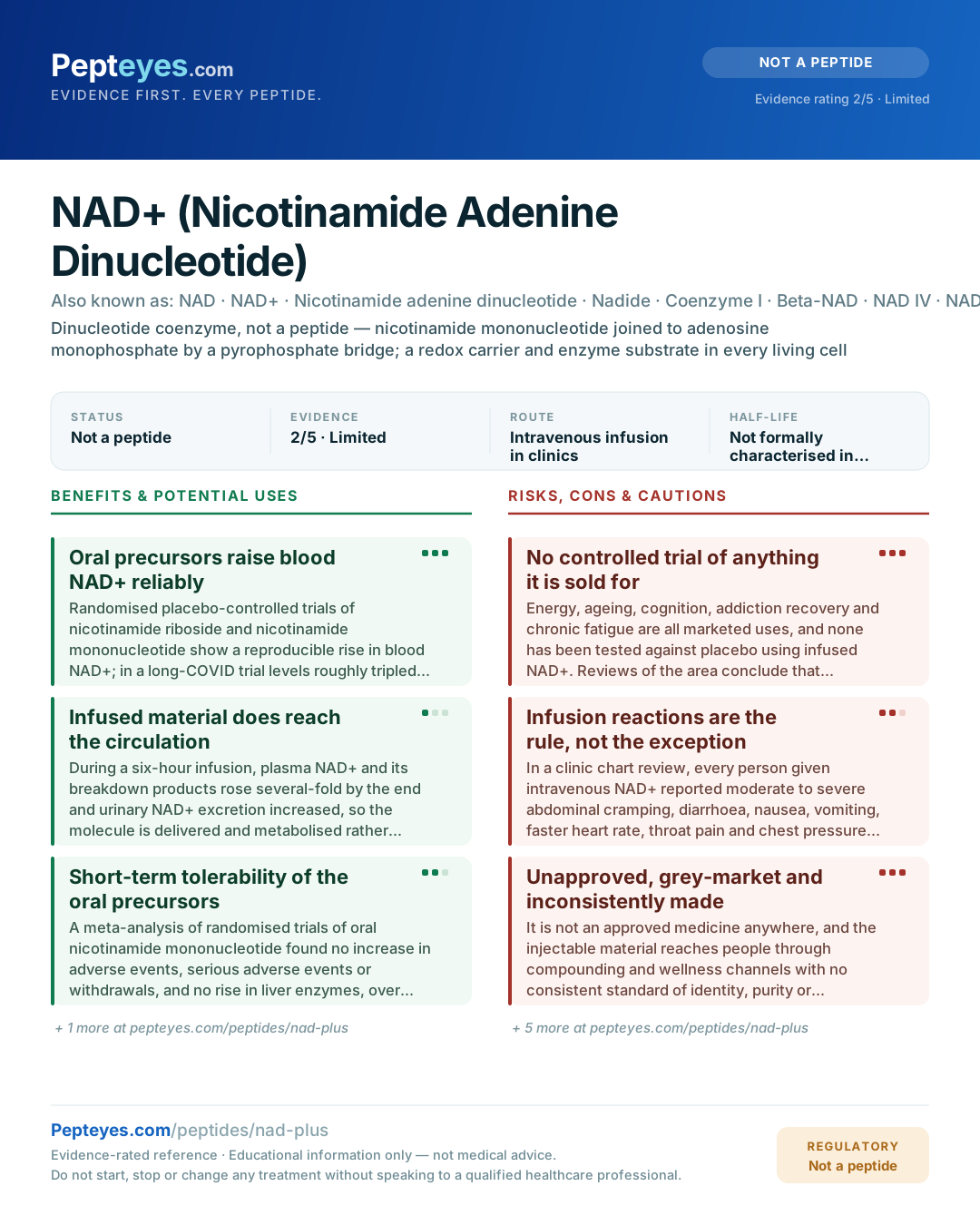
Oral precursors raise blood NAD+ reliably
Randomised placebo-controlled trials of nicotinamide riboside and nicotinamide mononucleotide show a reproducible rise in blood NAD+; in a long-COVID trial levels roughly tripled within weeks and stayed up. This is the best-supported claim in the whole field, and it is a claim about a blood measurement, not about injected NAD+.
Evidence: Strong evidence -
Infused material does reach the circulation
During a six-hour infusion, plasma NAD+ and its breakdown products rose several-fold by the end and urinary NAD+ excretion increased, so the molecule is delivered and metabolised rather than vanishing. What it then does inside cells, and whether any of it enters intact, was not measured.
Evidence: Preliminary -
Short-term tolerability of the oral precursors
A meta-analysis of randomised trials of oral nicotinamide mononucleotide found no increase in adverse events, serious adverse events or withdrawals, and no rise in liver enzymes, over trials running from a fortnight to several months. Tolerability over years is unstudied, and this says nothing about infusion.
Evidence: Moderate evidence -
Muscle NAD+ tracks with function in older adults
A cross-sectional study of human muscle found NAD+ lower in older adults, lowest in the physically impaired, and closer to young values in exercise-trained older people, correlating with mitochondrial and muscle function. It is an association in a snapshot, and the intervention it most supports is exercise.
Evidence: Preliminary
Risks and cautions
8 entries · 4 serious or common
-
No controlled trial of anything it is sold for
Energy, ageing, cognition, addiction recovery and chronic fatigue are all marketed uses, and none has been tested against placebo using infused NAD+. Reviews of the area conclude that randomised placebo-controlled trials of intravenous NAD+ are simply absent, and that the case rests on case series and uncontrolled report.
Evidence: Serious -
Infusion reactions are the rule, not the exception
In a clinic chart review, every person given intravenous NAD+ reported moderate to severe abdominal cramping, diarrhoea, nausea, vomiting, faster heart rate, throat pain and chest pressure during the drip, which stopped when the drip did. People slow the rate themselves to tolerate it, which is why infusions run long.
Evidence: Moderate evidence -
Unapproved, grey-market and inconsistently made
It is not an approved medicine anywhere, and the injectable material reaches people through compounding and wellness channels with no consistent standard of identity, purity or sterility. The federal recall record for compounded NAD+ injection runs back a decade and is dominated by failures of sterility assurance, with one batch also pulled as sub-potent.
Evidence: Serious -
A contaminated lot reached patients
In 2025 a compounded NAD+ injection was recalled at the most serious classification after three people developed low blood pressure, shaking and body aches from one lot; testing found bacterial endotoxin far above the permitted limit. The regulator's inspection described absent environmental monitoring and unvalidated aseptic practice.
Evidence: Serious -
Cancer history is an open and unanswered question
Proliferating cells depend on NAD+ as heavily as healthy ones — enough that blocking its synthesis has been pursued as an anticancer strategy. Animal work on precursors has not shown increased tumour burden, but that cannot exclude a long-term risk in a person given repeated infusions, and no human study has looked.
Evidence: Moderate evidence -
Non-sterile self-injection outside any clinic
The cost of clinic infusions pushes people to reconstitute and inject material at home. Injecting an unverified preparation outside sterile conditions risks local infection, abscess and bloodstream infection whatever the molecule itself does, and the intravenous route carries that risk furthest.
Evidence: Serious -
Precursor evidence borrowed to sell an infusion
Trials of oral nicotinamide riboside and nicotinamide mononucleotide are routinely cited on pages selling drips. They are trials of different molecules by a different route, and the sharpest finding in them — that raising blood NAD+ does not reliably change how anyone feels — is the part that does not get quoted.
Evidence: Moderate evidence -
Blood NAD+ sold back as a result
Testing services offer a blood NAD+ level as a before-and-after outcome. A multi-cohort analysis in 2026 found whole-blood NAD+ did not vary with age or lifestyle, though it did move with supplementation — so it responds to what you take without tracking what you are trying to fix.
Evidence: Moderate evidence
Counts are not a score. A single serious risk can outweigh several well-supported benefits, and a long benefit list built on preclinical work outweighs nothing at all.
Opinion — what people actually report
7 themes · 1 reported benefit · 3 reported problems
This is the weakest tier on this site. These are themes drawn from public discussion — forums, subreddits and patient threads — not from trials. There is no control group, no denominator, and no way to confirm that what someone injected matched its label. People post when a result is dramatic and when something goes wrong, and rarely when nothing happens, so treat everything below as a description of the conversation rather than of the compound. The bars count how often a thing is said, not how well it is supported.
-
A same-day lift people describe as clarity Reported benefit. Dominant theme: Comes up in most discussions of this compound.
The reason anyone goes back. Reports cluster on mental sharpness, lifted mood and a physical wakefulness that arrives during or just after the session rather than days later. Regulars distinguish it from stimulant energy and describe it as the fog lifting, while sceptics in the same threads point out that an afternoon lying down on a drip would lift most people.
-
The infusion itself is genuinely unpleasant Reported problem. Dominant theme: Comes up in most discussions of this compound.
Chest tightness or pressure, nausea, abdominal cramping, flushing and a racing feeling are described as near-universal when the drip runs quickly, and as fading almost immediately when it is slowed or stopped. Experienced posters treat the rate as the whole game and warn newcomers that a session takes far longer than the clinic schedule suggests.
-
Cost is what pushes people to inject at home Practical note. Dominant theme: Comes up in most discussions of this compound.
Clinic sessions are expensive enough that repeat users move to injecting themselves, and a large share of discussion is about that switch rather than about effects. The more careful voices keep raising sterility, reconstitution and what is actually in an unlabelled vial; the enthusiasm usually runs ahead of the caution.
-
The effect fades and the schedule creeps Reported problem. Recurring: Raised regularly, though not by everyone.
People describe the first session as the strongest and the benefit thinning over days, which leads to booking again sooner, then to maintenance schedules nobody planned at the start. A recurring self-aware comment is that they are chasing the first experience rather than getting a lasting change.
-
Precursor studies pasted into infusion threads Practical note. Recurring: Raised regularly, though not by everyone.
Trial results for oral NMN and nicotinamide riboside are routinely offered as proof that drips work. Better-informed posters keep pointing out that those are different molecules by a different route, and that the trials mostly measured a blood level rather than anything the participants noticed.
-
Blood NAD+ tests treated as the scoreboard Practical note. Recurring: Raised regularly, though not by everyone.
Before-and-after testing gets posted as evidence the money was well spent, and a rising number is read as a health improvement in itself. Debate about what the number actually represents, and how much it moves between samples, is a persistent undercurrent.
-
Sore sites, lumps and bad batches Reported problem. Occasional: Reported by a minority, or in specific contexts.
Burning and stinging at subcutaneous sites, lumps that linger, and occasional accounts of a vial that produced fever or shaking. These threads are the ones where the discussion turns from what the molecule does to who made the liquid.
Where the reports and the evidence part ways
The strong subjective reports are the whole market, and they are also the part with nothing behind them: no randomised trial has tested infused NAD+ against placebo for energy, mood, ageing or recovery, so the community is the only evidence that exists and it has no control group, no blinding and no way to know what was in the bag. Where reports and the published record do agree is the unpleasant part — a clinic case review found the cramping, nausea, chest pressure and racing heart that forums describe, tracking infusion rate and stopping when the drip stopped. The forum habit of citing oral precursor trials as support runs the other way: those trials show blood NAD+ rising dependably and outcomes people would notice mostly not improving, which is close to the opposite of what they are quoted for. The sterility worries, usually raised by the more cautious posters and dismissed as paranoia, turned out to be the best-founded concern of all after a contaminated injectable lot was recalled at the most serious classification.
Cheat sheet
The full sheet, all 77 compounds →The community reference numbers for this compound — reconstitution, working dose, cycle and bloodwork. Research and education only, not medical advice, and not part of the evidence-rated monograph above. Doses assume a 1mL / 100-unit insulin syringe — the calculator does the units for you.
Protocol overview
Dosing & reconstitution 500 mg vial
| WEEK | DAILY DOSE | UNITS PER INJECTION |
|---|---|---|
| Week 1 | 50 mg | 30 units (0.30 mL) |
| Week 2 | 75 mg | 45 units (0.45 mL) |
| Weeks 3 to 8 | 100 mg | 60 units (0.60 mL) |
| Weeks 9 to 12 | 100 mg | 60 units (0.60 mL) |
| Weeks 13 to 16 | 100 mg | 60 units (0.60 mL) |
Frequency: Inject once daily subcutaneously. This gradual titration begins at 50 mg daily to assess tolerance, as starting too high can produce adverse reactions such as insomnia, anxiety, or fatigue. Most individuals find doses in the 50 to 100 mg range well-tolerated after ramp-up.
On the master sheet
- Vial
- 500mg
- BAC
- 5mL
- Dose
- IV 250–1000mg / SubQ 25–100mg / oral 250–500mg daily
- Route
- IV/SubQ/oral
- Cycle
- 4–12 wks
- Time Off
- 2–4 wks
- Bloodwork
- CBC, CMP
- Pre-mixed nasal spray: NAD+ 500mg — Cellular energy, vitality
Side-effect family — NAD+: Flushing, chest tightness, nausea (IV) · Insomnia · Headache. What helps, and the red flags →
Readers on NAD+ (Nicotinamide Adenine Dinucleotide)
Questions and answers from readers, under generated names. Nothing here has been checked or reviewed by the site and none of it is medical advice. It is the least verified thing on this page — and it is here because people ask each other these things anyway, and most of the other places they can ask are run by sellers.
0 questions · 0 answers
No questions yet. Ask the first one above — it takes one box and an email address.
How names work, and the house rules
Names. Every verified address is given one generated name — two ordinary words — and keeps it. Nobody chooses a name and nobody can take another's. Posts marked desk were written by the site's own editorial desk, usually to open a thread; they carry a generated name like everyone else's and are held to the site's rules, which means they never state an amount.
What is not allowed. Selling, sourcing, vendor names, coupon codes and "message me" — posts that read that way are held and usually removed. Personal medical details you would not want public. Abuse. Instructions framed as what someone else should do.
What this is not. A reader's report of what happened to them is a report, not a finding, and an answer here is one person's view. Nothing in this section changes the evidence rating above it. If something you read here would change what you take, take it to a pharmacist or physician first.
Your data. Delete any post of yours at any time, or remove everything you have written together with your name. Details in the privacy notice.
Who should avoid it
- Anyone with a cancer history or an undiagnosed mass, where raising NAD+ has never been studied
- Treating addiction, chronic fatigue or long COVID with it in place of assessed care
- Pregnancy and breastfeeding
- Self-injection of material whose sterility and identity cannot be confirmed
- Anyone with unexplained fatigue who has not been investigated for a cause
If used under medical supervision, monitor
- No validated monitoring exists; a blood NAD+ level is not a health outcome
- Infusion-related symptoms: chest pressure, nausea, cramping, flushing and heart rate
- Injection and cannula sites for infection
- Anything new or unexplained in someone with a cancer history, raised with their oncology team
Interactions
Not exhaustive. Always have a pharmacist or physician review your full medication list — including supplements.
- Oral NAD+ precursors — nicotinamide riboside, nicotinamide mononucleotide and plain nicotinamide all converge on the same salvage step, so stacking them adds exposure rather than a second mechanism
- Methyl donors — clearing nicotinamide consumes methyl groups, which is the basis for the common advice to add one; the depletion it is meant to correct has not been demonstrated in people
- Cancer treatment — several anticancer strategies deliberately restrict NAD+ availability, so raising it during treatment runs against the intent and has not been studied
- Anything else given through the same line during an infusion, where the risk belongs to the cannula rather than the molecule
Regulatory & legal status
No NAD+ product is an approved medicine in the United States or the European Union. In the FDA's 503A review of substances nominated for pharmacy compounding, nicotinamide adenine dinucleotide sits in category 1 — under evaluation, with no significant safety risk identified — which is a holding position rather than permission, and is not the same as appearing on the 503A bulks list itself. It is not on the 503B list that governs outsourcing facilities, and in January 2026 the FDA told one such facility that its NAD+ products were therefore unapproved new drugs. The oral precursors are regulated as foods, on separate and shifting rules.
Infographic
What this entry was checked against
The specific records this monograph was verified against on its last research pass. We link live literature searches below as well, because these are a snapshot and the literature is not.
- Grant et al., Front. Aging Neurosci. 2019;11:257 — plasma and urine NAD+ metabolome during a six-hour intravenous NAD+ infusion
- Front. Aging 2026 — intravenous NAD+ versus nicotinamide riboside: retrospective tolerability pilot in a real-world setting
- Front. Aging 2026 — narrative review of intravenous NAD+ and NAD+ precursors in wellness and translational medicine
- FDA, Bulk Drug Substances Nominated for Use in Compounding Under Section 503A, updated 14 May 2026 — NAD and NADH listed in category 1
- FDA warning letter to GenoGenix LLC, 20 January 2026 — NAD+ not on the 503B bulks list, endotoxin finding and recall
- Nature Metabolism 2026 — human whole-blood NAD+ levels do not vary with age or lifestyle interventions
- Europe PMC record for Wu et al., eClinicalMedicine 2025 — randomised trial of nicotinamide riboside in long COVID
- ClinicalTrials.gov NCT06382688 — pilot comparison of intravenous nicotinamide riboside, intravenous NAD+, oral NR and saline in healthy adults
- openFDA drug enforcement reports — recalls of compounded NAD+ injection, including the 2025 class I recall for elevated endotoxin
- Venable LLP, October 2025 — FDA letters of 29 September 2025 concluding NMN is not excluded from the dietary supplement definition
Where to read further
We link to live literature searches rather than a frozen citation list, so you always see current results — including anything published after our last review.
- PubMed — all published literature on NAD+ (Nicotinamide Adenine Dinucleotide)
- PubMed — randomized controlled trials only
- ClinicalTrials.gov — registered human trials
Related peptides in Longevity & Mitochondrial
Terms used on this page
- Randomised Controlled Trial (RCT)
- A randomised controlled trial assigns participants to intervention or control by chance and follows them prospectively, which is what allows an outcome difference to be attributed to the treatment itself.
- Open-Label Study
- An open-label study is one in which participants and investigators both know which treatment was assigned, so nothing in the design shields the results from expectation or assessment bias.
- Phosphorylation
- Phosphorylation is the attachment of a phosphate group to a serine, threonine or tyrosine hydroxyl, adding 80 daltons and two negative charges, and it is the main switch by which cells relay a receptor signal.
- Placebo and Placebo Control
- A placebo is an inactive intervention matched to the real one in appearance and route, used as a control arm so that improvement caused by the drug can be separated from improvement that would occur anyway.
- Case Report and Case Series
- A case report describes one patient and a case series a small group, giving hypothesis-generating detail with no control group and no way to estimate how often the effect occurs.
- Reproducibility and Replication
- Reproducibility is obtaining the same result from the same data and analysis, while replication is obtaining a consistent result from new data, and only the second shows the finding is real.
This page is educational information, not medical advice. It cannot account for your medical history, medications, or risk factors. Do not start, stop or change any treatment based on it. Speak to a qualified healthcare professional who knows your case.