Supplied as a lyophilised powder to reconstitute
Healing & Tissue Repair
At a glance
Ten answers, each one line. Open any row for the detail behind it.
What it does Commercially, PDA exists because BPC-157 was banned from compounding.
Commercially, PDA exists because BPC-157 was banned from compounding. Chemically it is the same peptide with a different counter-ion. The marketing implies improved stability and a cleaner legal status; neither claim has independent evidence behind it.
Half-life Not established in humans, and not separately studied — it is… — Nothing established
Not established in humans, and not separately studied — it is BPC-157 with a different counter-ion, which has no human pharmacokinetics either.
Typical studied dose None established. No dose has ever been set for a human being, because… — Nothing established
None established. No dose has ever been set for a human being, because the studies that would set one have not been done. Any figure circulating for this compound was chosen by somebody selling it or by somebody guessing.
How often it is used No schedule exists. Cycles and intervals quoted for this compound come… — Nothing established
No schedule exists. Cycles and intervals quoted for this compound come from forums rather than from any study, and they vary because nothing anchors them.
How it is taken Subcutaneous (research) — Documented
Subcutaneous (research)
Main side effects Zero independent evidence · Regulatory workaround, not a regulatory clearance · Inherits every BPC-157 concern — Carries serious risk
Zero independent evidence — There is no published study of PDA as such — not in humans, and not head-to-head against BPC-157 in animals.
Regulatory workaround, not a regulatory clearance — Renaming or re-salting a substance barred from compounding does not make it approved. Buyers frequently misread it as legitimised.
Inherits every BPC-157 concern — Including the angiogenesis-and-cancer question and the absence of chronic safety data.
Storage before mixing As a sealed lyophilised powder, refrigerated is typical and a freezer…
As a sealed lyophilised powder, refrigerated is typical and a freezer suits long storage; both should be dark and dry. A dry powder tolerates a few days out of the cold far better than anything in solution — which is why it ships that way.
Shelf life after mixing Once mixed it is refrigerated and treated as short-lived. Bacteriostatic…
Once mixed it is refrigerated and treated as short-lived. Bacteriostatic water contains a preservative and buys the longer window; sterile water contains none and buys a much shorter one. Peptides in solution also degrade on their own, so the container is only half the question.
Evidence level 1/5 · Minimal — Nothing established
Animal or laboratory data only. No human efficacy evidence.
Regulatory status Research Use Only — Nothing established
Not approved. Marketed as a "legal alternative" after BPC-157 was barred from compounding — a claim regulators have not endorsed. Not approved. Marketing it as a compliant substitute for a substance FDA excluded from compounding is legally precarious.
Overview
Commercially, PDA exists because BPC-157 was banned from compounding. Chemically it is the same peptide with a different counter-ion. The marketing implies improved stability and a cleaner legal status; neither claim has independent evidence behind it.
Not approved for human use anywhereNo approval anywhere for human use. Sold under research-use labelling. Not approved. Marketing it as a compliant substitute for a substance FDA excluded from compounding is legally precarious.
| Regulatory status | Not approved. Marketed as a "legal alternative" after BPC-157 was barred from compounding — a claim regulators have not endorsed. |
|---|---|
| Drug class | Arginate salt form of the BPC-157 pentadecapeptide |
| Route | Subcutaneous (research) |
| Half-life | Not established in humans, and not separately studied — it is BPC-157 with a different counter-ion, which has no human pharmacokinetics either. |
| Evidence rating |
1/5 Minimal
Evidence rating 1 out of 5: Minimal
Animal or laboratory data only. No human efficacy evidence. |
| Studied in | No published clinical trials. No independent peer-reviewed characterisation of the salt form versus the acetate form. |
Pentadeca Arginate (PDA) sequence & structure
Pentadeca Arginate (PDA) is a 15-residue linear peptide with a free C-terminal acid; molecular weight 1,419.56 Da.
| Three-letter | H-Gly-Glu-Pro-Pro-Pro-Gly-Lys-Pro-Ala-Asp-Asp-Ala-Gly-Leu-Val-OH |
|---|---|
| Length | 15 amino acid residues |
| Modifications | None — an unmodified chain of standard L-amino acids |
| Molecular formula | C62H98N16O22 |
| Molecular weight | 1,419.56 Da (average, free base) |
| SMILES | CC(C)C[C@H](NC(=O)CNC(=O)[C@H](C)NC(=O)[C@H](CC(=O)O)NC(=O)[C@H](CC(=O)O)NC(=O)[C@H](C)NC(=O)[C@@H]1CCCN1C(=O)[C@H](CCCCN)NC(=O)CNC(=O)[C@@H]1CCCN1C(=O)[C@@H]1CCCN1C(=O)[C@@H]1CCCN1C(=O)[C@H](CCC(=O)O)NC(=O)CN)C(=O)N[C@H](C(=O)O)C(C)C |
| Identifiers | CAS 137525-51-0 · PubChem CID 9941957 |
| Which molecule | "Pentadeca Arginate" (PDA) is not a distinct peptide: it is the BPC-157 pentadecapeptide (bepecin) supplied as an L-arginine salt instead of the usual acetate. The Diagen patent US 9,850,282 covers mono-, di- and tri-basic-amino-acid salts (1-3 mol arginine, lysine or ornithine per mol peptide) and names bepecin di-L-arginine as the preferred form. This record describes the peptide itself (free base, all-L, unmodified termini), which is identical across all salt forms; sequence, formula, MW and CAS therefore refer to the free peptide, not to the salt. |
| Sources | PubChem CID 9941957 (BPC-157) - properties and synonymsChEMBL CHEMBL4297358 (BPC-157)US Patent 9,850,282 B2 - Stable pentadecapeptide salts (Diagen d.o.o.)FDA Global Substance Registration System - UNII 8ED8NXK95P (BPC-157 / bepecin) |
Free-base formula C62H98N16O22 and average MW 1419.56 Da (PubChem 1419.5; ChEMBL 1419.56; recomputed from the sequence 1419.56). The FDA GSRS record (UNII 8ED8NXK95P, WHO-DD name bepecin; synonyms PL-10, PL-14736, PLD-116) independently gives the same 15-residue sequence and CAS 137525-51-0, which passes the CAS check-digit test. The di-L-arginine salt adds two C6H14N4O2 (174.20 Da each) to give roughly 1767.96 Da, and the mono/tri-arginate forms differ accordingly, so vendor MW figures for PDA vary with stoichiometry; no CAS or UNII specific to the arginate salt was found in any source opened. The widely repeated claim that the arginate is far more stable than the acetate at pH 3 comes from the patent's own stability table (84.9% peptide remaining after 5 h at pH 3.0), not from peer-reviewed work, and no published study has examined PDA as a separate molecule.
Record confidence: high — two independent authoritative sources agree on the sequence and modifications. Every sequence on the site is listed with its sources on the peptide sequences index.
How it works
Identical peptide sequence to BPC-157, formulated as an arginate salt which is claimed to improve stability and absorption. The underlying biological mechanism — if any — is whatever BPC-157 does.
Evidence base
Rated 1 of 5 — Minimal. Animal or laboratory data only. No human efficacy evidence.
- Included on this site because it is heavily marketed, not because evidence supports it.
Benefits and risks, weighed against the evidence
Every entry below carries the strength of the evidence behind it — three bars for strong human data, two for moderate, one for preliminary or preclinical work. The two columns are not equal by design: where a compound has more documented risk than demonstrated benefit, the lists say so.
Reported benefits
2 entries
-
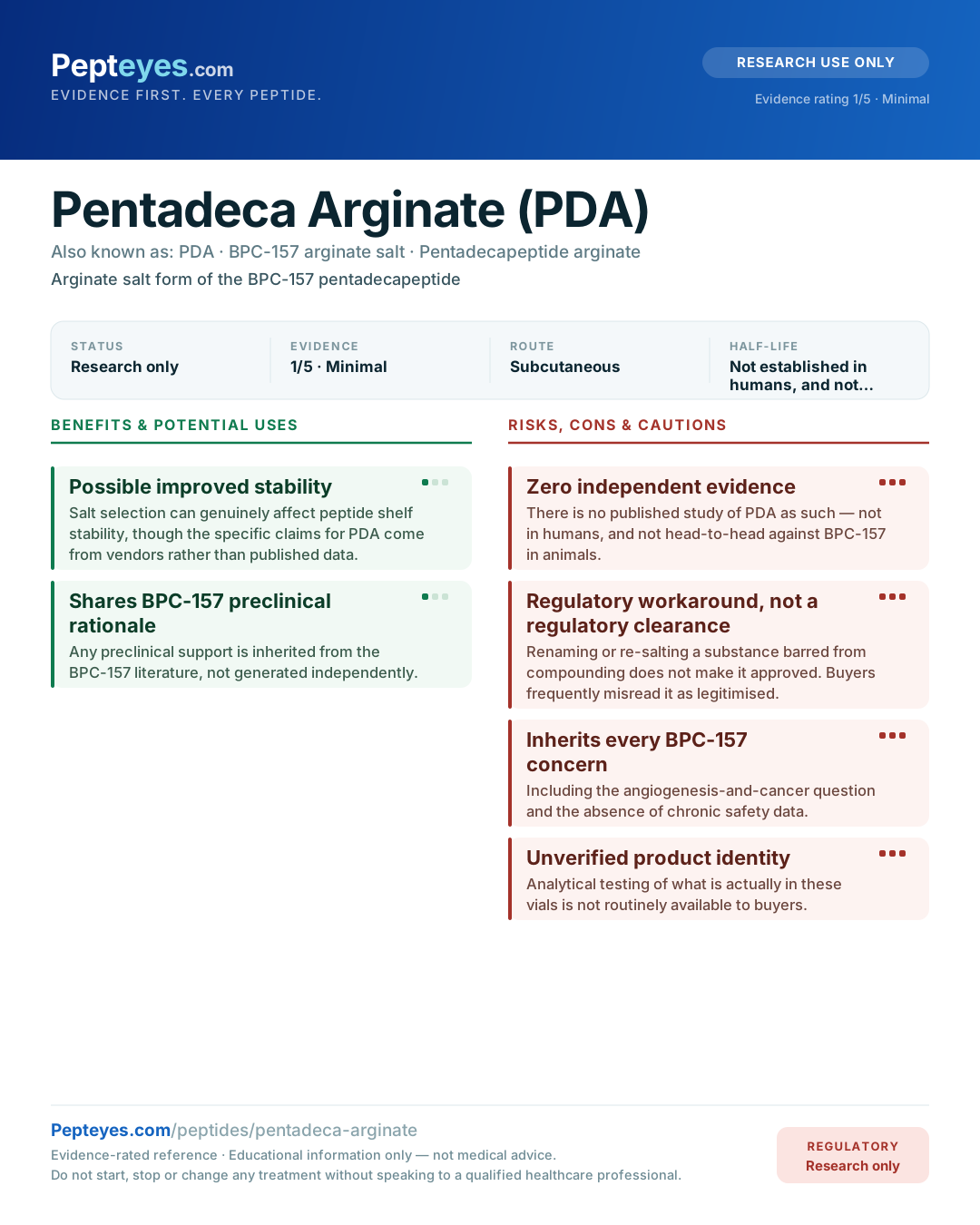
Possible improved stability
Salt selection can genuinely affect peptide shelf stability, though the specific claims for PDA come from vendors rather than published data.
Evidence: Preliminary -
Shares BPC-157 preclinical rationale
Any preclinical support is inherited from the BPC-157 literature, not generated independently.
Evidence: Preliminary
Risks and cautions
4 entries · 4 serious or common
-
Zero independent evidence
There is no published study of PDA as such — not in humans, and not head-to-head against BPC-157 in animals.
Evidence: Serious -
Regulatory workaround, not a regulatory clearance
Renaming or re-salting a substance barred from compounding does not make it approved. Buyers frequently misread it as legitimised.
Evidence: Serious -
Inherits every BPC-157 concern
Including the angiogenesis-and-cancer question and the absence of chronic safety data.
Evidence: Serious -
Unverified product identity
Analytical testing of what is actually in these vials is not routinely available to buyers.
Evidence: Serious
Counts are not a score. A single serious risk can outweigh several well-supported benefits, and a long benefit list built on preclinical work outweighs nothing at all.
Opinion — what people actually report
4 themes · 1 reported benefit · 1 reported problem
This is the weakest tier on this site. These are themes drawn from public discussion — forums, subreddits and patient threads — not from trials. There is no control group, no denominator, and no way to confirm that what someone injected matched its label. People post when a result is dramatic and when something goes wrong, and rarely when nothing happens, so treat everything below as a description of the conversation rather than of the compound. The bars count how often a thing is said, not how well it is supported.
-
Adopted as the compliant replacement for BPC-157 Practical note. Dominant theme: Comes up in most discussions of this compound.
The defining fact of the discussion. Uptake followed the FDA barring BPC-157 from compounding, and clinics moved to it for regulatory reasons rather than because new data appeared.
-
Reported as similar, or slightly better Reported benefit. Recurring: Raised regularly, though not by everyone.
People who switched typically describe comparable effects, sometimes with claims of better stability. The claims closely track what clinics and vendors say.
-
Suspicion that it is a rebrand Reported problem. Recurring: Raised regularly, though not by everyone.
A well-informed strand of the discussion points out it is the same pentadecapeptide as an arginate salt, and treats the "new and improved" framing as marketing.
-
Almost all reports come through clinics Practical note. Recurring: Raised regularly, though not by everyone.
Unlike BPC-157, most accounts originate from telehealth and wellness clinic patients, which shapes the tone and makes independent reports scarce.
Where the reports and the evidence part ways
The sceptical strand of the community is closer to correct than the enthusiastic one. This is the same pentadecapeptide in a different salt form, and the stability advantages claimed for it are vendor assertions rather than published comparisons. Critically, it inherits BPC-157's evidence base — which is to say, no published randomized human trials — while being marketed as though the change of name brought a change of standing. Renaming a substance does not generate evidence for it, and the regulatory workaround that produced the switch says nothing about whether it works.
Readers on Pentadeca Arginate (PDA)
Questions and answers from readers, under generated names. Nothing here has been checked or reviewed by the site and none of it is medical advice. It is the least verified thing on this page — and it is here because people ask each other these things anyway, and most of the other places they can ask are run by sellers.
0 questions · 0 answers
No questions yet. Ask the first one above — it takes one box and an email address.
How names work, and the house rules
Names. Every verified address is given one generated name — two ordinary words — and keeps it. Nobody chooses a name and nobody can take another's. Posts marked desk were written by the site's own editorial desk, usually to open a thread; they carry a generated name like everyone else's and are held to the site's rules, which means they never state an amount.
What is not allowed. Selling, sourcing, vendor names, coupon codes and "message me" — posts that read that way are held and usually removed. Personal medical details you would not want public. Abuse. Instructions framed as what someone else should do.
What this is not. A reader's report of what happened to them is a report, not a finding, and an answer here is one person's view. Nothing in this section changes the evidence rating above it. If something you read here would change what you take, take it to a pharmacist or physician first.
Your data. Delete any post of yours at any time, or remove everything you have written together with your name. Details in the privacy notice.
Who should avoid it
- Cancer history or undiagnosed mass
- Pregnancy and breastfeeding
- Tested athletes
If used under medical supervision, monitor
- No validated monitoring exists
Commonly confused with
These mix-ups cause real harm — two products sold under one name, or two molecules whose effects run in opposite directions.
Chemically the same peptide with a different counter-ion. PDA is marketed as a lawful alternative to a substance FDA excluded from compounding; that is a commercial framing, not a regulatory clearance.
Compare side by sideRegulatory & legal status
Not approved. Marketing it as a compliant substitute for a substance FDA excluded from compounding is legally precarious.
Infographic
Where to read further
We link to live literature searches rather than a frozen citation list, so you always see current results — including anything published after our last review.
- PubMed — all published literature on Pentadeca Arginate (PDA)
- PubMed — randomized controlled trials only
- ClinicalTrials.gov — registered human trials
Related peptides in Healing & Tissue Repair
Terms used on this page
- Counterion and Salt Form
- A counterion is the charged partner supplied with a peptide isolated as a salt, and the salt form decides how much of any weighed milligram of powder is actually peptide.
- Primary Structure
- Primary structure is the covalent composition of a peptide, meaning the linear order of its amino acid residues from N-terminus to C-terminus plus any disulfide connectivity and modifications.
- Preclinical Study and Animal Model
- Preclinical studies are the laboratory, cell and animal experiments done before any human exposure, establishing mechanism, target engagement and the toxicology package that permits a first trial.
- Peptide and Wellness Clinics
- Peptide and wellness clinics are cash-pay practices that prescribe peptides and hormones off-label or as compounded preparations, outside the indications and evidence supporting approved medicines.
This page is educational information, not medical advice. It cannot account for your medical history, medications, or risk factors. Do not start, stop or change any treatment based on it. Speak to a qualified healthcare professional who knows your case.