Supplied as a lyophilised powder to reconstitute
Healing & Tissue Repair
At a glance
Ten answers, each one line. Open any row for the detail behind it.
What it does A laboratory tool peptide from one Korean research group, designed to pull the brake off…
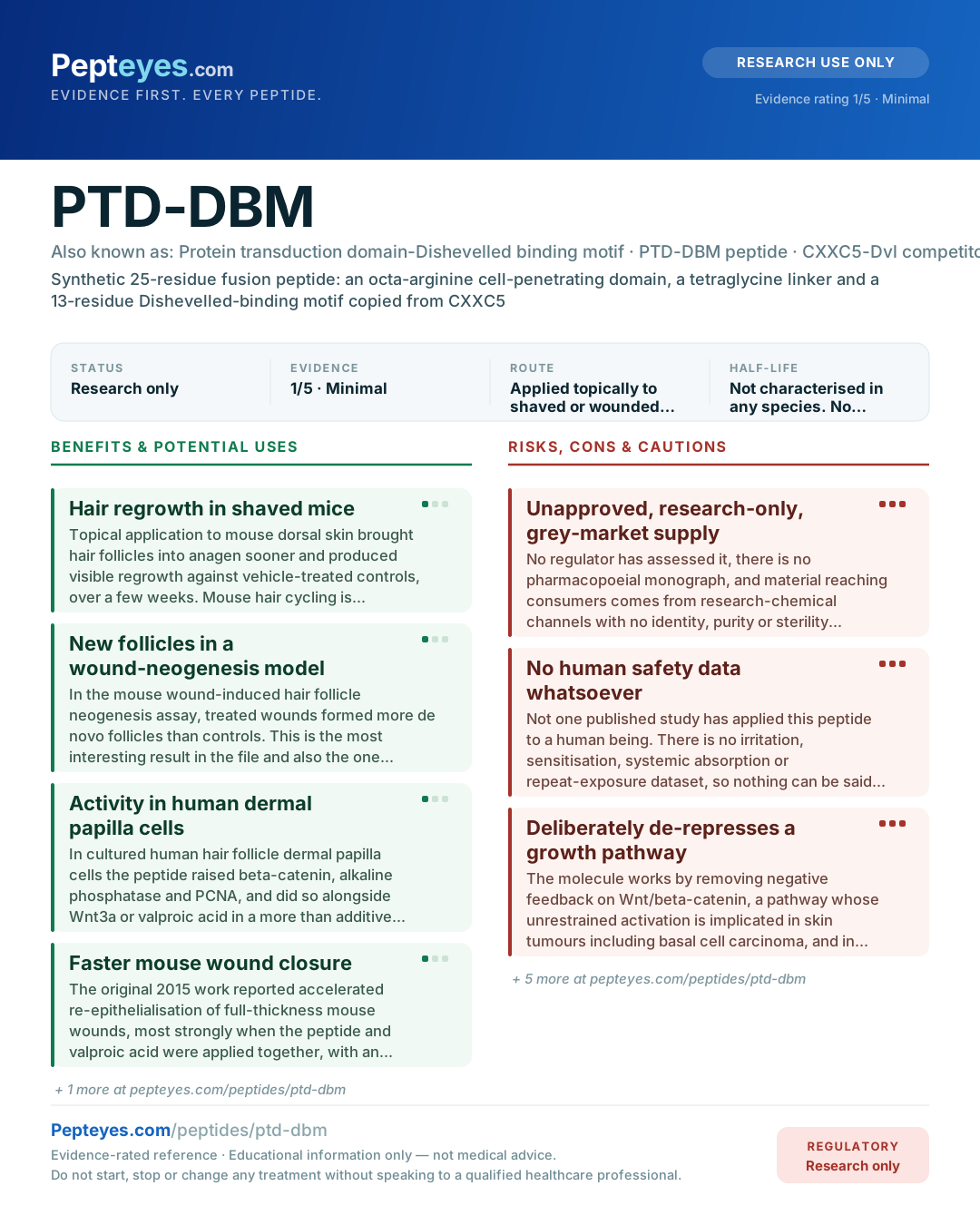
A laboratory tool peptide from one Korean research group, designed to pull the brake off Wnt signalling in skin. It is a poly-arginine delivery tag welded to the short stretch of CXXC5 that grips Dishevelled, so it competes CXXC5 off Dishevelled and lets beta-catenin signalling proceed. Everything published is mouse skin, mouse follicles and cultured human cells, usually with valproic acid applied alongside it. No human being has been studied.
Half-life Not characterised in any species. No pharmacokinetic study… — Nothing established
Not characterised in any species. No pharmacokinetic study exists; skin delivery was shown only qualitatively, via the fluorescein tag on the 2015 construct.
Typical studied dose None established. No dose has ever been set for a human being, because… — Nothing established
None established. No dose has ever been set for a human being, because the studies that would set one have not been done. Any figure circulating for this compound was chosen by somebody selling it or by somebody guessing.
How often it is used No schedule exists. Cycles and intervals quoted for this compound come… — Nothing established
No schedule exists. Cycles and intervals quoted for this compound come from forums rather than from any study, and they vary because nothing anchors them.
How it is taken Applied topically to shaved or wounded mouse skin, and added directly to… — Documented
Applied topically to shaved or wounded mouse skin, and added directly to cultured cells and follicles. No human route has been established.
Main side effects Unapproved, research-only, grey-market supply · No human safety data whatsoever · Deliberately de-represses a growth pathway — Carries serious risk
Unapproved, research-only, grey-market supply — No regulator has assessed it, there is no pharmacopoeial monograph, and material reaching consumers comes from research-chemical channels with no identity, purity or sterility guarantee. Content and impurity profile are unverified, and an arginine-rich peptide is an easy thing to get wrong.
No human safety data whatsoever — Not one published study has applied this peptide to a human being. There is no irritation, sensitisation, systemic absorption or repeat-exposure dataset, so nothing can be said about tolerability beyond guesswork from the mouse work.
Deliberately de-represses a growth pathway — The molecule works by removing negative feedback on Wnt/beta-catenin, a pathway whose unrestrained activation is implicated in skin tumours including basal cell carcinoma, and in fibrosis. The authors raise this themselves and report no rise in the oncogenic markers c-Myc or cyclin D1 — a marker readout over days, not a carcinogenicity assessment. Chronic human use has never been evaluated.
Storage before mixing As a sealed lyophilised powder, refrigerated is typical and a freezer…
As a sealed lyophilised powder, refrigerated is typical and a freezer suits long storage; both should be dark and dry. A dry powder tolerates a few days out of the cold far better than anything in solution — which is why it ships that way.
Shelf life after mixing Once mixed it is refrigerated and treated as short-lived. Bacteriostatic…
Once mixed it is refrigerated and treated as short-lived. Bacteriostatic water contains a preservative and buys the longer window; sterile water contains none and buys a much shorter one. Peptides in solution also degrade on their own, so the container is only half the question.
Evidence level 1/5 · Minimal — Nothing established
Animal or laboratory data only. No human efficacy evidence.
Regulatory status Research Use Only — Nothing established
Not approved by any regulator, not a listed cosmetic ingredient, and not the subject of any registered human trial as of September 2026. It circulates as a research-use-only laboratory reagent. Unapproved everywhere. It is not a licensed drug in any market, it has no INCI name and does not appear in the EU CosIng inventory or US cosmetic ingredient listings, so it cannot lawfully be sold as a labelled cosmetic ingredient in those markets. It is traded as a research chemical, which is a description of how it is labelled and not a permission to use it on people. The related small-molecule mimetics from the same laboratory are separate compounds with their own separate regulatory position.
Overview
A laboratory tool peptide from one Korean research group, designed to pull the brake off Wnt signalling in skin. It is a poly-arginine delivery tag welded to the short stretch of CXXC5 that grips Dishevelled, so it competes CXXC5 off Dishevelled and lets beta-catenin signalling proceed. Everything published is mouse skin, mouse follicles and cultured human cells, usually with valproic acid applied alongside it. No human being has been studied.
Not approved for human use anywhereNo approval anywhere for human use. Sold under research-use labelling. Unapproved everywhere. It is not a licensed drug in any market, it has no INCI name and does not appear in the EU CosIng inventory or US cosmetic ingredient listings, so it cannot lawfully be sold as a labelled cosmetic ingredient in those markets. It is traded as a research chemical, which is a description of how it is labelled and not a permission to use it on people. The related small-molecule mimetics from the same laboratory are separate compounds with their own separate regulatory position.
| Regulatory status | Not approved by any regulator, not a listed cosmetic ingredient, and not the subject of any registered human trial as of September 2026. It circulates as a research-use-only laboratory reagent. |
|---|---|
| Drug class | Synthetic 25-residue fusion peptide: an octa-arginine cell-penetrating domain, a tetraglycine linker and a 13-residue Dishevelled-binding motif copied from CXXC5 |
| Route | Applied topically to shaved or wounded mouse skin, and added directly to cultured cells and follicles. No human route has been established. |
| Half-life | Not characterised in any species. No pharmacokinetic study exists; skin delivery was shown only qualitatively, via the fluorescein tag on the 2015 construct. |
| Evidence rating |
1/5 Minimal
Evidence rating 1 out of 5: Minimal
Animal or laboratory data only. No human efficacy evidence. |
| Studied in | A 2015 wound-healing paper in mice and human dermal fibroblasts, and a 2017 hair paper using human hair follicle dermal papilla cells, human balding scalp tissue staining, shaved mice and a wound-induced hair follicle neogenesis model. Later mouse work and ex-vivo mouse vibrissa follicle culture extended it to androgen-driven hair loss. No human trial of any kind. |
PTD-DBM sequence & structure
PTD-DBM is a 25-residue linear peptide with a free C-terminal acid; molecular weight 3,082.6 Da.
| Three-letter | H-Arg-Arg-Arg-Arg-Arg-Arg-Arg-Arg-Gly-Gly-Gly-Gly-Arg-Lys-Thr-Gly-His-Gln-Ile-Cys-Lys-Phe-Arg-Lys-Cys-OH |
|---|---|
| Length | 25 amino acid residues |
| Modifications | None — an unmodified chain of standard L-amino acids |
| Molecular formula | C124H225N61O28S2 |
| Molecular weight | 3,082.6 Da (average, free base) |
| SMILES | CC[C@H](C)[C@@H](C(=O)N[C@@H](CS)C(=O)N[C@@H](CCCCN)C(=O)N[C@@H](CC1=CC=CC=C1)C(=O)N[C@@H](CCCNC(=N)N)C(=O)N[C@@H](CCCCN)C(=O)N[C@@H](CS)C(=O)O)NC(=O)[C@H](CCC(=O)N)NC(=O)[C@H](CC2=CN=CN2)NC(=O)CNC(=O)[C@H]([C@@H](C)O)NC(=O)[C@H](CCCCN)NC(=O)[C@H](CCCNC(=N)N)NC(=O)CNC(=O)CNC(=O)CNC(=O)CNC(=O)[C@H](CCCNC(=N)N)NC(=O)[C@H](CCCNC(=N)N)NC(=O)[C@H](CCCNC(=N)N)NC(=O)[C@H](CCCNC(=N)N)NC(=O)[C@H](CCCNC(=N)N)NC(=O)[C@H](CCCNC(=N)N)NC(=O)[C@H](CCCNC(=N)N)NC(=O)[C@H](CCCNC(=N)N)N |
| Identifiers | CAS 1609454-11-6 · PubChem CID 176453931 |
| Which molecule | This record describes the untagged 25-residue peptide H-RRRRRRRRGGGGRKTGHQICKFRKC-OH, which is what PubChem, the CAS registry and chemical catalogues call PTD-DBM. The construct actually used in the published mouse and cell work carried one further C-terminal lysine bearing a fluorescein isothiocyanate label for visualisation, so the studied molecule is a 26-residue fluorescent conjugate of higher mass; the two are not interchangeable as chemical entities. |
| Sources | PubChem CID 176453931 (formula, MW, isomeric SMILES)PubChem CID 176453931 CAS RN cross-reference (1609454-11-6)Overview of short peptides for hair loss, Biomedicines 2026 — table giving the construct as RRRRRRRRGGGGRKTGHQICKFRKCK-FITCUniProt Q7LFL8 (human CXXC5) — source protein for the Dishevelled-binding motif, residues 284-296Lee et al. 2015, J Exp Med 212:1061 — describes the peptide as PTD plus linker plus DBM plus FITC-conjugated lysine |
The C-terminal 13 residues RKTGHQICKFRKC correspond exactly to residues 284-296 of human CXXC5 (UniProt Q7LFL8), inside its CXXC zinc-finger region; the preceding octa-arginine is a generic cell-penetrating tag and the GGGG stretch a flexible linker. Confidence is medium rather than high because the full construct sequence could not be read from the primary papers themselves - the 2015 paper gives only a schematic and the 2017 hair paper is paywalled - so the sequence rests on PubChem plus a peer-reviewed review table, which agree. The two cysteines are free thiols in the catalogued compound, not a disulfide, and the material is normally supplied as a trifluoroacetate or acetate salt, so quoted salt masses run higher than the 3082.6 Da free-base figure.
Record confidence: medium — one authoritative source, or sources agree on the sequence but not on every identifier. Every sequence on the site is listed with its sources on the peptide sequences index.
How it works
CXXC5 is a negative-feedback regulator of the Wnt/beta-catenin pathway: when Wnt signalling fires, CXXC5 is induced and binds the PDZ domain of Dishevelled, blunting further signalling. In balding human scalp the protein was reported to be raised in miniaturised follicles and arrector pili muscles. PTD-DBM reproduces the CXXC5 fragment that contacts Dishevelled, so it occupies that site and displaces full-length CXXC5, de-repressing the pathway rather than stimulating a receptor. The octa-arginine segment is a standard cell-penetrating tag carrying the motif into cells, and the glycine linker keeps the two halves from interfering with each other. Downstream, cell work shows beta-catenin accumulation and rises in alkaline phosphatase and PCNA in hair follicle dermal papilla cells. The same de-repression is why it was first studied in wound healing, where it raised collagen I and alpha-smooth-muscle actin in human dermal fibroblasts.
Evidence base
Rated 1 of 5 — Minimal. Animal or laboratory data only. No human efficacy evidence.
- Evidence 1: animal and in-vitro only, and that is the ceiling the published record supports. Mouse shaving, mouse wound-neogenesis and mouse wound-healing models, ex-vivo mouse vibrissa follicle culture, cultured human dermal fibroblasts and hair follicle dermal papilla cells, and immunostaining of human balding scalp tissue. Work on human tissue or human cells outside the body is in-vitro evidence, not clinical evidence.
- No registered human trial exists, and the compound has never been tested in a human being in the published literature. Claims of human hair regrowth are extrapolation from mice.
- The strongest in-vivo results depend on co-treatment with valproic acid, so the peptide's independent contribution is not cleanly established even in mice. A reported mouse comparison favouring the peptide-plus-valproic-acid combination over topical minoxidil is a mouse comparison and says nothing about human scalps.
- The sequence, target and all key findings originate with a single research group, and the group's later effort moved to small-molecule mimetics rather than to a clinical programme with the peptide.
Benefits and risks, weighed against the evidence
Every entry below carries the strength of the evidence behind it — three bars for strong human data, two for moderate, one for preliminary or preclinical work. The two columns are not equal by design: where a compound has more documented risk than demonstrated benefit, the lists say so.
Reported benefits
5 entries
-
Hair regrowth in shaved mice
Topical application to mouse dorsal skin brought hair follicles into anagen sooner and produced visible regrowth against vehicle-treated controls, over a few weeks. Mouse hair cycling is synchronised in a way human scalp is not, so this translates poorly.
Evidence: Preliminary -
New follicles in a wound-neogenesis model
In the mouse wound-induced hair follicle neogenesis assay, treated wounds formed more de novo follicles than controls. This is the most interesting result in the file and also the one furthest from anything demonstrated in people.
Evidence: Preliminary -
Activity in human dermal papilla cells
In cultured human hair follicle dermal papilla cells the peptide raised beta-catenin, alkaline phosphatase and PCNA, and did so alongside Wnt3a or valproic acid in a more than additive way. Cultured cells on plastic, not a scalp.
Evidence: Preliminary -
Faster mouse wound closure
The original 2015 work reported accelerated re-epithelialisation of full-thickness mouse wounds, most strongly when the peptide and valproic acid were applied together, with an epidermal growth factor arm as the active comparator.
Evidence: Preliminary -
A specific, falsifiable target
Unlike most hair peptides, this one has a named protein-protein interaction, co-immunoprecipitation evidence that the interaction is disrupted, and knockout mice that phenocopy the drug effect. The mechanism is at least testable, whatever the clinical outcome proves to be.
Evidence: Preliminary
Risks and cautions
8 entries · 3 serious or common
-
Unapproved, research-only, grey-market supply
No regulator has assessed it, there is no pharmacopoeial monograph, and material reaching consumers comes from research-chemical channels with no identity, purity or sterility guarantee. Content and impurity profile are unverified, and an arginine-rich peptide is an easy thing to get wrong.
Evidence: Serious -
No human safety data whatsoever
Not one published study has applied this peptide to a human being. There is no irritation, sensitisation, systemic absorption or repeat-exposure dataset, so nothing can be said about tolerability beyond guesswork from the mouse work.
Evidence: Serious -
Deliberately de-represses a growth pathway
The molecule works by removing negative feedback on Wnt/beta-catenin, a pathway whose unrestrained activation is implicated in skin tumours including basal cell carcinoma, and in fibrosis. The authors raise this themselves and report no rise in the oncogenic markers c-Myc or cyclin D1 — a marker readout over days, not a carcinogenicity assessment. Chronic human use has never been evaluated.
Evidence: Serious -
Results are entangled with valproic acid
Much of the most impressive in vivo and cell data comes from co-treatment with valproic acid, a GSK-3 beta inhibitor that activates the same pathway from a different direction. Effects attributed to the peptide alone are often combination effects.
Evidence: Moderate evidence -
The marketed peptide is not the studied construct
The peptide in the papers carried an extra C-terminal lysine bearing a fluorescein tag for visualisation. Catalogued PTD-DBM is the untagged 25-residue chain. The tag is unlikely to drive activity, but the two are not the same molecule and nobody has published a side-by-side comparison.
Evidence: Moderate evidence -
Not a cosmetic ingredient
It carries no INCI name and appears in no cosmetic ingredient inventory, so a product containing it is not a lawfully labelled cosmetic in the EU or the US, whatever the seller calls it.
Evidence: Moderate evidence -
Two free cysteines and a cationic tag
The chain carries two unpaired thiols that can oxidise or form mixed disulfides in solution, and highly cationic arginine-rich sequences can perturb membranes at higher exposures. Neither behaviour has been characterised for this peptide.
Evidence: Moderate evidence -
Evidence from essentially one laboratory
The peptide, the target and the follow-on small molecules all come from the same academic group, and no independent group has reproduced the hair findings. Single-source evidence is the weakest kind.
Evidence: Moderate evidence
Counts are not a score. A single serious risk can outweigh several well-supported benefits, and a long benefit list built on preclinical work outweighs nothing at all.
Opinion — what people actually report
7 themes · 3 reported problems
This is the weakest tier on this site. These are themes drawn from public discussion — forums, subreddits and patient threads — not from trials. There is no control group, no denominator, and no way to confirm that what someone injected matched its label. People post when a result is dramatic and when something goes wrong, and rarely when nothing happens, so treat everything below as a description of the conversation rather than of the compound. The bars count how often a thing is said, not how well it is supported.
-
Getting hold of it is most of the conversation Practical note. Dominant theme: Comes up in most discussions of this compound.
Far more of the discussion concerns clinic programmes, compounding pharmacies, overseas suppliers, consultation charges and subscription fees than concerns what the peptide does. The recurring complaint is that thinning hair is being charged for heavily on the strength of an unproven laboratory reagent. None of the practical detail is repeated here.
-
The people who have tried it report nothing Reported problem. Dominant theme: Comes up in most discussions of this compound.
Accounts of months of use, almost always with topical valproic acid alongside, come back describing no visible change at all. There are very few first-hand reports in total, and the ones that exist are flat.
-
The valproic acid pairing is simply assumed Practical note. Dominant theme: Comes up in most discussions of this compound.
Hardly anyone discusses the peptide alone, because the mouse work used the two together. The recurring technical argument is that swallowed valproate is associated with shedding while the topical route is the one the research used, and that valproic acid and sodium valproate do not behave identically in a formulation.
-
Everyone knows it is a mouse result Reported problem. Recurring: Raised regularly, though not by everyone.
The sceptical strand is well informed: the pathway story is interesting, the human data does not exist, and the trials have been described as imminent for years. The prevailing mood is the field's standing disappointment that nothing ever arrives.
-
Identity and stability are unverifiable Reported problem. Recurring: Raised regularly, though not by everyone.
Buyers report being told the material needs refrigeration and degrades readily, and have no way to confirm that what arrived is a twenty-five-residue fusion peptide at all. Whether something that size crosses an intact scalp without microneedling is raised constantly and never settled.
-
Interest tracks the researcher rather than the data Practical note. Recurring: Raised regularly, though not by everyone.
Announcements from the laboratory behind it, and from the company set up to commercialise it, drive every spike in discussion. Each round produces fresh anticipation that no new human result supports.
-
It gets stacked into custom scalp blends Practical note. Occasional: Reported by a minority, or in specific contexts.
It appears in home-made and clinic-made mixtures with copper peptides and other hair compounds, which makes any report arising from those entirely unattributable.
Where the reports and the evidence part ways
Here the community and the evidence agree, and both are bleak. Everything published on PTD-DBM is mouse skin, mouse follicles and cultured human cells, nearly always with valproic acid applied beside it; the one genuinely human observation is that CXXC5 is raised in miniaturised follicles and arrector pili muscles in balding scalp, which motivates the idea without testing it. No human being has been studied and no trial is registered. So the flat first-hand accounts are not evidence that the compound fails — they are exactly what a laboratory reagent applied to a head would produce either way, and they cannot separate an inert molecule from an active one that never reached the follicle. The divergence that matters is commercial rather than scientific: clinics and compounders are charging prices that imply a clinical result, and there is no clinical result. The sceptics asking why a fusion peptide of that size should cross intact scalp are asking precisely the question the published work has never answered.
Readers on PTD-DBM
Questions and answers from readers, under generated names. Nothing here has been checked or reviewed by the site and none of it is medical advice. It is the least verified thing on this page — and it is here because people ask each other these things anyway, and most of the other places they can ask are run by sellers.
0 questions · 0 answers
No questions yet. Ask the first one above — it takes one box and an email address.
How names work, and the house rules
Names. Every verified address is given one generated name — two ordinary words — and keeps it. Nobody chooses a name and nobody can take another's. Posts marked desk were written by the site's own editorial desk, usually to open a thread; they carry a generated name like everyone else's and are held to the site's rules, which means they never state an amount.
What is not allowed. Selling, sourcing, vendor names, coupon codes and "message me" — posts that read that way are held and usually removed. Personal medical details you would not want public. Abuse. Instructions framed as what someone else should do.
What this is not. A reader's report of what happened to them is a report, not a finding, and an answer here is one person's view. Nothing in this section changes the evidence rating above it. If something you read here would change what you take, take it to a pharmacist or physician first.
Your data. Delete any post of yours at any time, or remove everything you have written together with your name. Details in the privacy notice.
Who should avoid it
- Anyone seeking a treatment rather than a laboratory reagent — there is no human evidence to act on
- Personal or current history of skin cancer, or a Wnt-driven tumour syndrome such as basal cell naevus syndrome
- Pregnancy and breastfeeding
- Broken, wounded or actively inflamed skin, where absorption is unpredictable
- Anyone with an undiagnosed scalp lesion or patch of hair loss
If used under medical supervision, monitor
- Nothing validated exists — there is no published human protocol, endpoint or biomarker for this peptide
- Any new, changing or non-healing skin lesion in a treated area warrants medical review
- Local irritation, redness or scaling at the application site
Interactions
Not exhaustive. Always have a pharmacist or physician review your full medication list — including supplements.
- Valproic acid — the published hair and wound results largely come from applying the two together, so their effects cannot be separated from the existing data
- Lithium and other GSK-3 beta inhibitors — act on the same pathway downstream of the same brake, with additive activation reported in cell work
- Topical minoxidil — described as the reference comparator in the mouse hair experiments; no human combination or comparison data exists
Regulatory & legal status
Unapproved everywhere. It is not a licensed drug in any market, it has no INCI name and does not appear in the EU CosIng inventory or US cosmetic ingredient listings, so it cannot lawfully be sold as a labelled cosmetic ingredient in those markets. It is traded as a research chemical, which is a description of how it is labelled and not a permission to use it on people. The related small-molecule mimetics from the same laboratory are separate compounds with their own separate regulatory position.
Infographic
What this entry was checked against
The specific records this monograph was verified against on its last research pass. We link live literature searches below as well, because these are a snapshot and the literature is not.
- Lee et al. 2017, J Invest Dermatol 137:2260-2269 — Targeting of CXXC5 by a competing peptide stimulates hair regrowth and wound-induced hair neogenesis (PMID 28595998)
- Lee et al. 2015, J Exp Med 212:1061-1080 — The Dishevelled-binding protein CXXC5 negatively regulates cutaneous wound healing (origin of the PTD-DBM peptide, PMID 26056233)
- CXXC5 mediates DHT-induced androgenetic alopecia via PGD2, Cells 2023 (PMID 36831222) — ex-vivo vibrissa follicle culture and mouse work with PTD-DBM
- Overview of short peptides for hair loss, Biomedicines 2026 — tabulates the PTD-DBM construct sequence and the C3H mouse model
- PubChem CID 176453931 — PTD-DBM formula, molecular weight and CAS cross-reference
- ClinicalTrials.gov query for PTD-DBM — returns no registered studies
Where to read further
We link to live literature searches rather than a frozen citation list, so you always see current results — including anything published after our last review.
- PubMed — all published literature on PTD-DBM
- PubMed — randomized controlled trials only
- ClinicalTrials.gov — registered human trials
Related peptides in Healing & Tissue Repair
Terms used on this page
- Human Dermal Fibroblast (HDF)
- Human dermal fibroblasts are the connective tissue cells that build and remodel the dermal matrix, and their cultured form is the standard test system for cosmetic ingredient screening.
- Cell-Penetrating Peptide (CPP)
- A cell-penetrating peptide is a short cationic or amphipathic sequence such as TAT or penetratin that carries attached cargo across the plasma membrane into cells, mainly through endocytosis.
- Fibroblast
- A fibroblast is the mesenchymal cell that produces and maintains connective tissue matrix, and which differentiates into a contractile myofibroblast during wound repair.
- Peptidomimetic
- A peptidomimetic is a molecule that reproduces the binding surface of a peptide while replacing part or all of its backbone, usually to gain protease resistance or oral absorption.
- Active Comparator
- An active comparator is a control arm given an established active treatment instead of placebo, so the trial estimates how a drug performs against real therapy rather than against nothing.
- Negative Feedback Loop
- A negative feedback loop is a control arrangement in which the output of a system inhibits its own production, holding the regulated variable near a set point and limiting how far any stimulus can push it.
This page is educational information, not medical advice. It cannot account for your medical history, medications, or risk factors. Do not start, stop or change any treatment based on it. Speak to a qualified healthcare professional who knows your case.