Supplied as a nasal solution
Cognitive & Neurological
At a glance
Ten answers, each one line. Open any row for the detail behind it.
What it does A well-established medicine in Russia with essentially no Western trial replication.
A well-established medicine in Russia with essentially no Western trial replication. The pharmacology is plausible and the domestic clinical literature is substantial; the problem is that almost none of it meets the methodological standards Western regulators require.
Half-life No human PK published; rat data show rapid blood degradation… — Nothing established
No human PK published; rat data show rapid blood degradation. Russian label: one intranasal dose acts 20–24 h — effect duration, not half-life.
Typical studied dose Set by the label of the regulator that approved it, which is not an FDA… — On the label
Set by the label of the regulator that approved it, which is not an FDA label and may not be in English. The approving country decides the dose, and it is not always the same as the dose studied elsewhere.
How often it is used Set on the approved label. The interval follows the half-life above… — On the label
Set on the approved label. The interval follows the half-life above, which is why some of these are weekly and others daily.
How it is taken Intranasal (primary), subcutaneous — Documented
Intranasal (primary), subcutaneous
Main side effects No Western regulatory review · Trial methodology concerns · Grey-market supply in the West — Carries serious risk
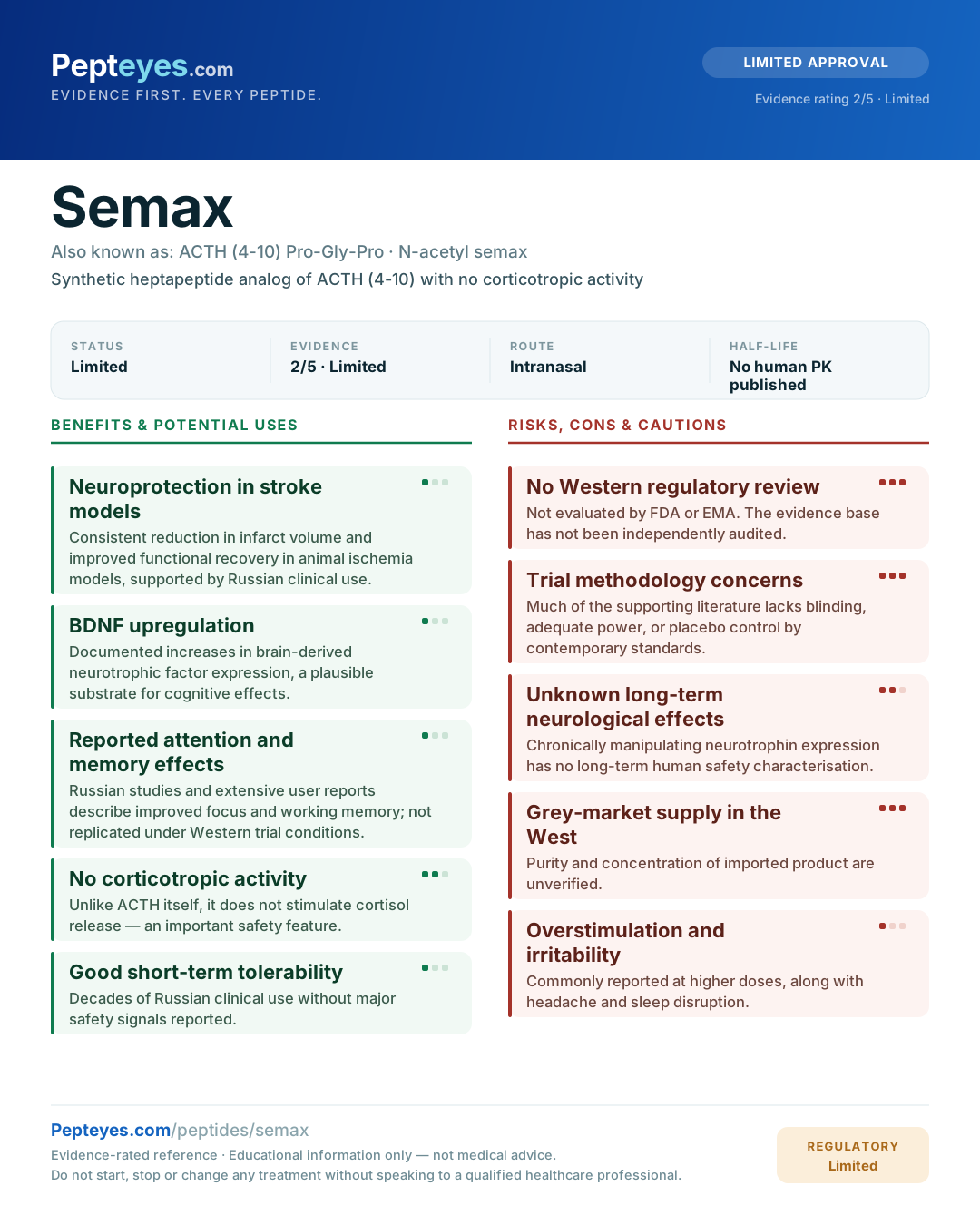
No Western regulatory review — Not evaluated by FDA or EMA. The evidence base has not been independently audited.
Trial methodology concerns — Much of the supporting literature lacks blinding, adequate power, or placebo control by contemporary standards.
Grey-market supply in the West — Purity and concentration of imported product are unverified.
Storage before mixing Refrigerated, upright and sealed. A nasal solution is usually preserved…
Refrigerated, upright and sealed. A nasal solution is usually preserved, but it is still a solution and the same rules on heat and light apply.
Shelf life after mixing Nothing to mix — it is not supplied as a powder. The relevant date is…
Nothing to mix — it is not supplied as a powder. The relevant date is the one printed on the product.
Evidence level 2/5 · Limited — Nothing established
Preclinical work plus scattered human reports, uncontrolled use, or negative trials.
Regulatory status Limited Approval — Documented
Registered in Russia for stroke, cognitive disorders and optic nerve conditions. Not approved in the US, EU or UK. Prescription medicine in Russia. Unapproved elsewhere; import for personal use occupies a legal grey area.
Overview
A well-established medicine in Russia with essentially no Western trial replication. The pharmacology is plausible and the domestic clinical literature is substantial; the problem is that almost none of it meets the methodological standards Western regulators require.
Limited or non-US approvalPrescription medicine in Russia. Unapproved elsewhere; import for personal use occupies a legal grey area.
| Regulatory status | Registered in Russia for stroke, cognitive disorders and optic nerve conditions. Not approved in the US, EU or UK. |
|---|---|
| Drug class | Synthetic heptapeptide analog of ACTH (4-10) with no corticotropic activity |
| Route | Intranasal (primary), subcutaneous |
| Half-life | No human PK published; rat data show rapid blood degradation. Russian label: one intranasal dose acts 20–24 h — effect duration, not half-life. |
| Evidence rating |
2/5 Limited
Evidence rating 2 out of 5: Limited
Preclinical work plus scattered human reports, uncontrolled use, or negative trials. |
| Studied in | Russian clinical trials in ischemic stroke, cognitive impairment, optic nerve atrophy and ADHD; extensive Russian preclinical neuroprotection work. |
Semax sequence & structure
Semax is a 7-residue linear peptide with a free C-terminal acid; molecular weight 813.93 Da.
| Three-letter | H-Met-Glu-His-Phe-Pro-Gly-Pro-OH |
|---|---|
| Length | 7 amino acid residues |
| Modifications | None — an unmodified chain of standard L-amino acids |
| Molecular formula | C37H51N9O10S |
| Molecular weight | 813.93 Da (average, free base) |
| SMILES | CSCC[C@@H](C(=O)N[C@@H](CCC(=O)O)C(=O)N[C@@H](CC1=CN=CN1)C(=O)N[C@@H](CC2=CC=CC=C2)C(=O)N3CCC[C@H]3C(=O)NCC(=O)N4CCC[C@H]4C(=O)O)N |
| Identifiers | CAS 80714-61-0 · PubChem CID 9811102 |
| Which molecule | Describes Semax proper (H-Met-Glu-His-Phe-Pro-Gly-Pro-OH, the Russian-registered nasal drug), i.e. ACTH(4-7) extended with Pro-Gly-Pro. The monograph's alias 'N-acetyl semax' (NA-Semax, often sold as the C-terminal amide 'NA-Semax amidate') is a distinct derivative with Ac-Met... and is not covered by this record; the monograph's 'ACTH(4-10) analog' wording refers to Semax replacing ACTH residues 8-10 (Arg-Trp-Gly) with Pro-Gly-Pro. |
| Sources | PubChem CID 9811102 (Semax; formula, MW, isomeric SMILES, IUPAC name)PubChem CID 9811102 synonyms (CAS 80714-61-0, UNII I5FAL2585H, H-Met-Glu-His-Phe-Pro-Gly-Pro-OH)Wikipedia: Semax (sequence MEHFPGP, C37H51N9O10S, 813.93 g/mol, CAS 80714-61-0, UNII I5FAL2585H)Int J Mol Sci 2021, PMID 34201112 (primary paper: Semax = ACTH(4-7)PGP, Met-Glu-His-Phe-Pro-Gly-Pro) |
Linear, unmodified all-L heptapeptide with free amine and free acid; no disulfides or non-natural residues. Sequence confirmed independently by PubChem (stereo-defined CID 9811102; RDKit InChIKey of the all-L MEHFPGP sequence matches the PubChem structure, formula C37H51N9O10S, average MW 813.93) and by peer-reviewed literature; Wikipedia cites the stereo-undefined duplicate CID 122178 for the same formula/CAS. CAS 80714-61-0 passes the check digit and is given by PubChem and Wikipedia; vendors sometimes list other CAS numbers (e.g. 2828433-33-4), so treat vendor CAS values with caution. Not in DrugBank, ChEMBL, KEGG or ChEBI (searches return only semaxanib). Marketed in Russia as 0.1% and 1% nasal drops.
Record confidence: high — two independent authoritative sources agree on the sequence and modifications. Every sequence on the site is listed with its sources on the peptide sequences index.
How it works
Modified ACTH fragment stripped of hormonal activity. Increases BDNF and NGF expression in the hippocampus, modulates monoaminergic and cholinergic transmission, and shows antioxidant and anti-apoptotic effects in ischemia models. The Pro-Gly-Pro tail confers resistance to peptidase degradation.
Evidence base
Rated 2 of 5 — Limited. Preclinical work plus scattered human reports, uncontrolled use, or negative trials.
- Large domestic literature, negligible international replication — treat both facts as real.
Benefits and risks, weighed against the evidence
Every entry below carries the strength of the evidence behind it — three bars for strong human data, two for moderate, one for preliminary or preclinical work. The two columns are not equal by design: where a compound has more documented risk than demonstrated benefit, the lists say so.
Reported benefits
5 entries
-
Neuroprotection in stroke models
Consistent reduction in infarct volume and improved functional recovery in animal ischemia models, supported by Russian clinical use.
Evidence: Preliminary -
BDNF upregulation
Documented increases in brain-derived neurotrophic factor expression, a plausible substrate for cognitive effects.
Evidence: Preliminary -
Reported attention and memory effects
Russian studies and extensive user reports describe improved focus and working memory; not replicated under Western trial conditions.
Evidence: Preliminary -
No corticotropic activity
Unlike ACTH itself, it does not stimulate cortisol release — an important safety feature.
Evidence: Moderate evidence -
Good short-term tolerability
Decades of Russian clinical use without major safety signals reported.
Evidence: Preliminary
Risks and cautions
5 entries · 3 serious or common
-
No Western regulatory review
Not evaluated by FDA or EMA. The evidence base has not been independently audited.
Evidence: Serious -
Trial methodology concerns
Much of the supporting literature lacks blinding, adequate power, or placebo control by contemporary standards.
Evidence: Serious -
Unknown long-term neurological effects
Chronically manipulating neurotrophin expression has no long-term human safety characterisation.
Evidence: Moderate evidence -
Grey-market supply in the West
Purity and concentration of imported product are unverified.
Evidence: Serious -
Overstimulation and irritability
Commonly reported at higher doses, along with headache and sleep disruption.
Evidence: Minor
Counts are not a score. A single serious risk can outweigh several well-supported benefits, and a long benefit list built on preclinical work outweighs nothing at all.
Opinion — what people actually report
12 themes · 4 reported benefits · 2 reported problems
This is the weakest tier on this site. These are themes drawn from public discussion — forums, subreddits and patient threads — not from trials. There is no control group, no denominator, and no way to confirm that what someone injected matched its label. People post when a result is dramatic and when something goes wrong, and rarely when nothing happens, so treat everything below as a description of the conversation rather than of the compound. The bars count how often a thing is said, not how well it is supported.
-
Described as clarity rather than stimulation Reported benefit. Dominant theme: Comes up in most discussions of this compound.
The most consistent characterisation, and the one that distinguishes it from stimulants in discussion — verbal fluency and focus without the jitter, crash or appetite suppression. Comparisons to prescription stimulants come up constantly, usually from people who have never taken one.
-
Verbal performance is what people notice first Reported benefit. Dominant theme: Comes up in most discussions of this compound.
The reports that go into detail are rarely about feeling sharper in the abstract. They describe the gap between having a thought and being able to say it closing — recall in meetings, articulating a complicated argument, holding a thread while speaking. Several describe timing it ahead of work that demands exactly that, and reserving it for those days rather than taking it routinely.
-
The first time is described as the strongest Practical note. Recurring: Raised regularly, though not by everyone.
A recurring pattern distinct from ordinary tolerance: people report the second or third use landing at a fraction of the first, even after a gap. It is one reason the most enthusiastic accounts tend to come from people early in their experience with it.
-
Something is said to persist after stopping Reported benefit. Occasional: Reported by a minority, or in specific contexts.
A minority report, and an interesting one: that a lifted baseline outlasts the course rather than fading with the last dose. It is also the claim most vulnerable to people simply getting used to working well, and nothing in the human literature speaks to it.
-
Injected versus intranasal is unsettled Practical note. Recurring: Raised regularly, though not by everyone.
Reports run in both directions — people who felt nothing injected and a great deal intranasally, and people who prefer injecting and say so. The published Russian work is intranasal, which is worth knowing before weighing an account based on another route.
-
Often reached for as an undiagnosed-ADHD self-test Practical note. Occasional: Reported by a minority, or in specific contexts.
A theme that sits underneath many accounts rather than on the surface: people who suspect they have attention problems, have never been assessed, and read a good response as confirmation. A compound working is not a diagnosis, and assessment is free or cheap in most places.
-
Mood lift and motivation Reported benefit. Recurring: Raised regularly, though not by everyone.
Frequently reported as a secondary effect, sometimes described as the main one after a few weeks.
-
N-Acetyl Semax Amidate is a different product Practical note. Dominant theme: Comes up in most discussions of this compound.
The distinction between plain Semax and the N-acetyl amidate variants dominates practical discussion, with the latter reported as stronger and longer-lasting.
-
Intranasal delivery is unpleasant Reported problem. Recurring: Raised regularly, though not by everyone.
Burning, drip and sinus irritation are the standard complaints, and a common reason people stop.
-
Effects fade with daily use Reported problem. Recurring: Raised regularly, though not by everyone.
Tolerance is widely reported, driving intermittent rather than continuous use.
-
The absence of a crash is itself a theme Practical note. Recurring: Raised regularly, though not by everyone.
Most accounts volunteer that there was no come-up, no crash and nothing resembling withdrawal on the days after — often unprompted, and usually as the reason they regard it as benign. Irritability or flatness afterwards is reported too, but by a clear minority and mostly after extended runs. Neither pattern has been measured in anyone.
-
Almost all the research is Russian and hard to read Practical note. Recurring: Raised regularly, though not by everyone.
A recurring frustration — the evidence people cite is largely untranslated, unregistered and difficult to appraise.
Where the reports and the evidence part ways
Semax is an approved drug in Russia for stroke and cognitive indications, which is the source of most claims made for it. That approval rests on a literature that is largely Russian-language, frequently unregistered, rarely blinded to Western standards, and almost never independently replicated — so "clinically approved" carries much less weight here than it sounds like it does. There are no Western regulatory approvals and no large independent randomized trials. The cognitive effects healthy users describe have essentially no controlled evidence behind them: the studies that exist are in stroke and pathology, not enhancement. The tolerance reports have no pharmacokinetic work to support or refute them. The gap is widest exactly where the accounts are most vivid: nobody has measured verbal fluency, recall under pressure or social perception on this compound in a healthy person, so the reports of reading a room better or thinking faster than colleagues are describing something no instrument has ever been pointed at. Reports like that are also the most vulnerable to expectation, to the day being a good one anyway, and to the fact that a person who feels sharper is the least reliable judge of whether they are. That is not a reason to dismiss them — it is the reason they sit in this section and not in the evidence above it.
Cheat sheet
The full sheet, all 77 compounds →The community reference numbers for this compound — reconstitution, working dose, cycle and bloodwork. Research and education only, not medical advice, and not part of the evidence-rated monograph above. Doses assume a 1mL / 100-unit insulin syringe — the calculator does the units for you.
Protocol overview
Dosing & reconstitution 10 mg vial
| WEEK | DAILY DOSE | UNITS PER INJECTION |
|---|---|---|
| Weeks 1 to 2 | 300 mcg | 3 units (0.03 mL) |
| Weeks 3 to 4 | 500 mcg | 5 units (0.05 mL) |
| Weeks 5 to 6 | 600 mcg | 6 units (0.06 mL) |
| Weeks 7 to 8 | 800 mcg | 8 units (0.08 mL) |
Frequency: Inject once daily subcutaneously. Most human nootropic studies use intranasal dosing in the range of
On the master sheet
- Vial
- 10mg
- BAC
- 2mL
- Dose
- Inj 200–600mcg / IN 50–100mcg per nostril 1–3x
- Route
- IN preferred
- Cycle
- 2–4 wks
- Time Off
- 1–2 wks
- Pre-mixed nasal spray: Semax 10mg — Focus, cognition, BDNF
Storage note: More fragile. 3–4 weeks reconstituted. Full storage guide →
Readers on Semax
Questions and answers from readers, under generated names. Nothing here has been checked or reviewed by the site and none of it is medical advice. It is the least verified thing on this page — and it is here because people ask each other these things anyway, and most of the other places they can ask are run by sellers.
2 questions · 0 answers
-
Slate Cairn desk — written by the site's editorial desk asked
Intranasal or injected — has anyone tried both, and did the route change anything? Worth flagging that the published Russian work is intranasal, so accounts based on another route are describing something that has not been studied that way.
Reply
No answers yet.
-
Wild Birch desk — written by the site's editorial desk asked
For anyone who has used Semax for work rather than for a diagnosed condition: what does it actually change, and how long does it last for you? The reports that go into detail tend to describe verbal recall and getting a thought into words, more than feeling stimulated. Interested in whether that matches other people, and whether the first time was stronger than what came after.
Reply
No answers yet.
How names work, and the house rules
Names. Every verified address is given one generated name — two ordinary words — and keeps it. Nobody chooses a name and nobody can take another's. Posts marked desk were written by the site's own editorial desk, usually to open a thread; they carry a generated name like everyone else's and are held to the site's rules, which means they never state an amount.
What is not allowed. Selling, sourcing, vendor names, coupon codes and "message me" — posts that read that way are held and usually removed. Personal medical details you would not want public. Abuse. Instructions framed as what someone else should do.
What this is not. A reader's report of what happened to them is a report, not a finding, and an answer here is one person's view. Nothing in this section changes the evidence rating above it. If something you read here would change what you take, take it to a pharmacist or physician first.
Your data. Delete any post of yours at any time, or remove everything you have written together with your name. Details in the privacy notice.
Who should avoid it
- Pregnancy
- Uncontrolled anxiety disorders
- Concurrent stimulant use without medical supervision
If used under medical supervision, monitor
- Blood pressure
- Sleep and mood tracking
Interactions
Not exhaustive. Always have a pharmacist or physician review your full medication list — including supplements.
- Nothing is established with any supplement. The nootropic combinations discussed online - choline sources, racetams, tyrosine, caffeine - have no combination study behind them in any species, and none has been measured for either effect or safety alongside this peptide.
- Dopaminergic stimulants and dopamine-precursor supplements - the one documented combination effect, and it is in rodents. Semax given shortly before d-amphetamine dramatically amplified its effect on extracellular striatal dopamine and on locomotor activity, while semax alone changed neither. Whether that transfers to a person, or to a supplement rather than a drug, is untested.
- Other intranasal products, because of the shared route rather than any pharmacology - absorption depends on intact nasal mucosa, and nothing has measured what a decongestant, a steroid spray or a saline rinse does to it. One intranasal supplement carries a documented harm of its own: FDA recorded more than a hundred and thirty reports of anosmia with zinc-containing intranasal cold products.
Commonly confused with
These mix-ups cause real harm — two products sold under one name, or two molecules whose effects run in opposite directions.
Developed at the same Russian institute and usually sold together. Semax targets cognition and neuroprotection; Selank targets anxiety. Both are registered in Russia and nowhere else.
Compare side by sideBoth Russian nootropics sold as Western supplements. Semax is an intranasal ACTH fragment; noopept is an orally active dipeptide ester that FDA has ruled is not a lawful dietary ingredient.
Compare side by sideRegulatory & legal status
Prescription medicine in Russia. Unapproved elsewhere; import for personal use occupies a legal grey area.
Off Category 2 since April 2026 and recommended by the FDA’s advisory committee in July 2026 — but not yet on the 503A bulks list, so not yet lawfully compoundable.
- Removed from Category 2
- 22 April 2026
- Advisory committee vote
- 8–5, one abstention on 23–24 July 2026, considered for selected neurological indications
- Approved as a drug?
- No. Compounding status and drug approval are separate questions; this compound has no approval for the uses it is sold for.
The full dated record, with sources, and every affected peptide →
Infographic
What this entry was checked against
The specific records this monograph was verified against on its last research pass. We link live literature searches below as well, because these are a snapshot and the literature is not.
- Eremin KO et al. Semax, an ACTH(4-10) analogue with nootropic properties, activates dopaminergic and serotoninergic brain systems in rodents. Neurochem Res 2005;30:1493-500 - semax alone did not alter dopamine; given before d-amphetamine it dramatically enhanced the dopamine and locomotor response
- FDA guidance, Drug Products Labeled as Homeopathic - states that by 2009 FDA had received more than 130 reports of anosmia associated with Zicam homeopathic intranasal zinc products and that labelled use gave significant daily intranasal zinc exposure
- Lim JH et al. Zicam-induced damage to mouse and human nasal tissue. PLoS One 2009 - the only intranasal agent tested that was cytotoxic in both mouse and human nasal tissue, with no recovery of olfactory function after two months
Where to read further
We link to live literature searches rather than a frozen citation list, so you always see current results — including anything published after our last review.
- PubMed — all published literature on Semax
- PubMed — randomized controlled trials only
- ClinicalTrials.gov — registered human trials
Related peptides in Cognitive & Neurological
Terms used on this page
- Enzymatic Degradation
- Enzymatic degradation is the breakdown of a peptide by proteases and peptidases in gut, blood, tissue and kidney, and it is the main reason unmodified peptides act only briefly.
- Nerve Growth Factor (NGF)
- Nerve growth factor is the founding neurotrophin, supporting sympathetic and sensory neurons and basal forebrain cholinergic neurons while also acting as a potent peripheral pain mediator.
- Cholinergic Signalling
- Cholinergic signalling is neurotransmission by acetylcholine at nicotinic and muscarinic receptors, the system that sets cortical attention and encoding and degenerates early in Alzheimer's disease.
- Tissue Perfusion
- Tissue perfusion is the volume of blood delivered through the capillary bed per unit of tissue mass per minute, the quantity that determines local oxygen and drug delivery.
- Adrenocorticotropic Hormone (ACTH)
- Adrenocorticotropic hormone is a 39-amino-acid pituitary peptide, cleaved from proopiomelanocortin, that drives cortisol synthesis in the adrenal cortex through the melanocortin-2 receptor.
- Brain-Derived Neurotrophic Factor (BDNF)
- BDNF is a neurotrophin that signals through the TrkB receptor to support neuronal survival, dendritic growth and the late, protein-synthesis-dependent phase of synaptic potentiation.
This page is educational information, not medical advice. It cannot account for your medical history, medications, or risk factors. Do not start, stop or change any treatment based on it. Speak to a qualified healthcare professional who knows your case.