Supplied as a finished topical
Skin & Cosmetic
At a glance
Ten answers, each one line. Open any row for the detail behind it.
What it does A four-residue acetylated peptide sold almost entirely inside Capixyl, a hair complex…
A four-residue acetylated peptide sold almost entirely inside Capixyl, a hair complex pairing it with a red clover extract rich in biochanin A. Its best human evidence is a 24-week randomised trial of a three-ingredient product against 3% minoxidil, a design that cannot tell you what the peptide itself did. Everything specific to the peptide is cell-culture and organ-culture work run by the company that makes the complex.
Half-life Not applicable — topical and non-systemic. No human… — Nothing established
Not applicable — topical and non-systemic. No human pharmacokinetic data exist for this peptide by any route.
Typical studied dose Set by the formulation, as a percentage of the finished cream or serum… — On the label
Set by the formulation, as a percentage of the finished cream or serum rather than as an amount taken. The concentration used in the published work is the figure worth comparing a product against.
How often it is used Applied as the product directs, usually once or twice a day. Topical… — On the label
Applied as the product directs, usually once or twice a day. Topical results in the published trials came from months of continuous use, not from a short course.
How it is taken Topical only — scalp lotions, hair serums and eyelash conditioners… — Documented
Topical only — scalp lotions, hair serums and eyelash conditioners, almost always as part of the Capixyl complex rather than as an isolated peptide.
Main side effects The peptide has never been tested alone in people · Cosmetic lawfulness is not evidence of efficacy · The mechanistic evidence is manufacturer-generated — Carries serious risk
The peptide has never been tested alone in people — Every human result attributed to it comes from a product that also contained biochanin A and ginseng extract, or from the Capixyl complex as a whole. Nothing in that evidence separates the peptide's contribution from the botanicals', and biochanin A has its own plausible anti-androgen mechanism.
Cosmetic lawfulness is not evidence of efficacy — Having an INCI name and a CAS number means the ingredient may lawfully be listed on a label and sold. It is a regulatory fact about labelling. No regulator has assessed this peptide for treating hair loss, and none has judged that it works.
The mechanistic evidence is manufacturer-generated — The fibroblast, skin explant and ex-vivo follicle experiments, and the four-month trichogram study, all appear in the ingredient manufacturer's technical dossier. They are sponsor-run, not peer reviewed, and reported with semi-quantitative scores and small group sizes.
Storage before mixing A finished cream or serum follows its own label — usually cool, dark and…
A finished cream or serum follows its own label — usually cool, dark and sealed. Copper peptides in particular discolour when they degrade, and a colour change is a reason to stop using it.
Shelf life after mixing Nothing to mix — it is not supplied as a powder. The relevant date is…
Nothing to mix — it is not supplied as a powder. The relevant date is the one printed on the product.
Evidence level 2/5 · Limited — Nothing established
Preclinical work plus scattered human reports, uncontrolled use, or negative trials.
Regulatory status Cosmetic Ingredient — Nothing established
Lawful cosmetic ingredient with an INCI name and a registered CAS number. Not a drug, not approved for hair loss anywhere, and its one peer-reviewed human trial tested a multi-ingredient product rather than the peptide. A lawful cosmetic ingredient in the US, the EU and other major markets, with an INCI name and a registered CAS number, used in hair and eyelash products. It holds no drug approval anywhere and no regulator has evaluated it for treating alopecia. That cosmetic listing is a labelling permission, not a finding of efficacy — it confirms the ingredient may go into a product, not that it does anything to hair.
Overview
A four-residue acetylated peptide sold almost entirely inside Capixyl, a hair complex pairing it with a red clover extract rich in biochanin A. Its best human evidence is a 24-week randomised trial of a three-ingredient product against 3% minoxidil, a design that cannot tell you what the peptide itself did. Everything specific to the peptide is cell-culture and organ-culture work run by the company that makes the complex.
Cosmetic IngredientLawful cosmetic ingredient with an INCI name and a registered CAS number. Not a drug, not approved for hair loss anywhere, and its one peer-reviewed human trial tested a multi-ingredient product rather than the peptide.
| Regulatory status | Lawful cosmetic ingredient with an INCI name and a registered CAS number. Not a drug, not approved for hair loss anywhere, and its one peer-reviewed human trial tested a multi-ingredient product rather than the peptide. |
|---|---|
| Drug class | Synthetic N-acetylated tetrapeptide C-terminal amide, Ac-Lys-Gly-His-Lys-NH2 — the GHK matrikine motif extended by an N-terminal lysine |
| Route | Topical only — scalp lotions, hair serums and eyelash conditioners, almost always as part of the Capixyl complex rather than as an isolated peptide. |
| Half-life | Not applicable — topical and non-systemic. No human pharmacokinetic data exist for this peptide by any route. |
| Evidence rating |
2/5 Limited
Evidence rating 2 out of 5: Limited
Preclinical work plus scattered human reports, uncontrolled use, or negative trials. |
| Studied in | One 24-week randomised, triple-blind trial in 32 adults with mild-to-moderate androgenetic alopecia, comparing a biochanin A, acetyl tetrapeptide-3 and ginseng combination against 3% minoxidil with no vehicle arm; plus manufacturer-run fibroblast, human skin explant and ex-vivo human follicle organ-culture experiments and a four-month trichogram study of the complex against a placebo lotion. |
Acetyl Tetrapeptide-3 sequence & structure
Acetyl Tetrapeptide-3 is a 4-residue linear peptide with a C-terminal amide; molecular weight 509.6 Da.
| Three-letter | Ac-Lys-Gly-His-Lys-NH2 |
|---|---|
| Length | 4 amino acid residues |
| Modifications |
|
| Molecular formula | C22H39N9O5 |
| Molecular weight | 509.6 Da (average, free base) |
| SMILES | CC(=O)N[C@@H](CCCCN)C(=O)NCC(=O)N[C@@H](CC1=CN=CN1)C(=O)N[C@@H](CCCCN)C(=O)N |
| Identifiers | CAS 827306-88-7 · PubChem CID 11752568 |
| Which molecule | Describes the single INCI substance Acetyl Tetrapeptide-3, Ac-Lys-Gly-His-Lys-NH2. The FDA substance record lists Acetyl Tetrapeptide-1 and the trade names Folixyl and Kollaren 6 as further names for this same molecule. Capixyl is the marketed complex of this peptide with butylene glycol, water, dextran and a Trifolium pratense flower extract — a mixture, not this compound. |
| Sources | PubChem CID 11752568 — Acetyl Tetrapeptide-3, formula, MW, isomeric SMILES and CAS cross-referenceFDA Global Substance Registration System, UNII D1HW9N9QBX — name AC-LYS-GLY-HIS-LYS-NH2, CAS 827306-88-7Lucas Meyer Cosmetics, Capixyl technical file — INCI name and CAS 827306-88-7 for the peptide componentLueangarun and Panchaprateep 2020, J Clin Aesthet Dermatol 13(10):32-37 (PMID 33584955) |
PubChem and the FDA substance record independently give the same sequence, both termini and the same CAS, and the average mass recomputed from residue masses (509.6 Da) matches the stated formula. The material is commonly handled as a trifluoroacetate salt and is sold as a dilute solution within the Capixyl complex, so molecular weights quoted for salt or complex will be higher than the free-base figure here.
Record confidence: high — two independent authoritative sources agree on the sequence and modifications. Every sequence on the site is listed with its sources on the peptide sequences index.
How it works
The claimed mechanism is structural rather than hormonal: the peptide is said to prompt connective-tissue cells to rebuild the extracellular matrix around the follicle, so the follicle sits more firmly in the dermis and resists miniaturisation. What was actually measured, in the ingredient manufacturer's own technical dossier, is narrower — more collagen III and laminin staining in a cultured human fibroblast line, and recovery of collagen VII staining at the dermal-epidermal junction of four corticosteroid-suppressed human skin explants. Collagen VII forms anchoring fibrils, which is where the anchoring language comes from, but it was scored in interfollicular skin rather than around follicles, by semi-quantitative image scoring rather than any direct measure of follicle retention. The 5-alpha-reductase inhibition usually credited to Capixyl belongs to biochanin A, not to the peptide.
Evidence base
Rated 2 of 5 — Limited. Preclinical work plus scattered human reports, uncontrolled use, or negative trials.
- Capped at 2. The only peer-reviewed randomised trial tested a three-ingredient combination, so however it turned out it cannot establish what this peptide alone does.
- The ex-vivo human follicle and skin explant work is in-vitro research on human tissue, not clinical evidence; on its own it would rate 1.
- All mechanistic data and the four-month trichogram study of the complex originate in the ingredient manufacturer's technical dossier and are not peer reviewed.
- The published trial declared no funding and no conflicts of interest, which is to its credit, but it had 32 participants, no placebo arm, and an active comparator at a strength below what is usual for men.
Benefits and risks, weighed against the evidence
Every entry below carries the strength of the evidence behind it — three bars for strong human data, two for moderate, one for preliminary or preclinical work. The two columns are not equal by design: where a compound has more documented risk than demonstrated benefit, the lists say so.
Reported benefits
4 entries
-
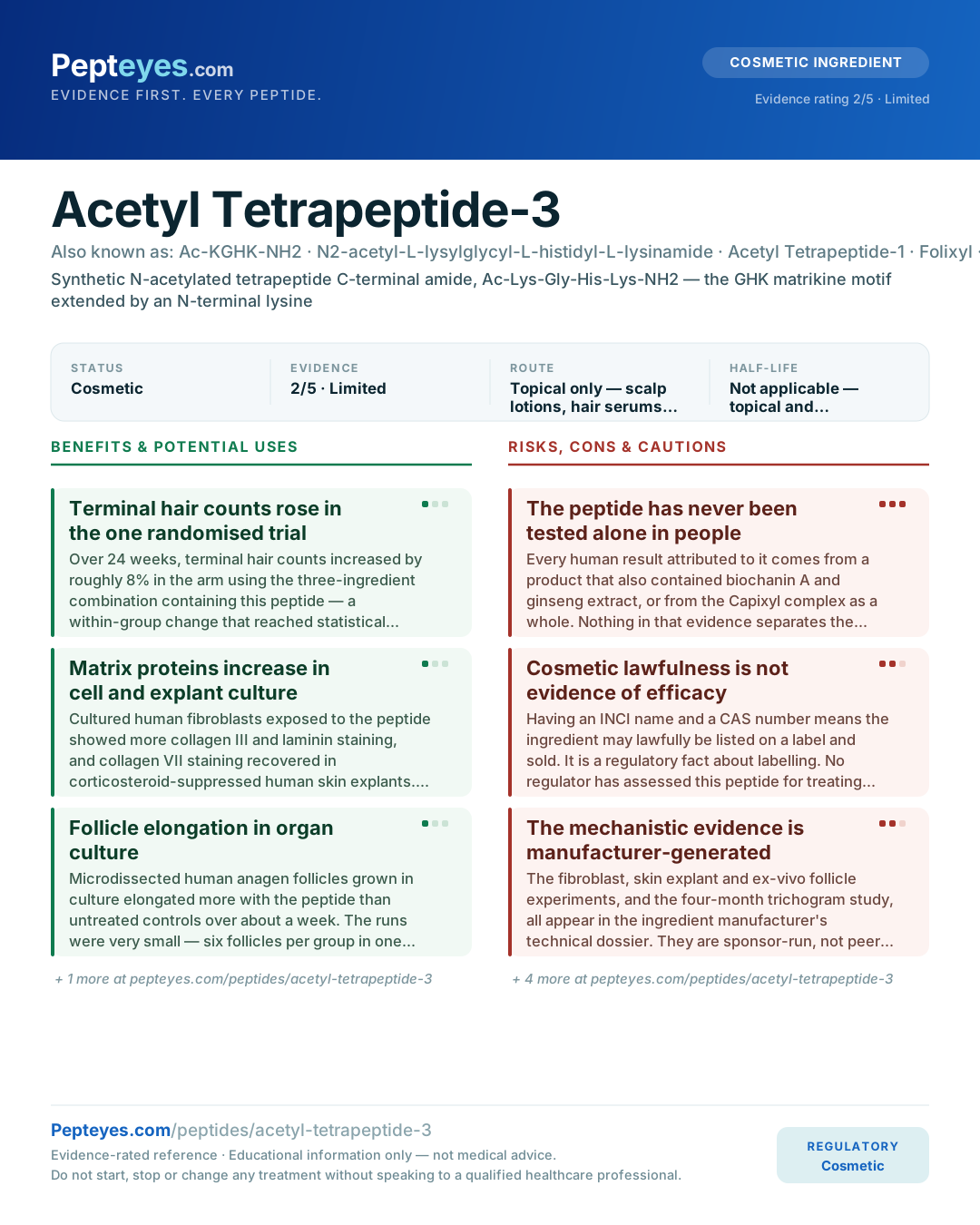
Terminal hair counts rose in the one randomised trial
Over 24 weeks, terminal hair counts increased by roughly 8% in the arm using the three-ingredient combination containing this peptide — a within-group change that reached statistical significance. The arm on 3% minoxidil rose by a near-identical amount.
Evidence: Preliminary -
Matrix proteins increase in cell and explant culture
Cultured human fibroblasts exposed to the peptide showed more collagen III and laminin staining, and collagen VII staining recovered in corticosteroid-suppressed human skin explants. Both were semi-quantitative image scores, in skin rather than in follicles.
Evidence: Preliminary -
Follicle elongation in organ culture
Microdissected human anagen follicles grown in culture elongated more with the peptide than untreated controls over about a week. The runs were very small — six follicles per group in one experiment, fifteen treated in another — and were performed by the ingredient's manufacturer.
Evidence: Preliminary -
No local adverse reactions recorded in the trial
The 24-week trial reported no local adverse reactions in the combination arm, while one participant on 3% minoxidil developed scalp eczema. Seventeen people using a three-ingredient product for 24 weeks is far too thin a base to characterise the peptide's tolerability.
Evidence: Preliminary
Risks and cautions
7 entries · 1 serious or common
-
The peptide has never been tested alone in people
Every human result attributed to it comes from a product that also contained biochanin A and ginseng extract, or from the Capixyl complex as a whole. Nothing in that evidence separates the peptide's contribution from the botanicals', and biochanin A has its own plausible anti-androgen mechanism.
Evidence: Serious -
Cosmetic lawfulness is not evidence of efficacy
Having an INCI name and a CAS number means the ingredient may lawfully be listed on a label and sold. It is a regulatory fact about labelling. No regulator has assessed this peptide for treating hair loss, and none has judged that it works.
Evidence: Moderate evidence -
The mechanistic evidence is manufacturer-generated
The fibroblast, skin explant and ex-vivo follicle experiments, and the four-month trichogram study, all appear in the ingredient manufacturer's technical dossier. They are sponsor-run, not peer reviewed, and reported with semi-quantitative scores and small group sizes.
Evidence: Moderate evidence -
The minoxidil comparison is weaker than it sounds
With 32 participants and no vehicle arm, no significant difference from 3% minoxidil reflects a trial too small to detect one, not demonstrated equivalence. Both arms also improved, which a study without a placebo group cannot disentangle from regression and shaving-cycle effects.
Evidence: Moderate evidence -
Follicle anchoring was never actually measured
Anchoring is inferred from collagen VII staining at the dermal-epidermal junction of interfollicular skin and from matrix proteins in a fibroblast line. No study tracked whether treated follicles were retained, shed less, or resisted miniaturisation in human scalp.
Evidence: Moderate evidence -
Labels rarely say how much is present
Products name the ingredient or the complex without stating its content, so a listing on the back of a bottle carries no information about whether the amount resembles anything that was tested.
Evidence: Minor -
Contact irritation or sensitisation
Uncommon, but scalp and eyelash products are left on and applied daily, and the red clover extract that usually accompanies the peptide is a plant extract with its own sensitisation potential.
Evidence: Minor
Counts are not a score. A single serious risk can outweigh several well-supported benefits, and a long benefit list built on preclinical work outweighs nothing at all.
Opinion — what people actually report
6 themes · 1 reported benefit · 1 reported problem
This is the weakest tier on this site. These are themes drawn from public discussion — forums, subreddits and patient threads — not from trials. There is no control group, no denominator, and no way to confirm that what someone injected matched its label. People post when a result is dramatic and when something goes wrong, and rarely when nothing happens, so treat everything below as a description of the conversation rather than of the compound. The bars count how often a thing is said, not how well it is supported.
-
Met inside a branded complex, not as a peptide Practical note. Dominant theme: Comes up in most discussions of this compound.
Most people encounter it as part of Capixyl, and hair-serum threads usually fold it into shorthand for the Redensyl-Capixyl-Procapil trio rather than judging it on its own. Very little of the discussion is actually about this molecule.
-
The serums it sits in are reported as doing very little Reported problem. Dominant theme: Comes up in most discussions of this compound.
Outcome reports cluster on slight thickening at best and no regrowth. The settled community view is that these products are an optional addition to minoxidil and finasteride rather than an alternative to either.
-
The minoxidil comparison is the most repeated claim about it Practical note. Recurring: Raised regularly, though not by everyone.
The trial finding that the Capixyl complex matched low-strength minoxidil is the line that sells it, and it turns up in almost every thread. The better replies point out that the trial tested the whole complex, which says nothing about the peptide.
-
In lash and brow products it is the prostaglandin-free selling point Practical note. Recurring: Raised regularly, though not by everyone.
A separate conversation with a different tone. Here it is chosen specifically to avoid the iris darkening, lid pigmentation and orbital fat loss associated with bimatoprost-type ingredients, and the accepted trade-off is a slower, milder result.
-
Modest lash and brow thickening over a couple of months Reported benefit. Recurring: Raised regularly, though not by everyone.
The positive reports that do exist come mostly from brow and lash users, who describe denser, darker-looking hair rather than new length, and who generally say it took longer than the packaging implied.
-
A small do-it-yourself strand mixes it with other short peptides Practical note. Occasional: Reported by a minority, or in specific contexts.
It appears by name in home-made scalp blends alongside copper peptides and other short sequences. Nothing in those accounts can be attributed to any single ingredient, and the people writing them usually say as much.
Where the reports and the evidence part ways
The community's low expectations are better founded than the marketing, and for a reason most of the marketing never mentions: the headline study cannot support the claim made from it. That trial ran a three-ingredient complex against 3% minoxidil over twenty-four weeks, so whatever it showed belongs to the complex — and the 5-alpha-reductase inhibition credited to Capixyl belongs to the red clover extract beside the peptide, not to the four residues people think they are buying. Everything specific to the peptide itself is cell-culture and skin-explant work from the ingredient manufacturer, scored by image intensity rather than by any direct measure of follicles retained. Where the forums are harsher than the evidence warrants is on the lash side: the peptide-versus-prostaglandin choice they frame as mere caution is a real one, and preferring a slow ingredient to a bimatoprost analogue genuinely avoids eye-area harms that are well documented, even if the growth it buys is small.
Readers on Acetyl Tetrapeptide-3
Questions and answers from readers, under generated names. Nothing here has been checked or reviewed by the site and none of it is medical advice. It is the least verified thing on this page — and it is here because people ask each other these things anyway, and most of the other places they can ask are run by sellers.
0 questions · 0 answers
No questions yet. Ask the first one above — it takes one box and an email address.
How names work, and the house rules
Names. Every verified address is given one generated name — two ordinary words — and keeps it. Nobody chooses a name and nobody can take another's. Posts marked desk were written by the site's own editorial desk, usually to open a thread; they carry a generated name like everyone else's and are held to the site's rules, which means they never state an amount.
What is not allowed. Selling, sourcing, vendor names, coupon codes and "message me" — posts that read that way are held and usually removed. Personal medical details you would not want public. Abuse. Instructions framed as what someone else should do.
What this is not. A reader's report of what happened to them is a report, not a finding, and an answer here is one person's view. Nothing in this section changes the evidence rating above it. If something you read here would change what you take, take it to a pharmacist or physician first.
Your data. Delete any post of yours at any time, or remove everything you have written together with your name. Details in the privacy notice.
Who should avoid it
- Known allergy to the peptide, or to red clover, which accompanies it in the Capixyl complex
- Broken, inflamed or infected scalp skin
- Eyelash application in anyone with active ocular surface disease
- Using it in place of assessment when hair loss is rapid, patchy, or leaves smooth scarred scalp
If used under medical supervision, monitor
- None required for a topical cosmetic
- Standardised photographs at fixed intervals if you want any honest read on whether something changed
- Stop and seek assessment if the scalp becomes irritated or shedding accelerates
Interactions
Not exhaustive. Always have a pharmacist or physician review your full medication list — including supplements.
- Topical minoxidil — no combination data exist; the one randomised trial compared the two rather than layering them
Regulatory & legal status
A lawful cosmetic ingredient in the US, the EU and other major markets, with an INCI name and a registered CAS number, used in hair and eyelash products. It holds no drug approval anywhere and no regulator has evaluated it for treating alopecia. That cosmetic listing is a labelling permission, not a finding of efficacy — it confirms the ingredient may go into a product, not that it does anything to hair.
Infographic
What this entry was checked against
The specific records this monograph was verified against on its last research pass. We link live literature searches below as well, because these are a snapshot and the literature is not.
- Lueangarun and Panchaprateep 2020 — herbal extract combination (biochanin A, acetyl tetrapeptide-3, ginseng) versus 3% minoxidil, 24-week randomised triple-blind trial, full text
- PubMed record and abstract for that trial, PMID 33584955
- Journal of Clinical and Aesthetic Dermatology, publisher full text of that trial — 2020;13(10):32-37, n=32, terminal hair count +8.3% versus +8.68% on 3% minoxidil
- Lucas Meyer Cosmetics, Capixyl technical file — sponsor-run fibroblast, skin explant, ex-vivo follicle and four-month trichogram studies, and the complex's INCI composition
- PubChem CID 11752568 — chemical identity of Acetyl Tetrapeptide-3
- FDA Global Substance Registration System, UNII D1HW9N9QBX — sequence, CAS and synonym record
Where to read further
We link to live literature searches rather than a frozen citation list, so you always see current results — including anything published after our last review.
- PubMed — all published literature on Acetyl Tetrapeptide-3
- PubMed — randomized controlled trials only
- ClinicalTrials.gov — registered human trials
Related peptides in Skin & Cosmetic
Terms used on this page
- Randomised Controlled Trial (RCT)
- A randomised controlled trial assigns participants to intervention or control by chance and follows them prospectively, which is what allows an outcome difference to be attributed to the treatment itself.
- N-Terminal Acetylation
- N-terminal acetylation caps the free alpha-amino group of a peptide with an acetyl group, adding 42 daltons, removing a positive charge, and blocking attack by aminopeptidases.
- Extracellular Matrix (ECM)
- The extracellular matrix is the network of collagens, proteoglycans and glycoproteins outside cells that bears mechanical load, stores growth factors, and signals back to the cells within it.
- Collagen Type III
- Collagen type III is a thin-fibril homotrimeric collagen abundant in blood vessels, fetal tissue and early granulation tissue, and its persistence marks mechanically inferior repair.
- Fibroblast
- A fibroblast is the mesenchymal cell that produces and maintains connective tissue matrix, and which differentiates into a contractile myofibroblast during wound repair.
- Dermis
- The dermis is the vascularised connective tissue layer beneath the epidermis, divided into a fine papillary layer and a coarse reticular layer, and it carries the skin's mechanical strength.
This page is educational information, not medical advice. It cannot account for your medical history, medications, or risk factors. Do not start, stop or change any treatment based on it. Speak to a qualified healthcare professional who knows your case.