Supplied as a finished topical
Skin & Cosmetic
At a glance
Ten answers, each one line. Open any row for the detail behind it.
What it does GHK with a biotin group welded to its N-terminus, encountered almost entirely as one of…
GHK with a biotin group welded to its N-terminus, encountered almost entirely as one of the three actives in the Procapil blend. The peptide on its own has been studied in cultured human hair follicles, where it increased hair-shaft growth over fourteen days. It has never been tested alone in a person: every human trial gave people the three-ingredient blend, and several layered that blend on top of minoxidil or platelet-rich plasma.
Half-life Not applicable — topical and non-systemic; no human… — Nothing established
Not applicable — topical and non-systemic; no human pharmacokinetics have been published
Typical studied dose Set by the formulation, as a percentage of the finished cream or serum… — On the label
Set by the formulation, as a percentage of the finished cream or serum rather than as an amount taken. The concentration used in the published work is the figure worth comparing a product against.
How often it is used Applied as the product directs, usually once or twice a day. Topical… — On the label
Applied as the product directs, usually once or twice a day. Topical results in the published trials came from months of continuous use, not from a short course.
How it is taken Topical, in leave-on scalp, brow and lash formulations — Documented
Topical, in leave-on scalp, brow and lash formulations
Main side effects The peptide alone has never been tested in people · Multi-ingredient attribution problem, compounded · Cosmetic lawfulness is not evidence of efficacy — Depends on the study
The peptide alone has never been tested in people — Every human study gave participants a finished multi-ingredient product. The only work on biotinoyl tripeptide-1 by itself is in-vitro and ex-vivo, which means the case for it rests on follicles in a culture dish rather than on anyone's scalp.
Multi-ingredient attribution problem, compounded — Procapil carries two other actives with their own rationales, and several trials then stack it on minoxidil or platelet-rich plasma. When a two-or-three-active arm beats a one-active arm, the extra effect could belong to any component or to none of them individually.
Cosmetic lawfulness is not evidence of efficacy — Appearing on the EU ingredient inventory as a hair-conditioning agent means the ingredient may lawfully be put in a cosmetic and described in cosmetic terms. It is a statement about labelling and safety review, not a regulator's conclusion that it does anything to hair loss.
Storage before mixing A finished cream or serum follows its own label — usually cool, dark and…
A finished cream or serum follows its own label — usually cool, dark and sealed. Copper peptides in particular discolour when they degrade, and a colour change is a reason to stop using it.
Shelf life after mixing Nothing to mix — it is not supplied as a powder. The relevant date is…
Nothing to mix — it is not supplied as a powder. The relevant date is the one printed on the product.
Evidence level 2/5 · Limited — Nothing established
Preclinical work plus scattered human reports, uncontrolled use, or negative trials.
Regulatory status Cosmetic Ingredient — Nothing established
A lawful cosmetic ingredient with no drug approval anywhere. The EU ingredient inventory lists it as a hair-conditioning agent, which is a labelling classification, not a regulator's finding that it grows hair. A lawful cosmetic ingredient in the United States, the European Union and the United Kingdom, listed in the EU cosmetic ingredient inventory as a hair-conditioning agent under Regulation 1223/2009. It holds no marketing authorisation as a medicine anywhere. That boundary constrains claims: in the US a product claiming to regrow hair or to treat androgenetic alopecia is making a drug claim and would need approval, and in the EU such a claim is outside what a cosmetic may say. It is not a controlled substance and is not named on the WADA Prohibited List.
Overview
GHK with a biotin group welded to its N-terminus, encountered almost entirely as one of the three actives in the Procapil blend. The peptide on its own has been studied in cultured human hair follicles, where it increased hair-shaft growth over fourteen days. It has never been tested alone in a person: every human trial gave people the three-ingredient blend, and several layered that blend on top of minoxidil or platelet-rich plasma.
Cosmetic IngredientA lawful cosmetic ingredient with no drug approval anywhere. The EU ingredient inventory lists it as a hair-conditioning agent, which is a labelling classification, not a regulator's finding that it grows hair.
| Regulatory status | A lawful cosmetic ingredient with no drug approval anywhere. The EU ingredient inventory lists it as a hair-conditioning agent, which is a labelling classification, not a regulator's finding that it grows hair. |
|---|---|
| Drug class | Vitamin-peptide conjugate: the tripeptide GHK (Gly-His-Lys) with biotin amide-bonded to the glycine N-terminus |
| Route | Topical, in leave-on scalp, brow and lash formulations |
| Half-life | Not applicable — topical and non-systemic; no human pharmacokinetics have been published |
| Evidence rating |
2/5 Limited
Evidence rating 2 out of 5: Limited
Preclinical work plus scattered human reports, uncontrolled use, or negative trials. |
| Studied in | On the peptide alone: cultured human hair-follicle explants over fourteen days and an eighteen-hour skin-explant localisation study, both commissioned by the ingredient manufacturer. The gene array in that dossier tested the blend, not the peptide. In people, only blend trials: a four-month randomised placebo-controlled study in 35 men, then add-on trials with minoxidil or PRP. |
Biotinoyl Tripeptide-1 (Biotinyl-GHK) sequence & structure
Biotinoyl Tripeptide-1 (Biotinyl-GHK) is a 3-residue linear peptide conjugate with a free C-terminal acid; molecular weight 566.68 Da.
| Three-letter | Biotinoyl-Gly-His-Lys-OH |
|---|---|
| Length | 3 amino acid residues |
| Modifications |
|
| Molecular formula | C24H38N8O6S |
| Molecular weight | 566.68 Da (average, free base) |
| SMILES | C1[C@H]2[C@@H]([C@@H](S1)CCCCC(=O)NCC(=O)N[C@@H](CC3=CN=CN3)C(=O)N[C@@H](CCCCN)C(=O)O)NC(=O)N2 |
| Identifiers | CAS 299157-54-3 · PubChem CID 11534242 |
| Which molecule | This record describes the single molecule biotinyl-GHK, INCI name Biotinoyl Tripeptide-1, CAS 299157-54-3. It is not GHK-Cu, which is the same tripeptide holding a copper(II) ion rather than carrying a covalent acyl group, and it is not palmitoyl tripeptide-1, which is the same tripeptide N-acylated with palmitic acid instead of biotin. Procapil, the trade blend it is usually encountered in, is a solution of this peptide together with apigenin and oleanolic acid in a glycol and surfactant carrier, and is a mixture rather than a compound. |
| Sources | PubChem CID 11534242 — formula, molecular weight, IUPAC name and isomeric SMILES for biotinoyl tripeptide-1PubChem CID 11534242 CAS cross-reference (RN 299157-54-3)FDA GSRS / UNII O6380721VA — BIOTINOYL TRIPEPTIDE-1, systematic name placing the biotinoyl acyl on the glycyl nitrogenCOSMILE Europe INCI entry, Biotinoyl Tripeptide-1 (CosIng-derived ingredient record and declared function)Sederma Procapil technical dossier — INCI declaration of the blend naming Biotinoyl Tripeptide-1 |
Two independent authoritative records agree on both the sequence and the point of attachment: the PubChem isomeric SMILES shows the biotin valeryl carbonyl bonded to the glycine nitrogen with the lysine side-chain amine drawn free, and the FDA GSRS systematic name reads as the N-acylated glycyl-L-histidyl-L-lysine with no N6 locant on the lysine. So the biotinyl group sits on the N-terminus, not on a lysine side chain — the opposite of the usual laboratory biotinylation of a protein, which targets lysine side chains. The formula and 566.68 Da mass are for the free base; material is often handled as an acetate or trifluoroacetate salt and is almost always sold as a dilute solution in a carrier, so a certificate of analysis may quote a different mass or a much lower assay.
Record confidence: high — two independent authoritative sources agree on the sequence and modifications. Every sequence on the site is listed with its sources on the peptide sequences index.
How it works
GHK is a tripeptide released from collagen during tissue damage, where it acts as a repair signal. Biotinoyl tripeptide-1 attaches biotin to its N-terminal glycine through an amide bond built from biotin's valeric acid tail, leaving the lysine side chain and the C-terminal acid free. Two things are claimed for that conjugation: the fused ring and five-carbon tail make a very water-loving tripeptide less hydrophilic and so more likely to associate with the follicle, and biotin is a cofactor for the carboxylases that build fatty acids in keratinocytes. In cultured follicles the peptide is reported to sustain keratinocyte division in the root sheath and to preserve collagen IV and laminin 5 in the basement membrane that anchors the follicle. In the blend it sits beside apigenin, offered as a vasodilator, and oleanolic acid, offered as a 5-alpha-reductase inhibitor; the androgen-pathway rationale belongs to those two, not to the peptide.
Evidence base
Rated 2 of 5 — Limited. Preclinical work plus scattered human reports, uncontrolled use, or negative trials.
- Rated 2. The peptide on its own has only laboratory data: cultured human hair-follicle explants and skin explants are in-vitro work on human tissue, not clinical trials, and count as evidence 1 however human the tissue is. What lifts it to 2 is the presence of scattered human trials, none of which tested the peptide.
- Every human trial studied a multi-ingredient formulation. The four-month placebo-controlled study tested a lotion containing biotinyl-GHK, apigenin and oleanolic acid together, so a positive result there cannot be assigned to any one of the three. Later trials compound this by adding minoxidil or platelet-rich plasma to both arms or to one.
- The human evidence is also thin and mixed. A randomised comparison in 54 men found the blend plus PRP performed worse than a different multi-ingredient topical plus PRP, and the add-on studies are small, single-centre and in one case not described as randomised.
- Cosmetic lawfulness is a regulatory fact about labelling and ingredient safety, not evidence that the ingredient works. Nothing about being on the EU inventory implies a regulator reviewed efficacy data for hair loss, because no regulator was asked to.
- The strongest peptide-specific findings, the explant growth figures and the follicle localisation, come from studies commissioned by the ingredient manufacturer and published as a technical dossier. They are reported here because that dossier is the origin of the data, not because sponsor-run work carries the weight of an independent trial.
Benefits and risks, weighed against the evidence
Every entry below carries the strength of the evidence behind it — three bars for strong human data, two for moderate, one for preliminary or preclinical work. The two columns are not equal by design: where a compound has more documented risk than demonstrated benefit, the lists say so.
Reported benefits
6 entries
-
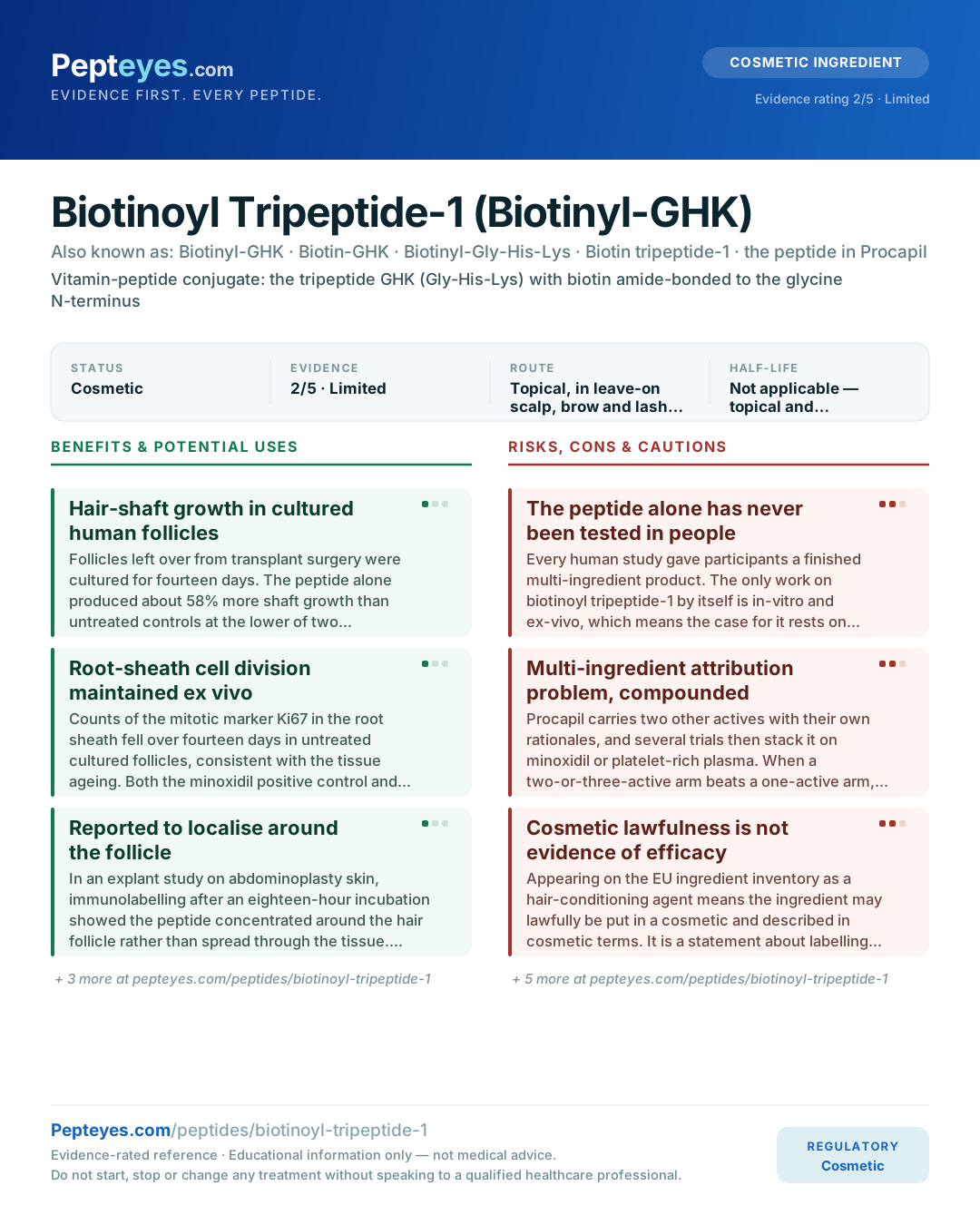
Hair-shaft growth in cultured human follicles
Follicles left over from transplant surgery were cultured for fourteen days. The peptide alone produced about 58% more shaft growth than untreated controls at the lower of two concentrations, similar to the minoxidil positive control, and about 121% more at the higher one. This is human tissue in a dish, not a person.
Evidence: Preliminary -
Root-sheath cell division maintained ex vivo
Counts of the mitotic marker Ki67 in the root sheath fell over fourteen days in untreated cultured follicles, consistent with the tissue ageing. Both the minoxidil positive control and the peptide kept the count up. A laboratory readout on explanted tissue, with no clinical endpoint attached.
Evidence: Preliminary -
Reported to localise around the follicle
In an explant study on abdominoplasty skin, immunolabelling after an eighteen-hour incubation showed the peptide concentrated around the hair follicle rather than spread through the tissue. That addresses the obvious objection to a hydrophilic tripeptide, but it is a short explant experiment from the manufacturer's own dossier.
Evidence: Preliminary -
Anagen shift in a blend trial
A four-month randomised placebo-controlled trial in 35 men, 18 on the blend and 17 on an indistinguishable placebo, measured the anagen-to-telogen ratio by videotrichogram and reported roughly a tenth more hair in the growth phase than at baseline, with no change on placebo. It tested the three-ingredient lotion, so nothing in it is attributable to the peptide.
Evidence: Preliminary -
Possible add-on value to minoxidil or PRP
A randomised trial in 140 men alternating the blend with 5% minoxidil reported higher hair counts than 5% minoxidil alone over twelve months, and a 160-patient non-randomised study favoured platelet-rich plasma plus the blend over PRP alone. A third randomised trial, in 54 men, found the blend plus PRP did worse than a rival multi-ingredient topical plus PRP. None isolates the peptide.
Evidence: Preliminary -
Well tolerated in the blend trials
The four-month placebo-controlled study reported the lotion was well tolerated by all 18 volunteers on it over four months, and the larger add-on trials report no tolerability problem. That is a finding about finished multi-ingredient products assessed by interview and scalp examination, not about the peptide, which has never been applied to a person on its own.
Evidence: Preliminary
Risks and cautions
8 entries
-
The peptide alone has never been tested in people
Every human study gave participants a finished multi-ingredient product. The only work on biotinoyl tripeptide-1 by itself is in-vitro and ex-vivo, which means the case for it rests on follicles in a culture dish rather than on anyone's scalp.
Evidence: Moderate evidence -
Multi-ingredient attribution problem, compounded
Procapil carries two other actives with their own rationales, and several trials then stack it on minoxidil or platelet-rich plasma. When a two-or-three-active arm beats a one-active arm, the extra effect could belong to any component or to none of them individually.
Evidence: Moderate evidence -
Cosmetic lawfulness is not evidence of efficacy
Appearing on the EU ingredient inventory as a hair-conditioning agent means the ingredient may lawfully be put in a cosmetic and described in cosmetic terms. It is a statement about labelling and safety review, not a regulator's conclusion that it does anything to hair loss.
Evidence: Moderate evidence -
The peptide-specific data comes from the ingredient manufacturer
The follicle-explant growth study, the localisation study and the gene array were commissioned by the company that makes the blend and circulate as a technical dossier rather than as peer-reviewed papers. They have not been independently replicated.
Evidence: Moderate evidence -
Biotin on a peptide is not a biotin supplement
The biotin here is chemically bonded to a tripeptide and applied to the scalp. It is not a nutrient being delivered, and it says nothing about swallowing biotin, which in reviewed case reports helped only people with a genuine deficiency or a specific hair or nail disorder.
Evidence: Minor -
Androgenetic alopecia keeps progressing while you experiment
Pattern hair loss is gradual and, once a follicle miniaturises past a point, not recoverable. Months spent on a cosmetic serum instead of assessed treatment are months of loss that treatments with real trial evidence might have slowed.
Evidence: Moderate evidence -
Any effect ends when use ends
Nothing in this evidence base suggests a durable change to the follicle. The blend trials measured people while they were still applying the product and none followed anyone after stopping.
Evidence: Minor -
Eye-area products carry the formulation's risks, not the peptide's
It is common in brow and lash serums, where the vehicle, preservatives and any added prostaglandin analogue matter far more than the peptide. Irritation, conjunctival redness and, with some lash actives, iris and periorbital changes belong to those other ingredients.
Evidence: Minor
Counts are not a score. A single serious risk can outweigh several well-supported benefits, and a long benefit list built on preclinical work outweighs nothing at all.
Opinion — what people actually report
No community discussion to summarise
There is no community self-report for biotinoyl tripeptide-1 as such. People meet it as one of the three actives in Procapil, or as a line on the ingredient list of a brow or lash serum, and what they discuss is the product: whether Procapil is worth adding to minoxidil, whether a peptide serum is the safer choice for lashes than a prostaglandin analogue. The peptide gets named in those threads but never judged, because nobody has used it on its own. That mirrors the published record exactly — every human trial gave people the blend, several of them layered over an established treatment — so neither the forums nor the literature can tell you what this molecule does by itself.
Readers on Biotinoyl Tripeptide-1 (Biotinyl-GHK)
Questions and answers from readers, under generated names. Nothing here has been checked or reviewed by the site and none of it is medical advice. It is the least verified thing on this page — and it is here because people ask each other these things anyway, and most of the other places they can ask are run by sellers.
0 questions · 0 answers
No questions yet. Ask the first one above — it takes one box and an email address.
How names work, and the house rules
Names. Every verified address is given one generated name — two ordinary words — and keeps it. Nobody chooses a name and nobody can take another's. Posts marked desk were written by the site's own editorial desk, usually to open a thread; they carry a generated name like everyone else's and are held to the site's rules, which means they never state an amount.
What is not allowed. Selling, sourcing, vendor names, coupon codes and "message me" — posts that read that way are held and usually removed. Personal medical details you would not want public. Abuse. Instructions framed as what someone else should do.
What this is not. A reader's report of what happened to them is a report, not a finding, and an answer here is one person's view. Nothing in this section changes the evidence rating above it. If something you read here would change what you take, take it to a pharmacist or physician first.
Your data. Delete any post of yours at any time, or remove everything you have written together with your name. Details in the privacy notice.
Who should avoid it
- Broken, inflamed, infected or freshly treated scalp skin
- Known allergy to the peptide or to other ingredients in the formulation
- Use in place of assessment for sudden, patchy or scarring hair loss
- Eye-area use of a product not formulated and tested for the eye area
If used under medical supervision, monitor
- None required for a topical cosmetic
- Photograph the same scalp area in the same light before starting, since hair change is slow and memory is unreliable
- Stop if redness, itching or scaling appears
- Have unexplained, rapid or patchy shedding assessed rather than treated with a serum
Interactions
Not exhaustive. Always have a pharmacist or physician review your full medication list — including supplements.
- Topical minoxidil — the only human data combining them tested the blend added to minoxidil, so nothing is known about the peptide's own contribution
- Platelet-rich plasma — two studies layered the blend over PRP sessions, which means neither the PRP result nor the topical result can be read on its own
- Oral biotin supplements — unrelated to this topical conjugate, but ingested biotin can distort immunoassays including troponin and thyroid tests, and the two are frequently confused because the names overlap
- Topical prostaglandin analogues in lash serums — the ocular and periorbital risks in those products come from the prostaglandin, not the peptide alongside it
Commonly confused with
These mix-ups cause real harm — two products sold under one name, or two molecules whose effects run in opposite directions.
Both are the same GHK tripeptide carrying something extra, and both are sold for hair, so the names get swapped constantly. GHK-Cu is a coordination complex in which a copper ion is held by the peptide, and much of its claimed activity is attributed to copper delivery. Biotinoyl tripeptide-1 contains no copper: biotin is covalently bonded to the N-terminus, a permanent chemical change rather than a bound metal.
Compare side by sideMatrixyl is palmitoyl pentapeptide-4, a different sequence entirely. The confusion is real because the Matrixyl 3000 blend contains palmitoyl tripeptide-1, which is the same GHK core as this molecule with a palmitoyl group instead of a biotinoyl one. Same tripeptide, different acyl group, different target: skin rather than scalp.
Compare side by sideRegulatory & legal status
A lawful cosmetic ingredient in the United States, the European Union and the United Kingdom, listed in the EU cosmetic ingredient inventory as a hair-conditioning agent under Regulation 1223/2009. It holds no marketing authorisation as a medicine anywhere. That boundary constrains claims: in the US a product claiming to regrow hair or to treat androgenetic alopecia is making a drug claim and would need approval, and in the EU such a claim is outside what a cosmetic may say. It is not a controlled substance and is not named on the WADA Prohibited List.
Infographic
What this entry was checked against
The specific records this monograph was verified against on its last research pass. We link live literature searches below as well, because these are a snapshot and the literature is not.
- PubChem CID 11534242 — biotinoyl tripeptide-1 compound record
- COSMILE Europe — Biotinoyl Tripeptide-1 INCI ingredient record and declared cosmetic function
- Sederma Procapil technical dossier — INCI declaration, the BIO-EC cultured hair-follicle explant study, the BIOALTERNATIVES explant localisation and gene-array work, and the four-month placebo-controlled trial run by Laboratoires DERMSCAN (sponsor-run, not peer-reviewed)
- Tr P, Ts R, K SK, Prasanna H. Cureus 2023 — randomised comparison of topical Procapil with PRP versus redensyl, saw palmetto and biotin with PRP in androgenetic alopecia (PMID 37292551)
- Fahim M, Khoso H, Khan J, Bakhtiar R. J Pak Assoc Dermatol 2024;34:384-391 — randomised trial of topical minoxidil alone versus minoxidil alternated with Procapil in 140 patients
- Khoso H, Fahim M. J Ayub Med Coll Abbottabad 2024 — platelet-rich plasma alone versus PRP with daily topical Procapil in 160 patients with androgenetic alopecia (PMID 39609969)
- Samadi A et al. J Cosmet Dermatol 2024;23:1492-1494 — letter reporting efficacy and tolerability of a topical caffeine plus Procapil formulation in male pattern hair loss (PMID 37990760)
- Patel DP, Swink SM, Castelo-Soccio L. Skin Appendage Disord 2017;3:166-169 (PMC5582478) — review of 18 reported cases finding benefit from biotin supplementation only where an underlying deficiency or specific hair or nail pathology was present
- FDA — biotin interference with troponin and other immunoassay-based laboratory tests (safety communication and device guidance)
- FDA GSRS substance record, UNII O6380721VA — BIOTINOYL TRIPEPTIDE-1
Where to read further
We link to live literature searches rather than a frozen citation list, so you always see current results — including anything published after our last review.
- PubMed — all published literature on Biotinoyl Tripeptide-1 (Biotinyl-GHK)
- PubMed — randomized controlled trials only
- ClinicalTrials.gov — registered human trials
Related peptides in Skin & Cosmetic
Terms used on this page
- N-Terminus
- The N-terminus is the end of a peptide chain bearing a free alpha-amino group, the point from which sequences are written and from which aminopeptidases and DPP-4 begin degrading the molecule.
- Keratinocyte
- Keratinocytes are the cells that make up almost all of the epidermis, differentiating from the basal layer upward and dying in a programmed way to build the stratum corneum barrier.
- Hydrophobicity
- Hydrophobicity is the tendency of a residue or peptide to be excluded from water, and it governs solubility, aggregation, chromatographic behaviour and interaction with membranes.
- Peptide Bond
- A peptide bond is the amide linkage joining the carboxyl group of one amino acid to the amino group of the next, formed with the loss of water and remarkably resistant to spontaneous hydrolysis.
- C-Terminus
- The C-terminus is the end of a peptide chain carrying a free alpha-carboxyl group, the point at which sequences stop being written and where carboxypeptidases attack.
- Amino Acid Side Chain
- The side chain, or R group, is the variable substituent on an amino acid's alpha carbon that determines its charge, polarity, bulk and chemical reactivity within a peptide.
This page is educational information, not medical advice. It cannot account for your medical history, medications, or risk factors. Do not start, stop or change any treatment based on it. Speak to a qualified healthcare professional who knows your case.