Supplied as a lyophilised powder to reconstitute
Longevity & Mitochondrial
At a glance
Ten answers, each one line. Open any row for the detail behind it.
What it does A four-residue peptide from the Khavinson family of Russian bioregulators, sold for the…
A four-residue peptide from the Khavinson family of Russian bioregulators, sold for the liver and lately for ageing in general. The published record is rat hepatocytes and liver explants, two weeks of feeding to rats, and cultured blood cells from people in their eighties, nearly all from one St Petersburg institute and its Tbilisi collaborators. The only time it was given to people is a 23-patient open comparison in chronic hepatitis that exists solely as an example in an expired patent. Sellers call it hepatoprotective; the liver evidence they cite mostly belongs to a calf-liver extract, a different substance.
Half-life Never measured in any species. It resists intestinal… — Documented
Never measured in any species. It resists intestinal peptidases in a test tube for hours, which is a stability finding, not a pharmacokinetic one.
Typical studied dose None established. No dose has ever been set for a human being, because… — Nothing established
None established. No dose has ever been set for a human being, because the studies that would set one have not been done. Any figure circulating for this compound was chosen by somebody selling it or by somebody guessing.
How often it is used No schedule exists. Cycles and intervals quoted for this compound come… — Nothing established
No schedule exists. Cycles and intervals quoted for this compound come from forums rather than from any study, and they vary because nothing anchors them.
How it is taken Grey-market lyophilised powder for injection, also swallowed by some… — Documented
Grey-market lyophilised powder for injection, also swallowed by some users; the inventor's patent describes intramuscular injection. No route has been studied for absorption in a person.
Main side effects The human record is one patent example that cannot be examined · Unapproved grey-market material of unverifiable identity · The evidence base traces to one programme — Carries serious risk
The human record is one patent example that cannot be examined — No trial of this peptide has been published in a journal or registered anywhere. The only account of people receiving it is an example in its inventor's patent: twenty-three patients, no reported control results, no randomisation or blinding, modest changes in two lab values. Everything else claimed for it in people is extrapolation from rat liver cells and cultured blood cells.
Unapproved grey-market material of unverifiable identity — It is not an approved medicine anywhere and circulates under research-use-only labelling with no oversight of identity, purity, sterility or endotoxin. Listings for it have given the wrong sequence, the wrong source organ and a molecular weight that matches no form of the molecule, which says something about how carefully it is handled.
The evidence base traces to one programme — The chemistry, the patent, the rat and hepatocyte work and the 2020 review all come from the St Petersburg Institute of Bioregulation and Gerontology. The chromatin work comes from a genetics department in Tbilisi that began as that institute's collaborator and works with peptides it supplied. No group outside that circle has published on the sequence, which is a weaker position than merely being untested.
Storage before mixing As a sealed lyophilised powder, refrigerated is typical and a freezer…
As a sealed lyophilised powder, refrigerated is typical and a freezer suits long storage; both should be dark and dry. A dry powder tolerates a few days out of the cold far better than anything in solution — which is why it ships that way.
Shelf life after mixing Once mixed it is refrigerated and treated as short-lived. Bacteriostatic…
Once mixed it is refrigerated and treated as short-lived. Bacteriostatic water contains a preservative and buys the longer window; sterile water contains none and buys a much shorter one. Peptides in solution also degrade on their own, so the container is only half the question.
Evidence level 2/5 · Limited — Nothing established
Preclinical work plus scattered human reports, uncontrolled use, or negative trials.
Regulatory status Research Use Only — Nothing established
Not an approved medicine anywhere. The US patent on the sequence lapsed in 2014 and nothing is marketed under this name through any regulator; it circulates under research-use-only labelling. No registered human trial exists as of October 2026. Livagen has no marketing authorisation in the United States, the European Union or the United Kingdom, and no licence as a medicine anywhere we could find. It is not a controlled substance. Its inventor's institute patented it in the United States in 2006 (US 7,101,854) on a Russian filing of 2000; the patent lapsed in 2014 for non-payment, so nothing stops anyone synthesising it. In Russia the group's commercial liver product is the calf-liver complex sold as Ventvil, not this peptide. It is not on the WADA Prohibited List, but the clause for substances with no approval from any health authority reaches it.
Overview
A four-residue peptide from the Khavinson family of Russian bioregulators, sold for the liver and lately for ageing in general. The published record is rat hepatocytes and liver explants, two weeks of feeding to rats, and cultured blood cells from people in their eighties, nearly all from one St Petersburg institute and its Tbilisi collaborators. The only time it was given to people is a 23-patient open comparison in chronic hepatitis that exists solely as an example in an expired patent. Sellers call it hepatoprotective; the liver evidence they cite mostly belongs to a calf-liver extract, a different substance.
Not approved for human use anywhereNo approval anywhere for human use. Sold under research-use labelling. Livagen has no marketing authorisation in the United States, the European Union or the United Kingdom, and no licence as a medicine anywhere we could find. It is not a controlled substance. Its inventor's institute patented it in the United States in 2006 (US 7,101,854) on a Russian filing of 2000; the patent lapsed in 2014 for non-payment, so nothing stops anyone synthesising it. In Russia the group's commercial liver product is the calf-liver complex sold as Ventvil, not this peptide. It is not on the WADA Prohibited List, but the clause for substances with no approval from any health authority reaches it.
| Regulatory status | Not an approved medicine anywhere. The US patent on the sequence lapsed in 2014 and nothing is marketed under this name through any regulator; it circulates under research-use-only labelling. No registered human trial exists as of October 2026. |
|---|---|
| Drug class | Synthetic tetrapeptide Lys-Glu-Asp-Ala, one of the Khavinson short peptide bioregulators, designed from the amino acid composition of a calf-liver polypeptide extract |
| Route | Grey-market lyophilised powder for injection, also swallowed by some users; the inventor's patent describes intramuscular injection. No route has been studied for absorption in a person. |
| Half-life | Never measured in any species. It resists intestinal peptidases in a test tube for hours, which is a stability finding, not a pharmacokinetic one. |
| Evidence rating |
2/5 Limited
Evidence rating 2 out of 5: Limited
Preclinical work plus scattered human reports, uncontrolled use, or negative trials. |
| Studied in | Rat hepatocyte cultures, liver explants and an organotypic liver culture; two weeks of oral dosing in young and old rats; carbon tetrachloride hepatitis and a transplanted hepatoma in rats, reported only in the patent; cultured lymphocytes from elderly donors and from cardiomyopathy and breast cancer patients; and one 23-patient open comparison in chronic hepatitis, also patent-only. |
Livagen sequence & structure
Livagen is a 4-residue linear peptide with a free C-terminal acid; molecular weight 461.47 Da.
Unmodified linear all-L tetrapeptide with a free amine and a free carboxyl terminus; monoisotopic mass 461.21218, average 461.47 (PubChem rounds to 461.5, the patent gives 461.48). CAS 433257-50-2 comes from the PubChem synonym set and its check digit is valid. The patent claims acetate, hydrochloride and oxalate salts among others, and material is usually supplied as an acetate or trifluoroacetate salt, so a certificate of analysis may quote a mass above the free-peptide figure. At least one listing gives 432 daltons, which matches no salt or free form of this sequence, and at least one gives the sequence KEDP, which is not a named Khavinson peptide. The FDA substance registry could not be queried for a UNII when this record was written.
Record confidence: high — two independent authoritative sources agree on the sequence and modifications. Every sequence on the site is listed with its sources on the peptide sequences index.
How it works
The hypothesis is the group's general one: that peptides of two to four residues enter the nucleus and bind DNA directly, switching tissue-specific genes on, this one assigned to the liver because it was built from a liver extract's amino acid make-up. In cultured hepatocytes from rats of every age it raised protein synthesis, most in cells from old animals, and increased the amplitude of the hour-scale rhythm of synthesis; Epitalon in the same assay did nothing. In lymphocytes from donors aged 75 to 88, cultured with it, the Tbilisi genetics group reported activated ribosomal genes, decondensed heterochromatin and release of genes silenced by age-related compaction, selectively on chromosomes 1 and 9. In human serum it inhibited enkephalin-degrading enzymes more strongly than Epitalon without binding opioid receptors. The claim that carriers such as PEPT1 ferry it into cells rests on docking scores, not measured transport.
Evidence base
Rated 2 of 5 — Limited. Preclinical work plus scattered human reports, uncontrolled use, or negative trials.
- Human exposure: the only report of the peptide given to people is Example 7 of US patent 7,101,854, an open comparison in 23 adults with chronic persistent hepatitis whose twelve-patient conventional-care control group has results that were never reported. It was never published in a journal. ClinicalTrials.gov returns nothing for Livagen or for Lys-Glu-Asp-Ala. That one example is the entire reason this entry sits at 2 rather than 1.
- Single programme: the St Petersburg Institute of Bioregulation and Gerontology authored the chemistry, the patent, the hepatocyte, explant and rat work and the 2020 review. The chromatin papers come from the Department of Genetics at Tbilisi State University, which began publishing on the peptide with Khavinson as co-author and has continued with peptides from the same source. This site caps a rating whenever an evidence base traces to one programme, however many papers it contains.
- Language: the liver-specific work (hepatocyte rhythm, organotypic liver culture, digestive enzymes, the toxic hepatitis experiments and the 2020 review) is Russian-language with English abstracts only; the chromatin papers are in English, mostly in Georgian Medical News. The claims about bilirubin, transaminases and glycogen in rat hepatitis cannot be checked against methods or figures from outside Russia.
- Substance confusion: the 2020 review treats the peptide alongside the calf-liver polypeptide complex it was designed from, sold in Russia as Ventvil and earlier called Hepalin. Most of the whole-animal liver results in that review belong to the complex; the peptide's own contribution is blood work in a tube and the rat experiments. The complex is a mixture of many peptides and a different substance, and the tetrapeptide inherits none of its record.
- Oral use: the one feeding study showed the peptide resists small-intestine peptidases in a tube and changed digestive enzyme activity in old rats. That is a stability finding and an enzyme readout, not an absorption measurement, and nothing shows the intact sequence reaching a human liver by mouth.
Benefits and risks, weighed against the evidence
Every entry below carries the strength of the evidence behind it — three bars for strong human data, two for moderate, one for preliminary or preclinical work. The two columns are not equal by design: where a compound has more documented risk than demonstrated benefit, the lists say so.
Reported benefits
6 entries
-
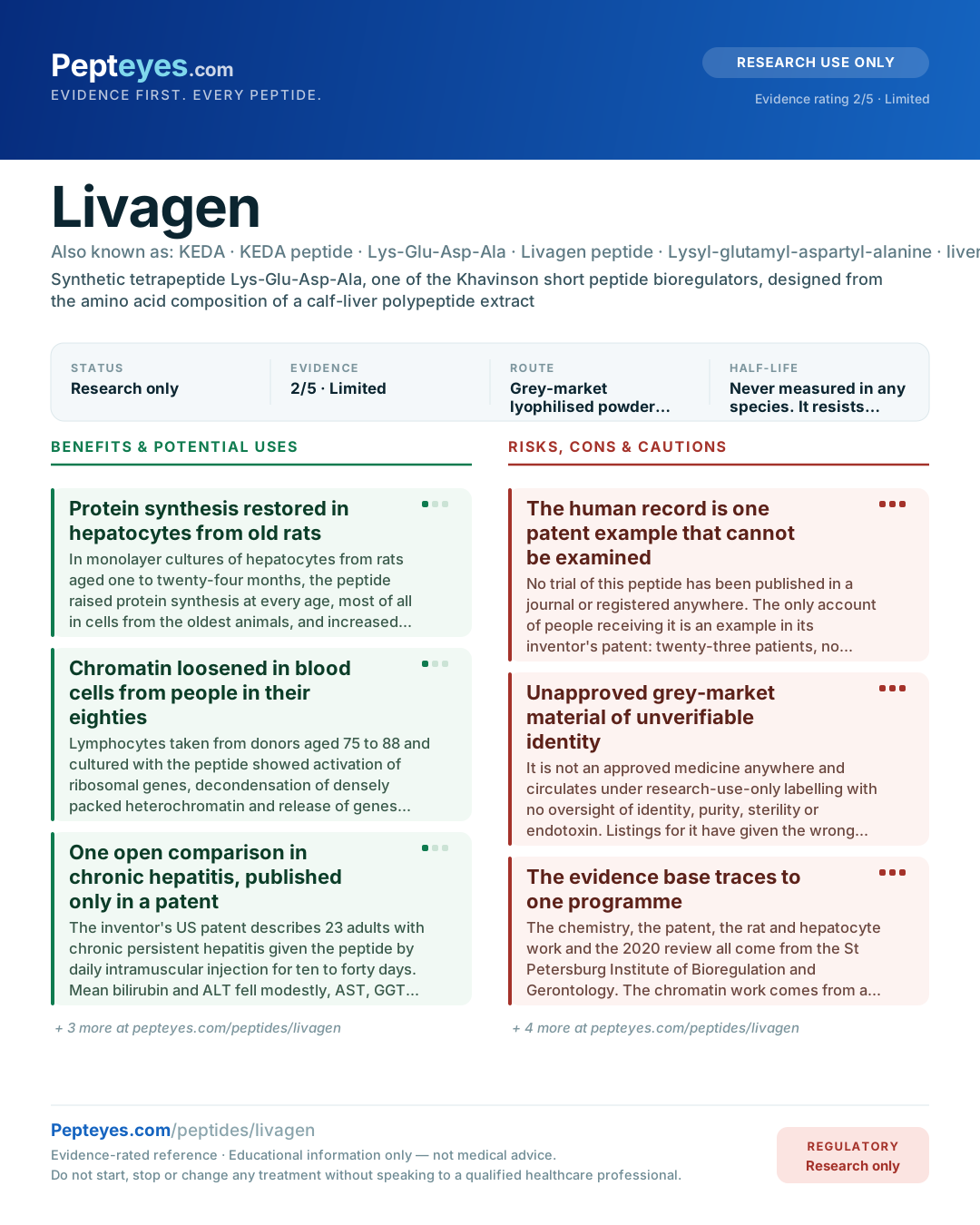
Protein synthesis restored in hepatocytes from old rats
In monolayer cultures of hepatocytes from rats aged one to twenty-four months, the peptide raised protein synthesis at every age, most of all in cells from the oldest animals, and increased the amplitude of the hour-scale rhythm of synthesis that flattens with age. Epitalon in the same assay changed nothing, which is the best evidence that the effect is sequence-specific.
Evidence: Preliminary -
Chromatin loosened in blood cells from people in their eighties
Lymphocytes taken from donors aged 75 to 88 and cultured with the peptide showed activation of ribosomal genes, decondensation of densely packed heterochromatin and release of genes silenced by age-related compaction, selectively on chromosomes 1 and 9. It is a reproducible readout from one laboratory, in cells in a dish; no one has shown it happens in a living person or that it would be desirable if it did.
Evidence: Preliminary -
One open comparison in chronic hepatitis, published only in a patent
The inventor's US patent describes 23 adults with chronic persistent hepatitis given the peptide by daily intramuscular injection for ten to forty days. Mean bilirubin and ALT fell modestly, AST, GGT and lipids did not change, and most patients reported less weakness. A control group of twelve on conventional care is mentioned, but its results are never reported, and no journal version of the study exists.
Evidence: Preliminary -
Survives gut peptidases and shifted digestive enzymes in old rats
Small-intestine peptide hydrolases barely cleave it in a tube, which is unusual for a short peptide. After two weeks by mouth, digestive enzyme activity fell in young rats and rose in old ones toward the young-control level. Resistance to digestion is not the same as absorption, and nothing shows the intact peptide reaching the liver by this route.
Evidence: Preliminary -
Liver protection and a smaller tumour in rats, by the inventor's account
The patent and the group's own review report that in rats with carbon tetrachloride hepatitis it normalised bilirubin, transaminases and liver glycogen, and that in rats carrying a transplanted hepatoma the tumour was smaller at a month with a tendency toward longer survival. None of this has been published outside the group, and a patent is an advocacy document.
Evidence: Preliminary -
Enkephalinase inhibition in human serum, in a tube
In human serum it inhibited the enzymes that degrade enkephalins, more potently than Epitalon and than standard peptidase inhibitors, without binding mu or delta opioid receptors in rat brain membranes. It is a mechanism in a tube, offered by sellers as evidence for mood and pain effects that have never been measured.
Evidence: Preliminary
Risks and cautions
7 entries · 4 serious or common
-
The human record is one patent example that cannot be examined
No trial of this peptide has been published in a journal or registered anywhere. The only account of people receiving it is an example in its inventor's patent: twenty-three patients, no reported control results, no randomisation or blinding, modest changes in two lab values. Everything else claimed for it in people is extrapolation from rat liver cells and cultured blood cells.
Evidence: Serious -
Unapproved grey-market material of unverifiable identity
It is not an approved medicine anywhere and circulates under research-use-only labelling with no oversight of identity, purity, sterility or endotoxin. Listings for it have given the wrong sequence, the wrong source organ and a molecular weight that matches no form of the molecule, which says something about how carefully it is handled.
Evidence: Serious -
The evidence base traces to one programme
The chemistry, the patent, the rat and hepatocyte work and the 2020 review all come from the St Petersburg Institute of Bioregulation and Gerontology. The chromatin work comes from a genetics department in Tbilisi that began as that institute's collaborator and works with peptides it supplied. No group outside that circle has published on the sequence, which is a weaker position than merely being untested.
Evidence: Serious -
Delaying real liver care
Fatty liver disease, viral hepatitis and alcohol-related liver disease all have assessment pathways and treatments with trial evidence behind them, and several are silent until late. Taking an untested peptide for 'liver support' instead of having abnormal liver tests, jaundice or heavy drinking assessed is the practical harm most likely to occur here.
Evidence: Serious -
Gene-activation effects are not benign by default
The reported actions are activation of ribosomal genes and unpacking of silenced chromatin in blood cells, plus faster growth of liver explants. A smaller tumour in one rat experiment reported by the inventor does not settle what sustained chromatin activation does over years. The oncologic question has not been asked in a person.
Evidence: Moderate evidence -
Injection hazards independent of the molecule
Reconstituting and injecting an unregulated lyophilised powder outside sterile conditions risks local infection, abscess and bloodstream infection whatever the peptide itself does or fails to do.
Evidence: Moderate evidence -
Guides contradict each other and the chemistry
A share of the guides circulating call it a thymus peptide, some give it the sequence of a different peptide, and their daily amounts span a range of hundreds-fold, none derived from a human study. A reader following one of them is following a copying error with a number attached.
Evidence: Moderate evidence
Counts are not a score. A single serious risk can outweigh several well-supported benefits, and a long benefit list built on preclinical work outweighs nothing at all.
Opinion — what people actually report
7 themes · 1 reported benefit · 1 reported problem
This is the weakest tier on this site. These are themes drawn from public discussion — forums, subreddits and patient threads — not from trials. There is no control group, no denominator, and no way to confirm that what someone injected matched its label. People post when a result is dramatic and when something goes wrong, and rarely when nothing happens, so treat everything below as a description of the conversation rather than of the compound. The bars count how often a thing is said, not how well it is supported.
-
Mostly guide copy, not first-hand accounts Practical note. Dominant theme: Comes up in most discussions of this compound.
The defining feature. Discussion is dominated by explainer pages and listings that paraphrase one another, and threads where someone describes actually taking it are rare. Its recent rise seems to come from wellness newsletters and practitioners adding it to a stack as liver support rather than from any forum consensus that it does something.
-
Called a thymus peptide as often as a liver one Practical note. Dominant theme: Comes up in most discussions of this compound.
A copying error that has spread through the guides: a share of them file it under the thymus, and some give it the two-residue sequence of a different Khavinson peptide. People arrive asking which organ it is even for, which is a fair question to have about a compound you are about to inject.
-
Arrives on a practitioner's suggestion for something else Practical note. Recurring: Raised regularly, though not by everyone.
The accounts that do exist usually describe adding it on a coach's or practitioner's advice for skin breakouts, gut trouble or a general sense of needing to detox, almost never for a diagnosed liver condition, and almost always alongside several other new things.
-
Dosing guides disagree by hundreds-fold Reported problem. Recurring: Raised regularly, though not by everyone.
The daily amounts recommended across the circulating guides span a range of several hundred times, with the course length borrowed from the Russian capsule tradition and the milligram figures apparently back-calculated from the vial size sold. None of them comes from a human study, and better-informed posters say so.
-
Capsules versus injection, again Practical note. Recurring: Raised regularly, though not by everyone.
The oral-form argument leans on a rat study showing the peptide resists gut enzymes in a tube, which gets repeated as proof of absorption. The injecting side assumes the opposite. Neither side has anything measured in a person to point at.
-
Stacked with Epitalon by default Practical note. Recurring: Raised regularly, though not by everyone.
Sold and discussed as half of a pair, because the two peptides appear together in the same Russian papers. The pairing is treated as a protocol rather than as an accident of how the research was run.
-
Vague reports of clearer skin, calmer mood, better labs Reported benefit. Occasional: Reported by a minority, or in specific contexts.
A minority describe calmer mood, clearer skin or a liver panel that looked better at the next draw, almost always while changing diet, alcohol intake or other supplements at the same time, and usually with the honesty to say they cannot tell what did it.
Where the reports and the evidence part ways
The discussion runs ahead of the record in a particular way. The sceptical guides say nobody has ever given Livagen to a person, which is not quite true: the inventor's expired patent describes an open comparison in twenty-three hepatitis patients, with the control group's results never reported. The enthusiastic guides treat it as an established hepatoprotector, which is further from the truth: there is no published trial, no registered trial and no absorption study, and most of the liver evidence attached to it belongs to a calf-liver extract that is a different substance. The thymus label is a copying error. The chromatin finding that gets quoted everywhere was made in cultured blood cells from people in their eighties, not in anyone's liver. And a liver panel that looks better after a course is uninterpretable without a comparison group, which even the inventor's own report did not supply.
Readers on Livagen
Questions and answers from readers, under generated names. Nothing here has been checked or reviewed by the site and none of it is medical advice. It is the least verified thing on this page — and it is here because people ask each other these things anyway, and most of the other places they can ask are run by sellers.
0 questions · 0 answers
No questions yet. Ask the first one above — it takes one box and an email address.
How names work, and the house rules
Names. Every verified address is given one generated name — two ordinary words — and keeps it. Nobody chooses a name and nobody can take another's. Posts marked desk were written by the site's own editorial desk, usually to open a thread; they carry a generated name like everyone else's and are held to the site's rules, which means they never state an amount.
What is not allowed. Selling, sourcing, vendor names, coupon codes and "message me" — posts that read that way are held and usually removed. Personal medical details you would not want public. Abuse. Instructions framed as what someone else should do.
What this is not. A reader's report of what happened to them is a report, not a finding, and an answer here is one person's view. Nothing in this section changes the evidence rating above it. If something you read here would change what you take, take it to a pharmacist or physician first.
Your data. Delete any post of yours at any time, or remove everything you have written together with your name. Details in the privacy notice.
Who should avoid it
- Use outside a registered clinical trial
- Anyone taking it for 'liver support' instead of having abnormal liver tests, jaundice or heavy drinking assessed
- Any cancer history, given the unstudied chromatin-activating and growth-promoting signalling
- Pregnancy and breastfeeding
- Children and adolescents
If used under medical supervision, monitor
- Not applicable outside a registered trial
- A trial would need liver histology or elastography and validated outcomes, not transaminase trends in an uncontrolled group
- Injection sites, for anyone injecting an unregulated powder
Interactions
Not exhaustive. Always have a pharmacist or physician review your full medication list — including supplements.
- No interaction study of any kind exists for this peptide
- Medicines cleared by the liver or known to injure it — never studied alongside it, and a transaminase that moves during a course cannot be attributed to either
- Epitalon and the other Khavinson short peptides it is stacked with — the pair appears together in the chromatin and enkephalinase papers, which is why they are sold together, not evidence that the combination does anything
- Anticoagulants — in the group's own tube experiments it slowed clotting and inhibited fibrinolysis, and nobody has looked at what that means in a person taking a blood thinner
Commonly confused with
These mix-ups cause real harm — two products sold under one name, or two molecules whose effects run in opposite directions.
Studied side by side for twenty years and sold as a pair, but assigned different organs: Epitalon is AEDG and pitched at the pineal gland and telomeres, this is KEDA and pitched at the liver. In the hepatocyte assay Epitalon did nothing; in the cardiomyopathy chromatin work Epitalon did more. Neither inherits the other's evidence, and both come from the same source.
Compare side by sideSame laboratory, same hypothesis, same shape of evidence, different assigned tissue: Cartalax is the three-residue AED sold for cartilage, this is the four-residue KEDA sold for the liver. They are listed together under 'bioregulators' and their claims get swapped; neither has a published human trial.
Compare side by sideRegulatory & legal status
Livagen has no marketing authorisation in the United States, the European Union or the United Kingdom, and no licence as a medicine anywhere we could find. It is not a controlled substance. Its inventor's institute patented it in the United States in 2006 (US 7,101,854) on a Russian filing of 2000; the patent lapsed in 2014 for non-payment, so nothing stops anyone synthesising it. In Russia the group's commercial liver product is the calf-liver complex sold as Ventvil, not this peptide. It is not on the WADA Prohibited List, but the clause for substances with no approval from any health authority reaches it.
Infographic
What this entry was checked against
The specific records this monograph was verified against on its last research pass. We link live literature searches below as well, because these are a snapshot and the literature is not.
- Khavinson VK, Lezhava TA, Monaselidze JG, Dzhokhadze TA, Dvalishvili NA, Bablishvili NK, Ryadnova IY. Effects of Livagen peptide on chromatin activation in lymphocytes from old people. Bull Exp Biol Med 2002;134:389-392 (PubMed 12533768) — the founding chromatin paper: ribosomal gene activation and heterochromatin decondensation in cultured lymphocytes from elderly donors
- Khavinson VKh, Lezhava TA, Malinin VV. Effects of short peptides on lymphocyte chromatin in senile subjects. Bull Exp Biol Med 2004 (PubMed 15085253) — five peptides compared in leukocytes of 75-88-year-olds; Epitalon and Livagen alone decondensed chromosome 9 pericentromeric chromatin
- Lezhava T, Jokhadze T. Activation of pericentromeric and telomeric heterochromatin in cultured lymphocytes from old individuals. Ann N Y Acad Sci 2007 (PubMed 17460203) — cobalt chloride with and without Livagen in lymphocytes from 80-91-year-olds; the best-known English-language paper on the peptide
- Lezhava T et al. Epigenetic modification under the influence of peptide bioregulators on the 'old' chromatin. Georgian Med News 2023 (PubMed 37042594) — the most recent chromatin paper from the Tbilisi group, naming the sequences of the four peptides compared
- Brodsky VYa, Khavinson VKh, Zolotarev YuA et al. Rhythm of protein synthesis in cultures of hepatocytes from rats of different ages. Norm and effect of the peptide livagen. Izv Akad Nauk Ser Biol 2001 (PubMed 15926314) — Russian-language, English abstract only: the source of the hepatocyte protein-synthesis claim and of the Epitalon null result in the same assay
- Timofeeva NM, Khavinson VKh, Malinin VV, Nikitina AA, Egorova VV. Effect of peptide Livagen on activity of digestive enzymes in gastrointestinal tract and non-digestive organs in rats of different ages. Adv Gerontol 2005;16:92-96 (PubMed 16075683) — Russian-language, English abstract only: resistance to intestinal peptidases and the two-week oral feeding result
- Kost NV, Sokolov OYu, Gabaeva MV, Zolotarev YuA, Malinin VV, Khavinson VKh. Effect of new peptide bioregulators livagen and epitalon on enkephalin-degrading enzymes in human serum. Izv Akad Nauk Ser Biol 2003 (PubMed 12942748) — Russian-language, English abstract only: enkephalinase inhibition in serum and no binding to mu or delta opioid receptors
- Kuznik BI, Khasanova NB, Ryzhak GA, Mezsheriakova IE, Khavinson VK. The influence of polypeptide liver complex and tetrapeptide KEDA on organism physiological function in norm and age-related pathology. Adv Gerontol 2020;33:159-164 (PubMed 32362099) — the group's own Russian-language review; identifies the calf-liver complex as Ventvil (earlier Hepalin), states that KEDA was designed from its amino acid composition, and summarises the toxic-hepatitis and digestive-enzyme work
- Khavinson VK. Tetrapeptide stimulating the functional activity of hepatocytes, pharmacological substance on its basis and the method of its application. US patent 7,101,854 B2, granted 2006, priority 2000, lapsed 2014 — the only document describing the peptide given to people: Example 7, 23 patients with chronic persistent hepatitis, plus the carbon tetrachloride hepatitis and hepatoma-27 rat experiments
- PubChem CID 87919683 — Livagen compound record: formula, mass, SMILES and the CAS number used here
Where to read further
We link to live literature searches rather than a frozen citation list, so you always see current results — including anything published after our last review.
- PubMed — all published literature on Livagen
- PubMed — randomized controlled trials only
- ClinicalTrials.gov — registered human trials
Related peptides in Longevity & Mitochondrial
Terms used on this page
- Amino Acid
- An amino acid is the monomer unit of a peptide, built from an alpha carbon carrying an amino group, a carboxyl group, a hydrogen and a variable side chain that defines its chemistry.
- Amino Acid Residue
- An amino acid residue is what remains of an amino acid once it has been joined into a chain and a molecule of water has been lost, and residue count is how peptide length is stated.
- Trial Registration and Prospective Protocol
- Trial registration is the public deposit of a study's design and prespecified outcomes before enrolment begins, creating a dated record against which the eventual publication can be checked.
- Peptide vs Polypeptide vs Protein
- Peptide, polypeptide and protein describe the same kind of molecule at different chain lengths, a distinction that is conventional in science but has a hard regulatory boundary at forty amino acids.
- Reproducibility and Replication
- Reproducibility is obtaining the same result from the same data and analysis, while replication is obtaining a consistent result from new data, and only the second shows the finding is real.
- Intramuscular Injection (IM)
- Intramuscular injection places drug into skeletal muscle, a more vascular and higher-capacity compartment than subcutaneous tissue that generally yields faster absorption of aqueous solutions.
This page is educational information, not medical advice. It cannot account for your medical history, medications, or risk factors. Do not start, stop or change any treatment based on it. Speak to a qualified healthcare professional who knows your case.