Supplied ready in solution
Hormonal & Reproductive
At a glance
Ten answers, each one line. Open any row for the detail behind it.
What it does Two very different stories in one molecule.
Two very different stories in one molecule. As an obstetric drug it is essential medicine with a boxed warning. As the "love hormone" delivered by nasal spray, the trial record has been consistently disappointing.
Half-life ~1–6 minutes intravenously — Documented
~1–6 minutes intravenously
Typical studied dose Set on the approved label, which states the starting dose, how it is… — On the label
Set on the approved label, which states the starting dose, how it is increased and the maximum. Read it there rather than anywhere else — including here.
How often it is used Set on the approved label. The interval follows the half-life above… — On the label
Set on the approved label. The interval follows the half-life above, which is why some of these are weekly and others daily.
How it is taken Intravenous (approved obstetric use); intranasal (research and off-label) — Documented
Intravenous (approved obstetric use); intranasal (research and off-label)
Main side effects Boxed warning against elective induction · Water intoxication and hyponatremia · Uterine hyperstimulation and rupture — Carries serious risk
Boxed warning against elective induction — The label explicitly warns against use for elective labor induction due to risks of uterine rupture and fetal distress.
Water intoxication and hyponatremia — Structural similarity to vasopressin gives antidiuretic activity; severe hyponatremia and seizures have occurred with high-dose infusion.
Uterine hyperstimulation and rupture — A serious obstetric complication requiring continuous fetal monitoring.
Storage before mixing Supplied already in solution and kept refrigerated, not frozen. Freezing…
Supplied already in solution and kept refrigerated, not frozen. Freezing a protein solution can aggregate it, which is not always visible.
Shelf life after mixing Nothing to mix — it is not supplied as a powder. The relevant date is…
Nothing to mix — it is not supplied as a powder. The relevant date is the one printed on the product.
Evidence level 5/5 · Very strong — Documented
Multiple phase 3 randomized trials plus regulatory approval in a major market.
Regulatory status FDA Approved — Documented
FDA-approved for labor induction and postpartum hemorrhage control. Intranasal use for social, psychiatric and relationship indications is off-label and not supported by consistent trial evidence. Prescription drug for approved obstetric indications. Compounded intranasal oxytocin is off-label.
Overview
Two very different stories in one molecule. As an obstetric drug it is essential medicine with a boxed warning. As the "love hormone" delivered by nasal spray, the trial record has been consistently disappointing.
FDA ApprovedFDA-approved for labor induction and postpartum hemorrhage control. Intranasal use for social, psychiatric and relationship indications is off-label and not supported by consistent trial evidence.
| Regulatory status | FDA-approved for labor induction and postpartum hemorrhage control. Intranasal use for social, psychiatric and relationship indications is off-label and not supported by consistent trial evidence. |
|---|---|
| Drug class | Endogenous nonapeptide hormone |
| Route | Intravenous (approved obstetric use); intranasal (research and off-label) |
| Half-life | ~1–6 minutes intravenously |
| Evidence rating |
5/5 Very strong
Evidence rating 5 out of 5: Very strong
Multiple phase 3 randomized trials plus regulatory approval in a major market. |
| Studied in | Extensive obstetric use and trials; numerous randomized trials of intranasal oxytocin in autism spectrum disorder, schizophrenia, PTSD and social anxiety, with predominantly negative or inconsistent results. |
Oxytocin sequence & structure
Oxytocin is a 9-residue disulfide-bridged peptide with a C-terminal amide; molecular weight 1,007.19 Da.
| Three-letter | H-Cys-Tyr-Ile-Gln-Asn-Cys-Pro-Leu-Gly-NH2 |
|---|---|
| Length | 9 amino acid residues |
| Modifications |
|
| Molecular formula | C43H66N12O12S2 |
| Molecular weight | 1,007.19 Da (average, free base) |
| SMILES | CC[C@H](C)[C@H]1C(=O)N[C@H](C(=O)N[C@H](C(=O)N[C@@H](CSSC[C@@H](C(=O)N[C@H](C(=O)N1)CC2=CC=C(C=C2)O)N)C(=O)N3CCC[C@H]3C(=O)N[C@@H](CC(C)C)C(=O)NCC(=O)N)CC(=O)N)CCC(=O)N |
| Identifiers | CAS 50-56-6 · PubChem CID 439302 · DrugBank DB00107 · UniProt P01178 |
| Which molecule | Record describes native human/mammalian oxytocin (identical to the synthetic drug substance in Pitocin and Syntocinon), which is what the pepteyes monograph covers; it is not the analogues carbetocin, demoxytocin or atosiban that share the tocin ring, nor vasopressin (differs at positions 3 and 8). |
| Sources | ChEBI CHEBI:7872 oxytocin (formula, average mass 1007.207, CAS 50-56-6, cyclic nonapeptide with disulfide)UniProt P01178 NEU1_HUMAN oxytocin-neurophysin 1 (peptide 20–28 = CYIQNCPLG, disulfide 20–25, Gly28 amidated)PubChem CID 439302 (PUG REST: C43H66N12O12S2, MW 1007.2, isomeric SMILES, synonyms incl. CAS 50-56-6; DrugBank substance DB00107 resolves to OXYTOCIN)ChEMBL CHEMBL395429 (HELM PEPTIDE1{C.Y.I.Q.N.C.P.L.G.[am]} with 1:R3–6:R3 disulfide; MW 1007.21)DailyMed – Pitocin (oxytocin injection) label (molecular weight 1007.19) |
Sequence, Cys1–Cys6 disulfide and C-terminal amide agree independently across ChEBI, UniProt P01178 (mature peptide = precursor residues 20–28), ChEMBL HELM and the FDA label; the formula recomputed from the residue composition (minus 8 H2O, minus H2 for the disulfide, amide terminus) also gives C43H66N12O12S2 / 1007.19. CAS 50-56-6 check digit validated. Pharmaceutical oxytocin is synthetic and dosed in USP units (about 2 µg per unit); vendors commonly sell the acetate salt, whose formula/MW differ from the free base given here.
Record confidence: high — two independent authoritative sources agree on the sequence and modifications. Every sequence on the site is listed with its sources on the peptide sequences index.
How it works
Binds oxytocin receptors on uterine smooth muscle to produce contractions, and on myoepithelial cells for milk ejection. Central oxytocin signalling modulates social cognition, trust and pair bonding — but how much intranasally administered oxytocin actually reaches relevant brain regions remains genuinely contested.
Evidence base
Rated 5 of 5 — Very strong. Multiple phase 3 randomized trials plus regulatory approval in a major market.
- Strong obstetric evidence; a notable and instructive replication failure in the social neuroscience literature.
Benefits and risks, weighed against the evidence
Every entry below carries the strength of the evidence behind it — three bars for strong human data, two for moderate, one for preliminary or preclinical work. The two columns are not equal by design: where a compound has more documented risk than demonstrated benefit, the lists say so.
Reported benefits
4 entries · 3 on strong human evidence
-
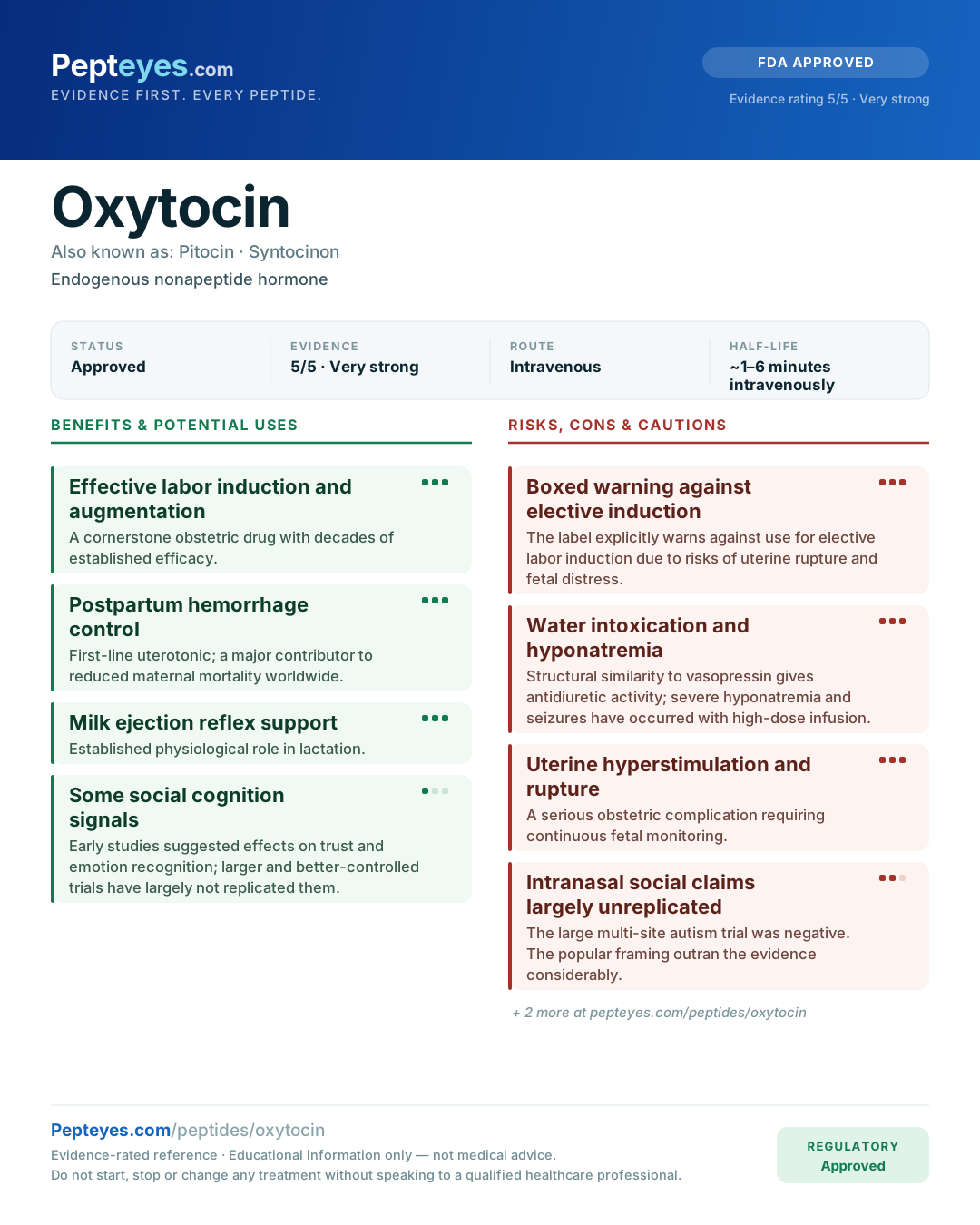
Effective labor induction and augmentation
A cornerstone obstetric drug with decades of established efficacy.
Evidence: Strong evidence -
Postpartum hemorrhage control
First-line uterotonic; a major contributor to reduced maternal mortality worldwide.
Evidence: Strong evidence -
Milk ejection reflex support
Established physiological role in lactation.
Evidence: Strong evidence -
Some social cognition signals
Early studies suggested effects on trust and emotion recognition; larger and better-controlled trials have largely not replicated them.
Evidence: Preliminary
Risks and cautions
6 entries · 3 serious or common
-
Boxed warning against elective induction
The label explicitly warns against use for elective labor induction due to risks of uterine rupture and fetal distress.
Evidence: Serious -
Water intoxication and hyponatremia
Structural similarity to vasopressin gives antidiuretic activity; severe hyponatremia and seizures have occurred with high-dose infusion.
Evidence: Serious -
Uterine hyperstimulation and rupture
A serious obstetric complication requiring continuous fetal monitoring.
Evidence: Serious -
Intranasal social claims largely unreplicated
The large multi-site autism trial was negative. The popular framing outran the evidence considerably.
Evidence: Moderate evidence -
Uncertain CNS delivery
How much intranasal oxytocin reaches the brain, and in what concentration, remains a live scientific dispute.
Evidence: Moderate evidence -
Cardiovascular effects with rapid IV administration
Hypotension and tachycardia can occur with bolus dosing.
Evidence: Moderate evidence
Counts are not a score. A single serious risk can outweigh several well-supported benefits, and a long benefit list built on preclinical work outweighs nothing at all.
Opinion — what people actually report
5 themes · 1 reported benefit · 2 reported problems
This is the weakest tier on this site. These are themes drawn from public discussion — forums, subreddits and patient threads — not from trials. There is no control group, no denominator, and no way to confirm that what someone injected matched its label. People post when a result is dramatic and when something goes wrong, and rarely when nothing happens, so treat everything below as a description of the conversation rather than of the compound. The bars count how often a thing is said, not how well it is supported.
-
Warmth and social ease, reported inconsistently Reported benefit. Recurring: Raised regularly, though not by everyone.
The effect people are seeking, and reports are split roughly between clear positives and nothing at all.
-
Highly variable and context-dependent Reported problem. Dominant theme: Comes up in most discussions of this compound.
A recurring observation that it seems to amplify whatever the existing mood and setting are rather than reliably producing warmth.
-
Occasional anxiety or emotional flatness Reported problem. Recurring: Raised regularly, though not by everyone.
A minority report the opposite of what they expected, sometimes describing heightened defensiveness.
-
Whether nasal spray reaches the brain is openly debated Practical note. Dominant theme: Comes up in most discussions of this compound.
One of the better-informed technical arguments in this space, with people citing the pharmacokinetic uncertainty directly.
-
Very different from its obstetric use Practical note. Recurring: Raised regularly, though not by everyone.
Regularly clarified — intravenous oxytocin in labour is an entirely separate context from intranasal use for social effects.
Where the reports and the evidence part ways
The community's own scepticism is well founded and matches where the science has ended up. Early intranasal oxytocin findings on trust and social cognition generated enormous interest; large replication attempts and meta-analyses have since substantially weakened them, and how much intranasally administered oxytocin reaches the central nervous system remains genuinely unresolved. The observation that effects appear context-dependent rather than uniformly prosocial is also consistent with the more careful literature. Oxytocin is well established as an obstetric drug and poorly established as a social one, and forums generally get this right.
Cheat sheet
The full sheet, all 77 compounds →The community reference numbers for this compound — reconstitution, working dose, cycle and bloodwork. Research and education only, not medical advice, and not part of the evidence-rated monograph above. Doses assume a 1mL / 100-unit insulin syringe — the calculator does the units for you.
Protocol overview
Dosing & reconstitution 10 mg vial
| WEEK | DAILY DOSE | UNITS PER INJECTION |
|---|---|---|
| Weeks 1 to 2 | 100 mcg | 1 units (0.01 mL) |
| Weeks 3 to 4 | 200 mcg | 2 units (0.02 mL) |
| Weeks 5 to 6 | 300 mcg | 3 units (0.03 mL) |
| Weeks 7 to 8 | 400 mcg | 4 units (0.04 mL) |
| Weeks 9 to 12 | 500 mcg | 5 units (0.05 mL) |
Frequency: Inject once daily subcutaneously. For 10 unit (0.10 mL) or smaller administrations, consider 30- or
On the master sheet
- Vial
- 10mg
- BAC
- 3mL
- Dose
- IN 8 IU per nostril / inj 1–10 IU
- Route
- Both
- Cycle
- PRN
- Time Off
- PRN
- Vial
- 10mg
- BAC
- 3mL
- Dose
- IN 8 IU per nostril / inj 1–10 IU
- Route
- Both
- Cycle
- PRN
- Bloodwork
- None standard
Readers on Oxytocin
Questions and answers from readers, under generated names. Nothing here has been checked or reviewed by the site and none of it is medical advice. It is the least verified thing on this page — and it is here because people ask each other these things anyway, and most of the other places they can ask are run by sellers.
0 questions · 0 answers
No questions yet. Ask the first one above — it takes one box and an email address.
How names work, and the house rules
Names. Every verified address is given one generated name — two ordinary words — and keeps it. Nobody chooses a name and nobody can take another's. Posts marked desk were written by the site's own editorial desk, usually to open a thread; they carry a generated name like everyone else's and are held to the site's rules, which means they never state an amount.
What is not allowed. Selling, sourcing, vendor names, coupon codes and "message me" — posts that read that way are held and usually removed. Personal medical details you would not want public. Abuse. Instructions framed as what someone else should do.
What this is not. A reader's report of what happened to them is a report, not a finding, and an answer here is one person's view. Nothing in this section changes the evidence rating above it. If something you read here would change what you take, take it to a pharmacist or physician first.
Your data. Delete any post of yours at any time, or remove everything you have written together with your name. Details in the privacy notice.
Who should avoid it
- Elective labor induction
- Cephalopelvic disproportion and other obstetric contraindications
- Unsupervised intranasal use for psychiatric conditions
If used under medical supervision, monitor
- Continuous fetal and uterine monitoring during obstetric use
- Serum sodium with prolonged infusion
- Fluid balance
Interactions
Not exhaustive. Always have a pharmacist or physician review your full medication list — including supplements.
- Vasoconstrictors and ergot alkaloids — severe hypertension has been reported
- Prostaglandins — potentiate uterine activity; careful sequencing required
- Volatile anesthetics — can reduce uterine response and cause hypotension
- Large-volume hypotonic fluids — compound the risk of water intoxication
Commonly confused with
These mix-ups cause real harm — two products sold under one name, or two molecules whose effects run in opposite directions.
Oxytocin and vasopressin differ by two amino acids, which is why high-dose oxytocin causes water retention and hyponatremia. Desmopressin is the engineered V2-selective vasopressin analog.
Compare side by sideRegulatory & legal status
Prescription drug for approved obstetric indications. Compounded intranasal oxytocin is off-label.
Infographic
Where to read further
We link to live literature searches rather than a frozen citation list, so you always see current results — including anything published after our last review.
- PubMed — all published literature on Oxytocin
- PubMed — randomized controlled trials only
- ClinicalTrials.gov — registered human trials
- DailyMed — official FDA prescribing information
Related peptides in Hormonal & Reproductive
Terms used on this page
- Boxed Warning
- A boxed warning is the strongest warning the FDA can place on a drug label, set in a box at the top of the prescribing information for risks of death or serious injury.
- Intranasal Delivery
- Intranasal delivery uses the nasal mucosa as an absorption surface, offering needle-free administration and rapid onset but low and variable bioavailability for peptides.
- Reproducibility and Replication
- Reproducibility is obtaining the same result from the same data and analysis, while replication is obtaining a consistent result from new data, and only the second shows the finding is real.
- Vasopressin
- Vasopressin is a nine-amino-acid posterior pituitary hormone that conserves water through renal V2 receptors and constricts vasculature through V1a receptors, released in response to plasma osmolality.
- Oxytocin
- Oxytocin is a nine-amino-acid posterior pituitary hormone that drives uterine contraction and milk ejection, and has been extensively but unsuccessfully tested intranasally for social effects.
- Intravenous Administration (IV)
- Intravenous administration delivers drug directly into the bloodstream, giving complete bioavailability by definition and making it the reference route against which all others are measured.
This page is educational information, not medical advice. It cannot account for your medical history, medications, or risk factors. Do not start, stop or change any treatment based on it. Speak to a qualified healthcare professional who knows your case.