Supplied as a lyophilised powder to reconstitute
Growth Hormone Axis
At a glance
Ten answers, each one line. Open any row for the detail behind it.
What it does The shortest biologically active fragment of GHRH.
The shortest biologically active fragment of GHRH. It has a legitimate history as a diagnostic agent and a large off-label life in anti-aging clinics, where the evidence is far thinner than the marketing suggests.
Half-life ~6–7 minutes intravenously (Geref SmPC); ~4 minutes measured… — Documented
~6–7 minutes intravenously (Geref SmPC); ~4 minutes measured during infusion in healthy men. Subcutaneous not separately characterised.
Typical studied dose Set by the label of the regulator that approved it, which is not an FDA… — On the label
Set by the label of the regulator that approved it, which is not an FDA label and may not be in English. The approving country decides the dose, and it is not always the same as the dose studied elsewhere.
How often it is used Set on the approved label. The interval follows the half-life above… — On the label
Set on the approved label. The interval follows the half-life above, which is why some of these are weekly and others daily.
How it is taken Subcutaneous, typically at night — Documented
Subcutaneous, typically at night
Main side effects Contraindicated in active malignancy · Weak evidence for adult anti-aging use · Glucose intolerance with sustained GH elevation — Carries serious risk
Contraindicated in active malignancy — Standard caution with any GH-axis stimulation.
Weak evidence for adult anti-aging use — The body-composition, energy and longevity claims made in wellness clinics have not been tested in adequate randomized trials.
Glucose intolerance with sustained GH elevation — A class effect of raising the GH/IGF-1 axis.
Storage before mixing As a sealed lyophilised powder, refrigerated is typical and a freezer…
As a sealed lyophilised powder, refrigerated is typical and a freezer suits long storage; both should be dark and dry. A dry powder tolerates a few days out of the cold far better than anything in solution — which is why it ships that way.
Shelf life after mixing Once mixed it is refrigerated and treated as short-lived. Bacteriostatic…
Once mixed it is refrigerated and treated as short-lived. Bacteriostatic water contains a preservative and buys the longer window; sterile water contains none and buys a much shorter one. Peptides in solution also degrade on their own, so the container is only half the question.
Evidence level 3/5 · Moderate — Depends on the study
Small or early-phase human trials, or good controlled topical human data.
Regulatory status Limited Approval — Documented
Formerly FDA-approved (Geref) as a pediatric GH diagnostic; withdrawn from the US market in 2008. Now supplied through compounding pharmacies. No longer an approved US drug product; lawful access is via patient-specific compounding under a prescription. FDA has scrutinised this category closely.
Overview
The shortest biologically active fragment of GHRH. It has a legitimate history as a diagnostic agent and a large off-label life in anti-aging clinics, where the evidence is far thinner than the marketing suggests.
Limited or non-US approvalNo longer an approved US drug product; lawful access is via patient-specific compounding under a prescription. FDA has scrutinised this category closely.
| Regulatory status | Formerly FDA-approved (Geref) as a pediatric GH diagnostic; withdrawn from the US market in 2008. Now supplied through compounding pharmacies. |
|---|---|
| Drug class | Truncated GHRH analog — first 29 amino acids of human GHRH |
| Route | Subcutaneous, typically at night |
| Half-life | ~6–7 minutes intravenously (Geref SmPC); ~4 minutes measured during infusion in healthy men. Subcutaneous not separately characterised. |
| Evidence rating |
3/5 Moderate
Evidence rating 3 out of 5: Moderate
Small or early-phase human trials, or good controlled topical human data. |
| Studied in | Historic pediatric GH-deficiency diagnosis and treatment studies; small older trials in adults; extensive uncontrolled clinical use. |
Sermorelin sequence & structure
Sermorelin is a 29-residue linear peptide with a C-terminal amide; molecular weight 3,357.93 Da.
| Three-letter | H-Tyr-Ala-Asp-Ala-Ile-Phe-Thr-Asn-Ser-Tyr-Arg-Lys-Val-Leu-Gly-Gln-Leu-Ser-Ala-Arg-Lys-Leu-Leu-Gln-Asp-Ile-Met-Ser-Arg-NH2 |
|---|---|
| Length | 29 amino acid residues |
| Modifications |
|
| Molecular formula | C149H246N44O42S |
| Molecular weight | 3,357.93 Da (average, free base) |
| Identifiers | CAS 86168-78-7 · PubChem CID 16132413 · DrugBank DB00010 · UniProt P01286 |
| Which molecule | Sermorelin is the unmodified GHRH(1-29)-NH2 fragment (GRF 1-29). It should not be confused with the stabilised analogues built on the same backbone: CJC-1295 without DAC / modified GRF(1-29) (D-Ala2, Gln8, Ala15, Leu27 substitutions) or tesamorelin (trans-3-hexenoyl-GHRH(1-44)-NH2). |
| Sources | PubChem CID 16132413 (properties)UniProt P01286 (SLIB_HUMAN, somatoliberin precursor)ChEMBL CHEMBL1201490 (sermorelin acetate)KEGG DRUG D08509 (Sermorelin INN; full sequence, formula, CAS)DrugCentral 2433 (sermorelin; GHRH(1-29)-amide, formula, MW, CAS, UNII) |
Sequence equals residues 32-60 of the human GHRH precursor (UniProt P01286; mature somatoliberin is 32-75) with a C-terminal amide; KEGG D08509 lists the identical 29-mer and DrugCentral describes it as GHRH(1-29)-amide, and the formula C149H246N44O42S (N44/O42) is only consistent with the amidated form. Formula/MW (3357.93; KEGG gives 3357.89) are for the free base; the former FDA product Geref (NDA 020443, EMD Serono, approved 1997, discontinued) and most vendor material are the acetate salt, so vendor MW figures may include acetate/TFA counter-ions. UNII 89243S03TE; CAS 86168-78-7 check digit verified.
Record confidence: high — two independent authoritative sources agree on the sequence and modifications. Every sequence on the site is listed with its sources on the peptide sequences index.
How it works
Binds pituitary GHRH receptors, producing a brief GH pulse that mirrors natural nocturnal secretion. Because the pituitary remains in charge, somatostatin feedback caps the response — which is both its safety feature and its efficacy ceiling.
Evidence base
Rated 3 of 5 — Moderate. Small or early-phase human trials, or good controlled topical human data.
- Strong evidence for the original pediatric diagnostic indication.
- Weak evidence for the adult wellness indications it is now mostly used for.
Benefits and risks, weighed against the evidence
Every entry below carries the strength of the evidence behind it — three bars for strong human data, two for moderate, one for preliminary or preclinical work. The two columns are not equal by design: where a compound has more documented risk than demonstrated benefit, the lists say so.
Reported benefits
5 entries · 1 on strong human evidence
-
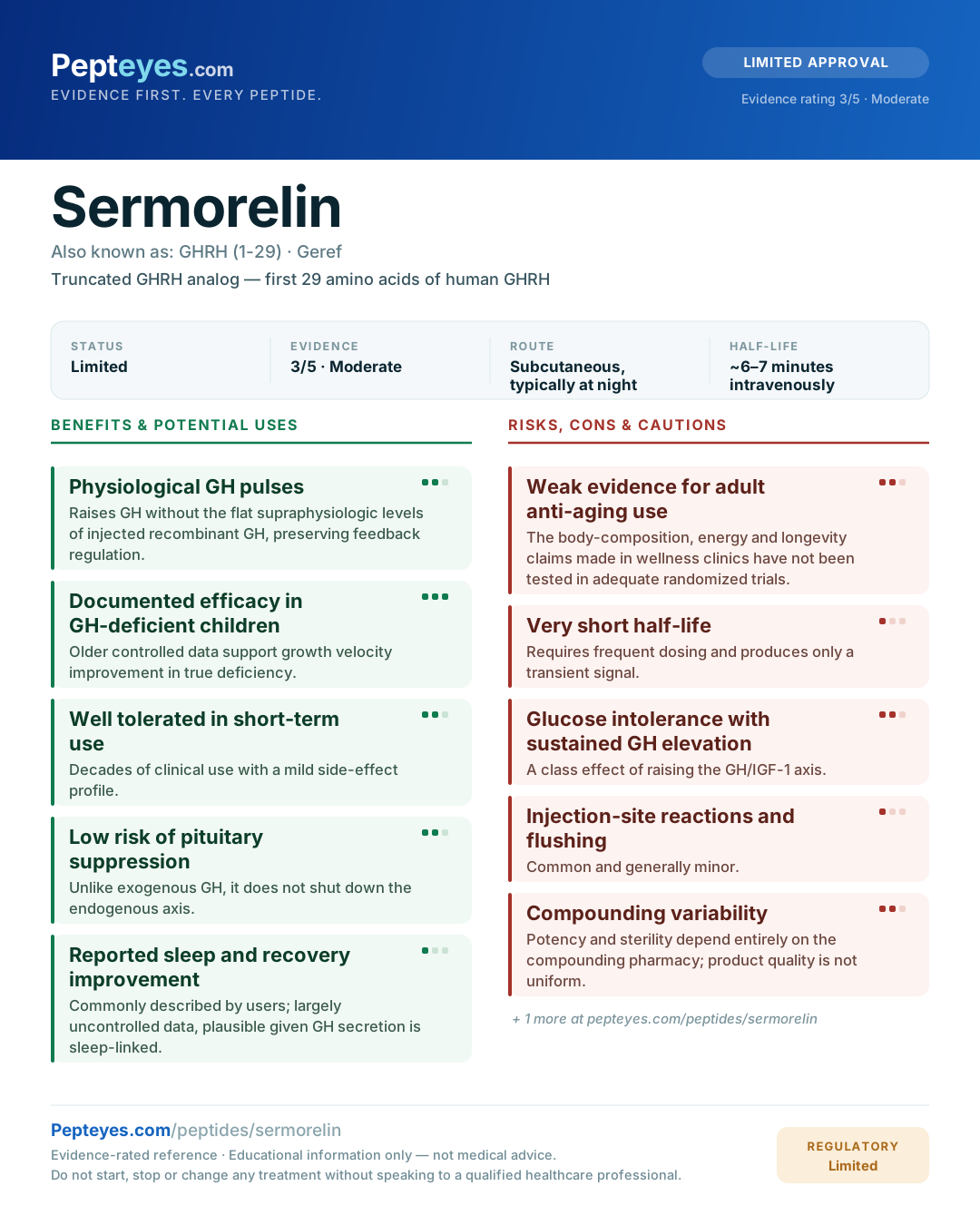
Physiological GH pulses
Raises GH without the flat supraphysiologic levels of injected recombinant GH, preserving feedback regulation.
Evidence: Moderate evidence -
Documented efficacy in GH-deficient children
Older controlled data support growth velocity improvement in true deficiency.
Evidence: Strong evidence -
Well tolerated in short-term use
Decades of clinical use with a mild side-effect profile.
Evidence: Moderate evidence -
Low risk of pituitary suppression
Unlike exogenous GH, it does not shut down the endogenous axis.
Evidence: Moderate evidence -
Reported sleep and recovery improvement
Commonly described by users; largely uncontrolled data, plausible given GH secretion is sleep-linked.
Evidence: Preliminary
Risks and cautions
6 entries · 1 serious or common
-
Weak evidence for adult anti-aging use
The body-composition, energy and longevity claims made in wellness clinics have not been tested in adequate randomized trials.
Evidence: Moderate evidence -
Very short half-life
Requires frequent dosing and produces only a transient signal.
Evidence: Minor -
Glucose intolerance with sustained GH elevation
A class effect of raising the GH/IGF-1 axis.
Evidence: Moderate evidence -
Injection-site reactions and flushing
Common and generally minor.
Evidence: Minor -
Compounding variability
Potency and sterility depend entirely on the compounding pharmacy; product quality is not uniform.
Evidence: Moderate evidence -
Contraindicated in active malignancy
Standard caution with any GH-axis stimulation.
Evidence: Serious
Counts are not a score. A single serious risk can outweigh several well-supported benefits, and a long benefit list built on preclinical work outweighs nothing at all.
Opinion — what people actually report
6 themes · 2 reported benefits · 2 reported problems
This is the weakest tier on this site. These are themes drawn from public discussion — forums, subreddits and patient threads — not from trials. There is no control group, no denominator, and no way to confirm that what someone injected matched its label. People post when a result is dramatic and when something goes wrong, and rarely when nothing happens, so treat everything below as a description of the conversation rather than of the compound. The bars count how often a thing is said, not how well it is supported.
-
The one people can get legally Practical note. Dominant theme: Comes up in most discussions of this compound.
Its main draw. Compounded prescriptions through anti-ageing and telehealth clinics make it the entry point for people unwilling to buy research chemicals.
-
Sleep quality Reported benefit. Dominant theme: Comes up in most discussions of this compound.
The most frequently reported benefit, echoing the rest of this class.
-
Effects described as subtle and slow Reported problem. Dominant theme: Comes up in most discussions of this compound.
Reports commonly say months rather than weeks, and many people conclude the effect was too small to justify the cost.
-
Injection site redness and itching Reported problem. Recurring: Raised regularly, though not by everyone.
The most common physical complaint, generally minor.
-
Priced as a clinic programme Practical note. Recurring: Raised regularly, though not by everyone.
A recurring frustration is that the cost reflects the consultation model rather than the compound, and the value question dominates long threads.
-
Modest changes in body composition over months Reported benefit. Occasional: Reported by a minority, or in specific contexts.
Reported by a minority, and usually alongside changes in training and diet that make attribution difficult.
Where the reports and the evidence part ways
Sermorelin has real pharmacological standing — it was FDA-approved for diagnosing growth hormone deficiency in children and works as a GHRH analogue. That approval is the source of most of its credibility, and it is not for what it is now sold to do. It was withdrawn from the US market commercially rather than for safety, and there are no trials supporting anti-ageing, body composition or vitality claims in adults with normal growth hormone. The community's own verdict — subtle, slow, expensive — is probably closer to the truth than the clinic marketing that surrounds it.
Cheat sheet
The full sheet, all 77 compounds →The community reference numbers for this compound — reconstitution, working dose, cycle and bloodwork. Research and education only, not medical advice, and not part of the evidence-rated monograph above. Doses assume a 1mL / 100-unit insulin syringe — the calculator does the units for you.
Protocol overview
Dosing & reconstitution 5 mg vial
| WEEK | DAILY DOSE | UNITS PER INJECTION |
|---|---|---|
| Weeks 1 to 2 | 200 mcg | 2 units (0.02 mL) |
| Weeks 3 to 4 | 300 mcg | 3 units (0.03 mL) |
| Weeks 5 to 6 | 400 mcg | 4 units (0.04 mL) |
| Weeks 7 to 8 | 500 mcg | 5 units (0.05 mL) |
Frequency: Inject once daily subcutaneously at bedtime. Bedtime administration is strongly recommended because endogenous GH secretion peaks during sleep. For 10 unit (0.10 mL) or smaller administrations, consider
On the master sheet
- Vial
- 5mg
- BAC
- 2mL
- Dose
- 200–300mcg nightly
- Route
- SubQ
- Cycle
- 8–16 wks
- Time Off
- 3–4 wks
- Bloodwork
- IGF-1, glucose
Readers on Sermorelin
Questions and answers from readers, under generated names. Nothing here has been checked or reviewed by the site and none of it is medical advice. It is the least verified thing on this page — and it is here because people ask each other these things anyway, and most of the other places they can ask are run by sellers.
0 questions · 0 answers
No questions yet. Ask the first one above — it takes one box and an email address.
How names work, and the house rules
Names. Every verified address is given one generated name — two ordinary words — and keeps it. Nobody chooses a name and nobody can take another's. Posts marked desk were written by the site's own editorial desk, usually to open a thread; they carry a generated name like everyone else's and are held to the site's rules, which means they never state an amount.
What is not allowed. Selling, sourcing, vendor names, coupon codes and "message me" — posts that read that way are held and usually removed. Personal medical details you would not want public. Abuse. Instructions framed as what someone else should do.
What this is not. A reader's report of what happened to them is a report, not a finding, and an answer here is one person's view. Nothing in this section changes the evidence rating above it. If something you read here would change what you take, take it to a pharmacist or physician first.
Your data. Delete any post of yours at any time, or remove everything you have written together with your name. Details in the privacy notice.
Who should avoid it
- Active malignancy
- Pregnancy
- Untreated diabetes (relative)
- Known hypersensitivity
If used under medical supervision, monitor
- IGF-1 as a surrogate for GH exposure
- Fasting glucose and HbA1c
- Symptoms of fluid retention or joint pain
Interactions
Not exhaustive. Always have a pharmacist or physician review your full medication list — including supplements.
- Corticosteroids — suppress the GH response
- Thyroid hormone — affects GH axis testing and response
- Insulin and antidiabetic drugs — GH elevation opposes insulin action
Regulatory & legal status
No longer an approved US drug product; lawful access is via patient-specific compounding under a prescription. FDA has scrutinised this category closely.
Infographic
Where to read further
We link to live literature searches rather than a frozen citation list, so you always see current results — including anything published after our last review.
- PubMed — all published literature on Sermorelin
- PubMed — randomized controlled trials only
- ClinicalTrials.gov — registered human trials
Related peptides in Growth Hormone Axis
Terms used on this page
- Growth Hormone-Releasing Hormone (GHRH)
- GHRH is the 44-residue hypothalamic peptide that binds a Gs-coupled receptor on pituitary somatotrophs to drive growth hormone synthesis and pulsatile release.
- Somatostatin
- Somatostatin is a cyclic inhibitory peptide, circulating as 14- and 28-residue forms, that suppresses growth hormone release and broadly inhibits endocrine and exocrine secretion.
- Pulsatile GH Secretion
- Pulsatile GH secretion is the discontinuous release of growth hormone in discrete bursts separated by near-undetectable troughs, generated by alternating GHRH and somatostatin drive.
- Negative Feedback Loop
- A negative feedback loop is a control arrangement in which the output of a system inhibits its own production, holding the regulated variable near a set point and limiting how far any stimulus can push it.
- Exogenous GH vs Endogenous Stimulation
- Exogenous growth hormone delivers a fixed pharmacological dose, whereas secretagogues ask the pituitary to release its own, which caps achievable exposure without removing the class effects.
- Insulin-Like Growth Factor 1 (IGF-1)
- IGF-1 is a 70-amino-acid, proinsulin-like peptide produced mainly by the liver under growth hormone control, and it mediates most of the anabolic effects attributed to growth hormone.
This page is educational information, not medical advice. It cannot account for your medical history, medications, or risk factors. Do not start, stop or change any treatment based on it. Speak to a qualified healthcare professional who knows your case.